Exporting chilli successfully requires completing six sequential stages: post-harvest sorting, size grading, compliant packaging, phytosanitary certification, customs documentation, and temperature-controlled shipment by air or sea. Each stage feeds directly into the next, and a failure at any point disrupts the entire supply chain and shortens shelf life before the product reaches its destination.
Meeting export requirements for chilli means satisfying three simultaneous compliance layers: international food safety certifications such as GlobalGAP, FDA, ISO, GRASP, and Sedex; phytosanitary and customs standards set by each importing country; and technical packaging and cold chain specifications including storage at 2 to 4°C and shelf life preservation up to 35 days. All three layers are evaluated together by import authorities upon arrival, not separately.
The global chilli export landscape is shaped by distinct regional demand patterns across Europe, the Middle East, North America, and Asia, alongside a competitive field of exporting countries led by China, India, Spain, Mexico, and a rising Vietnam. Identifying the right target market and understanding what top exporters do differently is the strategic advantage that converts a compliant shipment into a profitable, long-term trade relationship.
How Do You Export Chilli Step by Step?
Exporting fresh chilli follows six core stages in sequence: post-harvest handling and sorting, size grading and packaging, laboratory testing and certification, phytosanitary inspection, customs documentation and clearance, and temperature-controlled transportation by air or sea to the destination market.
Each stage operates as follows, beginning with documentation requirements and moving through packaging and cold chain standards.
What Documents Are Required to Export Chilli?
Five core documents are required to export chilli internationally, and each one serves a distinct compliance or logistics function: a Phytosanitary Certificate, a Certificate of Origin, a Health and Safety or Food Safety Declaration, a Commercial Invoice and Packing List, and a Bill of Lading or Airway Bill depending on the shipping method. Each document is reviewed simultaneously by customs and inspection authorities upon arrival at the destination port.
The following breakdown explains how each document functions within the export chain:
Phytosanitary Certificate: Issued by the national plant protection authority of the exporting country, this certificate confirms the chilli consignment is free from regulated pests and diseases. It is mandatory for virtually every import market worldwide.
Certificate of Origin (C/O): Confirms the country where the chilli was grown and processed. This document determines eligibility for preferential tariff rates under Free Trade Agreements, making it directly relevant to the final landed cost for the importer.
Health and Safety Certificate or Food Safety Declaration: Required by the EU, Japan, and several other markets to confirm that pesticide residue levels comply with the importing country’s Maximum Residue Level (MRL) thresholds.
Commercial Invoice and Packing List: Standard trade documents detailing the buyer, seller, product specification, quantity, unit price, total value, and packaging breakdown by box.
Bill of Lading (sea freight) or Airway Bill (air freight): The transport contract and proof of shipment issued by the carrier, required by customs at the destination port before cargo can be released.
Specific markets impose additional requirements beyond this core set. The United States requires FDA facility registration for any food processing establishment supplying the American market. The European Union enforces entry through Border Inspection Posts where documentary, identity, and physical checks are conducted on arrival. Japan and South Korea apply some of the strictest MRL thresholds globally, often requiring pre-shipment laboratory results from an accredited third-party testing facility as supporting documentation before customs clearance is granted.
How Should Fresh Chilli Be Packed and Stored for Export?
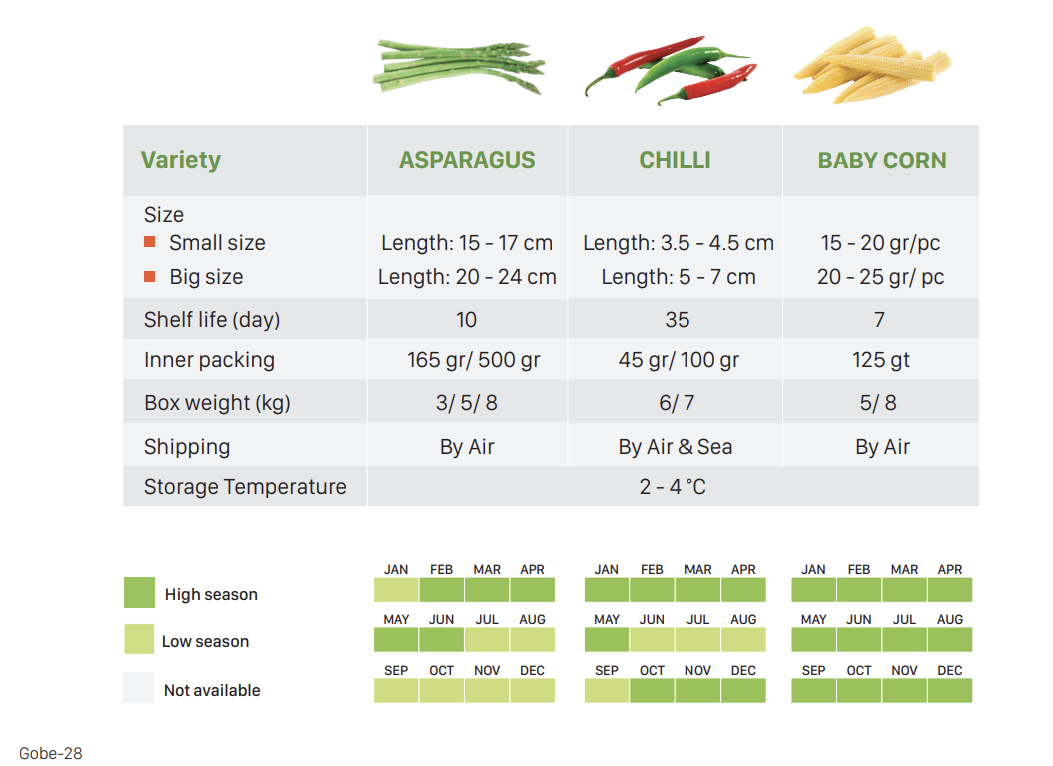
Fresh chilli for export must be graded by size, packed into compliant inner units, boxed to target weight, and maintained at 2 to 4°C throughout the entire cold chain to achieve a shelf life of up to 35 days. This is a technical requirement rather than a general guideline: any temperature break above 4°C accelerates microbial growth, softens the skin, and causes colour degradation that disqualifies the product at inspection.
The packaging and storage specifications for fresh chilli export are structured as follows:
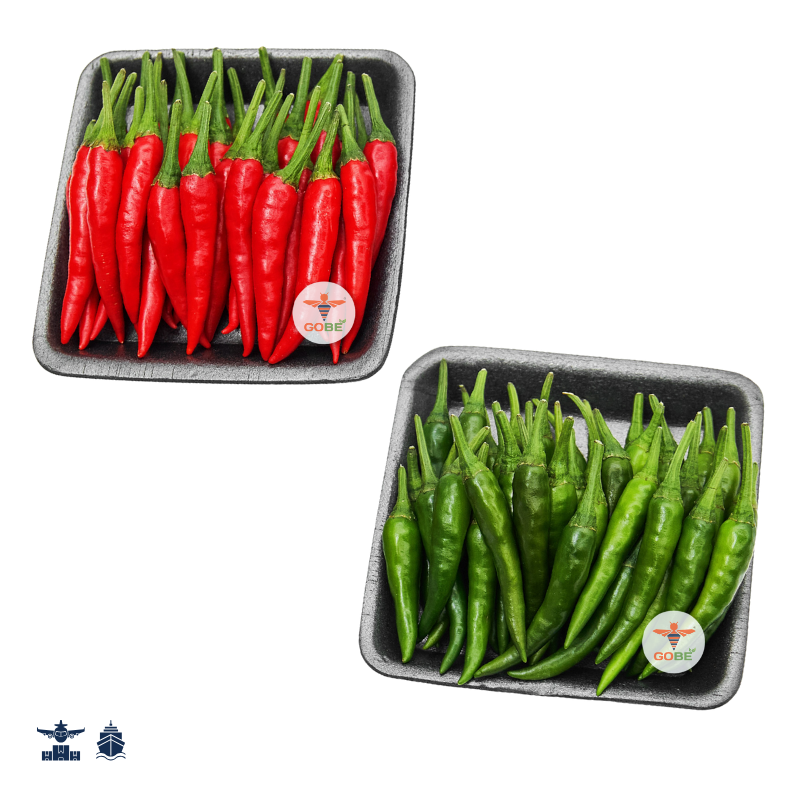
Size classification: Chilli is graded into two categories before packing. Small size measures 3.5 to 4.5 cm in length and is preferred by Asian markets and specialty retail buyers. Big size measures 5 to 7 cm in length and is the standard specification for European and Middle Eastern importers.
Inner packing: Retail-ready inner packs are prepared in either 45-gram or 100-gram portions, matching the packaging specification of the destination retailer or distributor.
Box weight: Master cartons are filled to either 6 kg or 7 kg per box, providing flexibility to match the volume requirements of different buyers.
Storage temperature: The cold chain must be maintained at 2 to 4°C from the moment chilli leaves the packing house through transit to the destination port.
Shelf life: When the cold chain remains unbroken at 2 to 4°C, fresh chilli retains commercial quality for up to 35 days, which is sufficient for sea freight to European, Middle Eastern, and North American markets.
The table below summarises the key technical specifications for fresh chilli export. Importers and buyers should use this reference to align purchase orders with compliant supply.
Specification
Detail
Small size
Length: 3.5 to 4.5 cm
Big size
Length: 5 to 7 cm
Inner packing
45 g or 100 g per unit
Box weight
6 kg or 7 kg per master carton
Storage temperature
2 to 4°C
Shelf life
Up to 35 days
Shipping method
Air and sea freight
Packing houses located within growing regions provide a decisive competitive advantage. Processing chilli within 12 hours of harvest before placing it into cold storage locks in peak freshness and maximises the usable portion of the 35-day shelf life available for transit and in-market distribution.
What Are the Requirements for Exporting Chilli?
Exporting chilli internationally requires meeting three parallel groups of standards simultaneously: legal and certification requirements (GlobalGAP, FDA, ISO, GRASP, Sedex), technical phytosanitary and plant health standards, and market-specific import regulations that vary between the EU, the United States, the Middle East, and Asia. Exporters who satisfy only one or two of these layers risk rejection, quarantine detention, or permanent delisting by importers upon arrival.
One factor that cuts across all three groups is MRL compliance. Maximum Residue Levels for pesticides used during cultivation must fall within the thresholds set by the importing country. The EU applies some of the strictest MRL limits in the world, often lower than Codex Alimentarius standards, meaning agrochemical management in the field must be planned with the target export market in mind from the first growing cycle.
Which Certifications Are Needed to Export Chilli Internationally?
Five internationally recognised certifications are needed to access major global chilli markets: GlobalGAP, FDA registration, ISO, GRASP, and Sedex. Each certification addresses a different dimension of quality, safety, and supply chain ethics, and together they form a compliance portfolio that satisfies the requirements of supermarkets, distributors, and government regulators across four continents.
The following explains how each certification functions in practice:
GlobalGAP: The Global Good Agricultural Practices standard regulates how fresh produce is cultivated, harvested, and handled on the farm. GlobalGAP certification is a non-negotiable requirement for supplying European supermarkets and a growing number of Middle Eastern retail chains. It governs pesticide use, fertiliser application, water management, and worker hygiene.
FDA (U.S. Food and Drug Administration): Any food processing facility supplying the American market must be registered with the FDA. Fresh chilli shipments to the United States are also subject to the Foreign Supplier Verification Program (FSVP), which requires importers to verify that overseas suppliers comply with U.S. food safety standards equivalent to those applied domestically.
ISO (International Organization for Standardization): ISO certification, particularly ISO 9001 for quality management systems, demonstrates that the exporter operates consistent, documented, and auditable production and processing procedures. It provides importers with confidence that each shipment meets the same standard as the previous one.
GRASP (GlobalGAP Risk Assessment on Social Practice): This add-on module to GlobalGAP evaluates social and labour conditions throughout the supply chain, including worker health and safety, freedom of association, and fair remuneration. GRASP is increasingly required by European retailers as part of their ethical sourcing commitments.
Sedex / SMETA Audit: Membership of the Supplier Ethics Data Exchange platform and completion of a SMETA audit allows exporters to share audited social compliance data with multiple buyers through a single platform, reducing duplicated audit costs and increasing supply chain transparency.
Japan and South Korea may additionally require HACCP (Hazard Analysis Critical Control Points) system documentation as part of import approval for fresh produce. Exporters targeting these markets should prepare HACCP plans alongside the core certification portfolio described above.
What Are the Phytosanitary and Customs Requirements for Chilli Export?
Phytosanitary requirements for chilli export involve national-level pest and disease inspection conducted by the exporting country’s plant protection authority, followed by verification at the destination border by the importing country’s agricultural inspection agency. These inspections assess three things: the absence of quarantine pests, MRL compliance, and the accuracy of accompanying documentation.
The process and key regulatory bodies involved by market are as follows:
Exporting country inspection: The national phytosanitary authority inspects and certifies each consignment before departure. In Vietnam, this is conducted by the Plant Protection Department under the Ministry of Agriculture and Rural Development. The Phytosanitary Certificate issued at this stage is the primary document reviewed at the import border.
U.S. market: The USDA APHIS (Animal and Plant Health Inspection Service) regulates the import of fresh chilli into the United States. Specific pest risk assessments may require pre-clearance programmes or treatment protocols depending on the pest risk profile of the origin country.
EU market: Fresh chilli entering the European Union must pass through Border Inspection Posts where EFSA-aligned MRL thresholds are applied. The EU operates an advance notification system (TRACES) that importers must use before shipments arrive at the port of entry.
Tariffs and FTA benefits: Tariff rates on fresh chilli vary by market and by the exporting country’s FTA status. Vietnam benefits from reduced tariff rates into the EU under the EU-Vietnam Free Trade Agreement (EVFTA), lowering landed costs for European buyers sourcing from Vietnam compared to non-FTA origins.
Rules of Origin: To qualify for preferential tariff treatment under FTAs, chilli must meet the specific Rules of Origin criteria defined in the agreement, typically requiring that the product is wholly obtained or sufficiently processed in the FTA partner country.
Which Are the Best Markets for Chilli Export?
The best export markets for fresh chilli are concentrated in four regions: Europe (the Netherlands, Germany, and the United Kingdom), the Middle East (UAE, Kuwait, and Saudi Arabia), North America (Canada and the United States), and premium Asian markets (Japan and South Korea). Each region represents a distinct combination of import volume, price level, certification requirements, and consumer preference that exporters must evaluate against their own supply capacity and compliance capability.
A factor that determines long-term market viability beyond initial entry is supply continuity. Importers and supermarket chains operating on weekly replenishment cycles require suppliers capable of delivering consistent quality and quantity 52 weeks per year. Exporters who cannot guarantee year-round supply are systematically excluded from the most valuable retail contracts, regardless of price competitiveness.
Which Regions Import the Most Fresh Chilli?
The largest importing regions for fresh chilli are Europe, the Middle East, North America, and premium Asian markets, each defined by distinct volume, quality, and compliance requirements that shape how exporters must position their supply offer.
The table below shows the key characteristics of each import region for fresh chilli. Exporters can use this overview to prioritise target markets based on their certification status and supply capability.
Region
Key Markets
Main Requirements
Demand Pattern
Europe
Netherlands, Germany, United Kingdom
GlobalGAP, MRL compliance, Sedex or GRASP
Year-round, retail contract focus
Middle East
UAE, Kuwait, Saudi Arabia
Halal handling, consistent supply
Year-round, high volume
North America
Canada, United States
FDA registration, MRL alignment
Year-round, multicultural retail
Asia
Japan, South Korea
Strictest MRL globally, HACCP documentation
Premium pricing, strict freshness
Emerging
Maldives, Singapore, ASEAN
Basic food safety compliance
Growing, accessible entry
Each region’s key characteristics are described below:
Europe (Netherlands, Germany, United Kingdom): The Netherlands functions as the primary entry and redistribution hub for fresh chilli into continental Europe. European importers require GlobalGAP certification and strict MRL compliance with EU pesticide thresholds. Retail contracts often include private label packaging requirements and Sedex or GRASP audits as conditions of listing.
Middle East (UAE, Kuwait, Saudi Arabia): Gulf Cooperation Council countries represent one of the highest-demand markets for fresh chilli globally, driven by culinary traditions that use chilli extensively. The UAE serves as a regional redistribution centre for the broader GCC and parts of Africa. Demand is high year-round and price sensitivity is moderate, making the region attractive for exporters who can supply consistently.
North America (Canada, United States): Both markets require FDA compliance and MRL alignment with U.S. tolerances. Canada has emerged as an accessible entry point for chilli exporters from Southeast Asia due to relatively streamlined import procedures and strong demand from a diverse multicultural consumer base.
Asia (Japan, South Korea): Japan applies the strictest phytosanitary and MRL standards of any major import market globally. Entry requires meticulous documentation, third-party laboratory test results, and in some cases pre-import registration with Japanese authorities. The price premium achievable in Japan compensates for the compliance investment required.
Emerging markets (Maldives, Southeast Asia): The Maldives imports virtually all of its fresh produce due to limited domestic agricultural capacity, making it a stable and accessible micro-market. Emerging Southeast Asian markets including Singapore are also growing import destinations as middle-class demand for premium fresh produce increases.
What Do Importers Look for When Buying Fresh Chilli?
Importers evaluate fresh chilli across five criteria: visual consistency (size, colour, skin condition), international certification compliance, supply reliability and scheduling flexibility, shelf life performance upon arrival, and competitive pricing relative to production standards. All five criteria are assessed before a supplier is approved, not after a trial order is placed.
Each criterion operates as follows in the buying decision:
Visual consistency: Importers require uniform size grading and consistent colour saturation across the entire consignment. Mixed sizes or colour variation within a box create downstream quality control problems for packers and retailers. Size specifications must be agreed and locked in before the first trial order is shipped.
Certification compliance: A buyer’s quality team requests the full certification portfolio before confirming a supplier. A missing certification disqualifies the exporter at the sourcing stage regardless of price or product quality.
Supply reliability and private label flexibility: Supermarket buyers operating on replenishment programmes require suppliers who commit to fixed weekly volumes and adapt packaging to private label specifications. Exporters who can only offer spot supply are limited to secondary distribution channels.
Shelf life upon arrival: Importers calculate backward from their own retail distribution timelines. For fresh chilli with a 35-day shelf life at 2 to 4°C, sea freight to Europe takes approximately 25 to 30 days, leaving 5 to 10 days for in-market distribution. This is commercially acceptable only when the cold chain is unbroken throughout transit.
Competitive pricing: Importers consistently source from origins that combine high production standards with competitive landed costs. Exporters who hold FTA-preferential tariff rates, such as Vietnam under the EVFTA for EU supply, offer a structural cost advantage over competitors from non-FTA countries.
Who Are the Top Chilli Exporters in the World?
The global chilli export landscape is led by five countries: China, India, Spain, Mexico, and Vietnam, each occupying a distinct position in the value chain based on production volume, product type (fresh versus dried), target market, and competitive pricing. Southeast Asian producers, particularly Vietnam, have gained significant ground in the premium fresh chilli segment as European and Middle Eastern buyers diversify their supplier base away from sole reliance on traditional origins.
Global fresh chilli supply chains are shifting toward origins that combine GlobalGAP-certified growing practices with competitive farm-gate costs and efficient port connectivity. This shift, which previously favoured Spanish and Dutch produce, now increasingly benefits Asian producers who have built compliant infrastructure.
Which Countries Are the Largest Exporters of Chilli?
Five countries account for the majority of global chilli exports: China leads in total volume, India dominates the dried chilli segment, Spain and the Netherlands control EU redistribution, Mexico supplies North America, and Vietnam is emerging as a high-quality fresh chilli origin for Europe, the Middle East, and Japan.
The table below provides a comparative overview of the world’s top chilli exporting countries. Importers can use this to benchmark origin selection against their target market and compliance requirements.
Country
Primary Segment
Key Markets
Competitive Advantage
China
Fresh and processed
Asia, Middle East, Africa
Highest volume, lowest price
India
Dried chilli
UAE, United Kingdom, Southeast Asia
Dominant dried segment, key varieties
Spain
Fresh, EU-grown
Continental Europe
Intra-EU access, no import documentation
Mexico
Fresh
United States, Canada
Proximity, USMCA tariff-free access
Vietnam
Fresh, tropical
Europe, Middle East, Japan
GlobalGAP-certified, EVFTA preferential tariffs
The competitive position of each country is described below:
China: The world’s largest chilli producer by volume exports both fresh and processed chilli to markets across Asia, the Middle East, and Africa. Its scale advantage results in highly competitive pricing, though quality consistency and MRL compliance have been areas of concern for premium buyers in Europe and Japan.
India: India is the global leader in dried chilli exports by volume and value, with key varieties including Guntur, Byadagi, and Kashmiri chilli. Fresh chilli exports from India are growing but remain secondary to the dried segment. India’s primary fresh chilli export markets are the UAE, the United Kingdom, and parts of Southeast Asia.
Spain and the Netherlands: Spain is a major producer of sweet peppers and fresh chilli within the EU, supplying intra-European markets with produce that meets all EU phytosanitary and MRL requirements without additional import documentation. The Netherlands functions as Europe’s primary fresh produce trading hub, importing, repackaging, and redistributing chilli from multiple origins to markets across the continent.
Mexico: Mexico is the dominant fresh chilli supplier to the United States and Canada, benefiting from geographical proximity and tariff-free access under the USMCA. Varieties including jalapeño, serrano, and habanero are produced at scale for North American retail and foodservice channels.
Vietnam: Vietnam is recognised as a competitive source of fresh chilli for European, Middle Eastern, and Japanese markets. Vietnamese producers offer GlobalGAP-certified production, competitive farm-gate pricing, and a growing cold chain logistics infrastructure that supports reliable sea freight exports. The EVFTA provides preferential tariff access to European buyers, further improving Vietnam’s cost competitiveness relative to non-FTA origins.
What Makes a Chilli Exporter Competitive in Global Markets?
A competitive chilli exporter controls the full supply chain from farm to port, operates packing facilities within the growing region, holds a comprehensive international certification portfolio, maintains 52-week supply capability, and employs a team with deep knowledge of each target market’s phytosanitary and commercial requirements. Together, these factors determine whether an exporter can hold a retail listing long term or is limited to spot sales.
Each factor contributes to competitiveness in the following ways:
Farm-to-port supply chain control: Exporters who own or directly manage their growing areas maintain oversight of agrochemical inputs from the first day of cultivation, which is the only reliable method to guarantee MRL compliance across every harvest. Exporters who rely entirely on spot purchases from open markets cannot provide the same assurance to premium buyers.
Packing house proximity to growing areas: Locating the packing facility within or adjacent to the growing region reduces the time between harvest and cold storage entry. Processing within 12 hours of harvest before entering 2 to 4°C cold storage maximises the usable portion of the 35-day shelf life available for international transit.
Comprehensive certification portfolio: GlobalGAP, FDA, ISO, GRASP, and Sedex together cover the compliance requirements of virtually every premium import market globally. An exporter holding all five certifications can respond to buyer requests across Europe, North America, the Middle East, and Asia without requiring additional audit cycles before onboarding.
52-week supply capability: Supermarket and distributor contracts are structured around year-round supply commitments. An exporter who can only supply during peak season is commercially limited to spot or secondary channel sales. Year-round supply is achieved through a combination of owned growing areas and contracted partner farms scheduled to stagger harvest timing across the calendar.
Market-specific compliance expertise: Different import markets apply different inspection protocols, MRL thresholds, labelling requirements, and documentation formats. Exporters with in-house teams who understand the regulatory specifics of each target market avoid costly errors, border delays, and reputational damage with buyers.
Is Vietnam a Reliable Source for Fresh Chilli Export?
Yes, Vietnam is a reliable source for fresh chilli export, supported by three structural advantages: a seasonality calendar that enables high-season supply from January through August and October through December, an established cold chain logistics infrastructure supporting both air and sea freight, and a growing base of internationally certified producers meeting GlobalGAP, FDA, ISO, GRASP, and Sedex standards. For importers and distributors seeking a stable, traceable, and premium-quality source of fresh chilli, Vietnam is a first-tier consideration alongside traditional origins such as Spain and India.
When Is the Best Time to Source Fresh Chilli from Vietnam?
The best time to source fresh chilli from Vietnam is during the high season, which runs from January through August and again from October through December, covering 11 months of high-volume availability per year. September is the only low-season month, making year-round supply contracts highly feasible for importers who plan ahead.
The table below shows Vietnam’s fresh chilli seasonality calendar. Importers can use this schedule to align procurement planning with peak supply availability and identify the single low-season month that requires forward purchasing or supplementary sourcing.
Month
Season
January
High season
February
High season
March
High season
April
High season
May
High season
June
High season
July
High season
August
High season
September
Low season
October
High season
November
High season
December
High season
Key practical implications for importers planning procurement from Vietnam include:
High season (January to August, October to December): Peak production volumes allow exporters to commit to consistent weekly shipment schedules with full flexibility on size classification. Small size (3.5 to 4.5 cm) suits Asian retail and specialty market buyers; Big size (5 to 7 cm) is the standard specification for European and Middle Eastern importers.
Low season (September): Reduced supply in September means importers should plan forward purchases in August to buffer inventory or arrange supplementary sourcing from secondary origins during this single month.
Shelf life logistics: With a 35-day shelf life at 2 to 4°C, fresh chilli from Vietnam is fully compatible with sea freight to Europe (approximately 25 to 30 days transit), the Middle East (10 to 20 days), and Japan (5 to 10 days), leaving adequate remaining shelf life for in-market distribution in each case.
Should You Ship Fresh Chilli by Air or by Sea?
Sea freight is the recommended default shipping method for fresh chilli when cold chain continuity is guaranteed, because a 35-day shelf life at 2 to 4°C makes sea transit to most global markets commercially viable. Air freight should be reserved for premium markets with tight delivery windows, small-volume trial shipments, or routes where sea transit time exceeds 20 days. The choice between air and sea is a trade-off between speed, cost, and the specific commercial requirements of the destination market.
The comparison between air and sea freight for fresh chilli export breaks down as follows:
Air freight: Transit time of 1 to 3 days from Vietnam to most destinations. Cost per kilogram is significantly higher than sea freight. Best suited for premium markets such as Japan and South Korea where buyers pay a price premium that absorbs the freight cost differential. Also appropriate for first trial shipments where the buyer needs to evaluate product quality at arrival before committing to larger sea freight volumes.
Sea freight: Transit time ranging from 5 to 10 days to Japan, 10 to 20 days to the Middle East, and 25 to 30 days to Europe. Cost per kilogram is substantially lower than air freight, making it the commercially viable option for volume orders to all major markets. With a 35-day shelf life at 2 to 4°C, sea freight to Europe leaves 5 to 10 days of remaining shelf life upon arrival, which is sufficient for standard distribution cycles if the cold chain remains unbroken.
Cold chain requirement: Maintaining 2 to 4°C from farm to port to destination cold store is non-negotiable regardless of shipping method. A single temperature break during transit can reduce remaining shelf life by days, creating rejection risk at the buyer’s quality inspection.
Scenario recommendation: For the Japanese market with its premium pricing and strict freshness expectations, air freight is often justified commercially. For Europe, North America, and the Middle East at volume, sea freight with a fully managed cold chain is the standard commercial model used by leading chilli exporters worldwide.
Gobeimex (Golden Bee Import Export Company Limited) operates exactly this model from Vietnam, combining a packing house in Tien Giang located within the heart of the growing region to ensure harvest-to-pack processing within 12 hours, with a dedicated refrigerated container fleet that maintains an unbroken cold chain from the farm to the port of export. Holding certifications including GlobalGAP, GRASP, ISO, FDA, and Sedex, and operating with 52-week supply capability across buyers in Canada, the UAE, the United Kingdom, Germany, the Netherlands, Japan, Kuwait, and beyond, Gobeimex represents Vietnam’s fresh chilli export capability at its most complete.
For importers, distributors, and supermarket buyers seeking a verified, certified, and commercially reliable source of fresh chilli from Vietnam, contact Gobeimex at Info@gobeimex.com or visit gobeimex.com.