Shopping cart

Subtotal $0.00

View cartCheckout

Durian export

Vietnam IQF Ready-to-Eat Durian Pulp is a premium frozen fruit product sourced from certified growing regions across the Central Highlands and Mekong Delta, individually quick-frozen at minus 35 degrees Celsius to preserve flavor, aroma, and texture without additives. Gobeimex, operating under Golden Bee Import Export Company Limited, supplies this product with full farm-to-port traceability to importers across Canada, the UAE, the UK, Germany, the Netherlands, Japan, Kuwait, and beyond.

Global importers evaluating Vietnam IQF durian pulp need to assess product specifications including Brix content, moisture percentage, grade classification, packaging format, cold chain continuity, and destination-market certification compliance before placing their first order. These technical parameters determine whether the product meets retail, foodservice, or industrial ingredient requirements in the target market.

The procurement process follows six structured stages: supplier qualification, certification verification, MOQ and pricing negotiation, purchase order confirmation, pre-shipment inspection, and cold chain shipment coordination. Each stage is governed by the regulatory requirements of the importing country, and the sections below provide a complete, actionable sourcing guide for international buyers.

What Is IQF Ready-to-Eat Durian Pulp and Why Is Vietnam a Leading Export Source?

IQF Ready-to-Eat Durian Pulp is produced by applying Individual Quick Freezing technology to fresh durian flesh, preserving cell structure, flavor compounds, aroma, and nutritional integrity without additives or further processing after thawing. This section covers the IQF processing method, Vietnam’s structural growing advantages, and the supply continuity factors that make Vietnam a tier-one origin for global frozen durian trade. Understanding both the product and the origin is the foundation for a confident sourcing decision.

How Does the IQF Processing Method Preserve Durian Pulp Quality for Export?

Individual Quick Freezing preserves durian pulp quality by rapidly lowering the core temperature of each fruit flesh piece to minus 35 degrees Celsius within minutes of seed separation, preventing large ice crystal formation that damages cell walls and causes texture degradation upon thawing. This distinction is critical for ready-to-eat classification: a correctly IQF-processed durian aril, thawed at 2 to 4 degrees Celsius for 4 to 6 hours, delivers texture, aroma, and flavor that closely replicates freshly opened durian with no cooking or blending required by the end consumer.

The IQF process for durian pulp follows a controlled sequence at the packing house:

  • Fresh durian fruit is harvested at optimal ripeness, at Brix 28 to 33 degrees for Monthong/Ri6 varieties
  • Fruit is transported to the packing house within 12 hours of harvest
  • Husk removal, seed separation, and aril grading are performed under temperature-controlled conditions
  • Individual arils enter a continuous IQF tunnel freezer and reach a core temperature of minus 18 degrees Celsius or below within 20 to 30 minutes
  • Frozen arils are packaged under vacuum or modified atmosphere conditions before entering cold storage at minus 18 degrees Celsius for shipment

According to the Vietnam Fruit and Vegetable Association (Vinafruit), the IQF method extends commercial shelf life of durian pulp to 18 to 24 months under continuous cold chain conditions, compared to 6 to 9 months for conventionally frozen block durian of equivalent Brix content.

Why Is Vietnam a Strategic Source Country for IQF Durian Pulp in Global Trade?

Vietnam holds approximately 65,000 to 70,000 hectares of durian cultivation area in export-grade growing zones, with annual fresh durian output exceeding 1.5 million metric tons, providing the raw material volume necessary to support year-round IQF export supply. Growing regions in Dak Lak, Lam Dong, Tien Giang, Ben Tre, and Dak Nong are within 200 to 400 kilometers of major port facilities at Ho Chi Minh City, enabling rapid farm-to-port cold chain continuity critical for premium IQF product integrity.

Vietnam’s key growing regions offer distinct climate and soil advantages:

  • Central Highlands (Dak Lak, Lam Dong, Dak Nong): Higher elevation, diurnal temperature variation, and well-drained basalt soils produce durian with concentrated sugar content, firmer flesh, and superior aroma, particularly suited to Monthong variety cultivation
  • Mekong Delta (Tien Giang, Ben Tre, Vinh Long): Alluvial lowland conditions support Ri6 variety cultivation with high volume output, rich creamy texture, and consistent Brix content across harvest seasons
  • Year-round harvest calendar: Staggered harvest seasons across multiple growing zones enable Vietnamese exporters to supply IQF durian pulp continuously for 52 weeks per year, a structural advantage over single-harvest origin countries

Gobeimex maintains packing house operations in Tien Giang Province and Ho Chi Minh City, enabling sourcing across both primary growing zones and delivering IQF-processed durian pulp with maximum freshness and supply continuity to international buyers.

Which Premium Vietnam Durian Varieties Are Available as IQF Pulp for Export?

Two primary durian varieties are available as IQF pulp from Vietnam for export: Monthong/Ri6 and premium Musang King, each differentiated by Brix content, flesh color, aroma intensity, and target market preference. Selecting the correct variety for a specific import market depends on understanding their key quality specifications and grade classifications, which are detailed below.

What Are the Key Quality Specifications of Monthong and Ri6 IQF Durian Pulp?

Monthong and Ri6 IQF durian pulp are the dominant export varieties from Vietnam, characterized by a Brix content of 28 to 34 degrees, pale to deep golden-yellow flesh color, mild-to-moderate aroma suited to a broad consumer base, and dense flesh texture with low fiber content. These physical characteristics make Monthong/Ri6 highly compatible with the IQF freezing process: dense flesh retains cell structure under rapid freezing, and consistent aril size enables uniform portioning after thawing.

The table below summarizes standard quality specifications for Vietnam Monthong/Ri6 IQF Durian Pulp, the most widely exported frozen durian variety from Vietnam. Importers should use this table as a reference framework for evaluating product conformity during sampling and pre-shipment inspection.

Quality Parameter Standard Specification
Brix (natural sugar content) 28 to 34 degrees
Moisture content 60 to 65%
Flesh color Pale yellow to deep golden yellow
Aril size (individual piece) 40 to 120 grams per aril
Seed-to-flesh ratio Less than 15% seed weight per aril
Foreign matter Zero tolerance
Core temperature at export Minus 18 degrees Celsius or below
Shelf life (continuous cold chain) 18 to 24 months

Ri6, the Vietnamese classification equivalent of Monthong in local farming nomenclature, accounts for the majority of Vietnam’s IQF durian pulp export volume because of its consistent agronomic performance across the Mekong Delta growing zone. Lam Dong-origin Monthong typically commands a 10 to 15% price premium over Mekong Delta Ri6 due to higher Brix readings, at 30 to 34 degrees versus 28 to 30 degrees, and firmer flesh texture resulting from cooler highland growing temperatures.

What Premium Durian Grades Does Vietnam Export as IQF Pulp and How Are They Classified?

Vietnam IQF durian pulp for export is classified into two primary grade categories, Grade A and Grade B, differentiated by aril size consistency, flesh color uniformity, Brix range, and absence of surface defects. Grade A targets premium retail and supermarket channels in Europe, North America, and Japan, while Grade B is positioned for foodservice, ingredient processing, and value-segment retail markets in the Middle East and Southeast Asia.

The table below defines the key differentiating parameters between Grade A and Grade B Vietnam IQF durian pulp export classifications, covering the specific product attributes that determine which grade is appropriate for a given market segment. Importers should use this table to specify the correct grade when submitting a product inquiry or purchase order.

Classification Parameter Grade A Grade B
Brix content 30 to 34 degrees 27 to 30 degrees
Aril size uniformity 60 to 120 grams, less than 10% size variation 40 to 100 grams, up to 20% size variation
Flesh color uniformity Consistent golden yellow, no browning Minor color variation acceptable
Surface defects Zero visible defects Up to 5% minor surface marks acceptable
Target market EU, UK, US, Canada, Japan UAE, Kuwait, Southeast Asia, foodservice
Price premium vs. Grade B 15 to 25% premium Base reference price

Gobeimex applies a dual-stage quality control system: the first inspection occurs at the farm level under GlobalGAP protocol, and the second is conducted by in-house quality control specialists at the packing house using calibrated refractometers, colorimetric assessment, and weight verification per aril before IQF processing begins. This two-point control system ensures that grade classification commitments made at order confirmation are consistently met at pre-shipment inspection.

Does Vietnam IQF Durian Pulp Comply with International Food Safety and Import Standards?

Yes, Vietnam IQF durian pulp from certified exporters complies with international food safety and import standards through a certification portfolio covering GlobalGAP, ISO, FDA, HACCP, GRASP, and Sedex, addressing the full regulatory spectrum across North American, European, Middle Eastern, and Asian import markets. This section breaks down which certifications are required by destination market and how each certification maps to a specific layer of the supply chain risk profile.

What Certifications Should Global Importers Require from a Vietnam IQF Durian Exporter?

Global importers should require, at minimum, four internationally recognized certifications from any Vietnam IQF durian pulp exporter: GlobalGAP covering farming practices and traceability, ISO 22000 or equivalent covering food safety management systems, HACCP covering hazard analysis in processing, and FDA registration required for the United States market. Each certification addresses a distinct layer of the supply chain and carries specific practical implications for the importing entity.

The table below summarizes each certification required for Vietnam IQF durian pulp export, identifying the supply chain layer it governs and its relevance to importers by destination market. Purchasing managers and import compliance teams should use this table to define minimum certification requirements before entering sourcing negotiations.

Certification Supply Chain Layer Covered Key Implication for Importer
GlobalGAP Farm level: pesticide management, irrigation, worker safety, traceability Required for EU market entry; verifies MRL compliance and traceable farm-of-origin documentation
ISO 22000 / ISO 9001 Processing and quality management system Demonstrates consistent operational processes and documented quality control at packing house level
HACCP Food processing level: hazard identification and critical control points Required by most food safety regulatory bodies; standard requirement for frozen food processing facilities
FDA Registration US market-specific facility registration Mandatory for any facility exporting food products to the United States under the FDA Food Safety Modernization Act
Sedex / GRASP Social compliance and ethical sourcing at farm and facility level Increasingly required by European supermarket chains and North American retailers under ESG procurement policies

Gobeimex holds all five certifications across its certified farm network and packing house operations, including GlobalGAP covering 200-plus hectares of partner-operated growing areas, GRASP, ISO, FDA, and Sedex, providing importers with a single-source supplier that satisfies the compliance requirements of all major import markets simultaneously.

Which Global Markets Accept Vietnam IQF Durian Pulp and What Are Their Key Requirements?

Vietnam IQF durian pulp is accepted in major import markets across four continents, including Canada, the United States, the UK, Germany, the Netherlands, the UAE, Kuwait, Japan, and Australia, each carrying distinct regulatory entry conditions related to phytosanitary certification, pesticide residue limits, facility registration, and labeling requirements. The regulatory entry profile varies significantly between market clusters, and importers must verify compliance with each destination’s requirements before placing the first shipment order.

The table below groups import markets by regulatory cluster and outlines primary compliance requirements relevant to IQF durian pulp sourcing from Vietnam. This enables importers to assess whether their prospective Vietnam supplier’s certification portfolio satisfies the entry conditions of their specific destination market.

Market Cluster Representative Countries Key Regulatory Requirements
North America Canada, United States FDA facility registration (US); Canadian Food Inspection Agency import permit; phytosanitary certificate; HACCP documentation; country-of-origin labeling
European Union and UK Germany, Netherlands, France, UK EU MRL compliance (EC No 396/2005); GlobalGAP or equivalent farm-level certification; phytosanitary certificate; TRACES NT import notification (EU); UK IPAFFS notification
Middle East UAE, Kuwait, Saudi Arabia Halal certification for certain distribution channels; Gulf Standard Organization labeling requirements; phytosanitary certificate; certificate of origin
Northeast Asia Japan, South Korea Japan Ministry of Agriculture plant quarantine compliance; Japan Food Sanitation Law pesticide MRL conformity; Korean MFDS import declaration

Gobeimex maintains market-specific documentation packages for each destination cluster, including pre-prepared phytosanitary certificate templates, certificate of origin issuance through the Vietnam Chamber of Commerce and Industry, and FDA facility compliance records for the US market. New importers receive full documentation preparation support during their first order cycle.

What Are the Packaging and Cold Chain Specifications for IQF Durian Pulp Export from Vietnam?

IQF durian pulp from Vietnam is available in retail-ready and bulk foodservice packaging formats, maintained at minus 18 degrees Celsius continuously from packing house cold storage through refrigerated container transport to destination port and importer warehouse. Understanding packaging parameters and cold chain requirements enables importers to plan downstream storage, distribution, and retail display requirements accurately before committing to an order.

The key packaging specifications for Vietnam IQF durian pulp retail formats are listed below:

  • Net weight options: 400 grams, 500 grams, 1 kilogram per vacuum-sealed PE bag
  • Outer carton: 10 kilograms net per master carton for 400-gram and 500-gram packs; 10 to 12 kilograms per master carton for 1-kilogram packs
  • Packaging material: food-grade PE vacuum bags, printed with product name, variety, origin, Brix range, net weight, lot number, production date, best-before date, and storage instructions
  • Custom label and private label printing: available for importers meeting minimum order quantity requirements

Bulk foodservice and industrial format specifications include:

  • Net weight options: 5 kilograms and 10 kilograms per vacuum-sealed PE bag
  • Outer carton: 10 kilograms net per master carton for 5-kilogram packs; 10 to 20 kilograms per master carton for 10-kilogram packs
  • Application: wholesale distributors, food manufacturers, bubble tea ingredient suppliers, hotel and restaurant supply chains, airline catering suppliers

Cold chain specifications governing Vietnam IQF durian pulp export shipments are:

  • Product core temperature at point of packing: minus 18 degrees Celsius or below
  • Cold storage at packing house: minus 18 to minus 22 degrees Celsius
  • Refrigerated container transport temperature setting: minus 18 degrees Celsius
  • Temperature logging: continuous electronic data loggers installed in each container, with data downloadable at destination for compliance verification
  • Maximum allowable temperature deviation during transit: plus or minus 2 degrees Celsius
  • Port-to-importer inland transport: importer is responsible for maintaining minus 18 degrees Celsius from port of discharge to importer cold storage facility

Gobeimex’s Tien Giang packing house operates a continuous IQF tunnel freezer line, blast freezer backup capacity, and a minus 20 degrees Celsius cold storage area for consolidated export orders before reefer container loading. The company operates its own fleet of refrigerated transport vehicles for farm-to-packing-house and packing-house-to-port movement, ensuring unbroken cold chain integrity from the point of IQF processing to container sealing.

How Can Global Importers Source Premium IQF Durian Pulp from Vietnam Step by Step?

Global importers can source premium IQF durian pulp from Vietnam by following a structured six-stage procurement process: product inquiry and sample request, certification verification and supplier qualification, MOQ and commercial terms negotiation, purchase order confirmation, pre-shipment inspection, and cold chain shipment coordination. Typical lead time is 4 to 8 weeks from initial inquiry to first container departure, depending on production schedule availability and destination port logistics.

The six stages are detailed below with specific actions, documents, and decision points at each step.

Stage 1: Initial Product Inquiry and Sample Request

Contact the exporter directly via email or WhatsApp with a product specification brief that includes: target variety (Monthong/Ri6 or Musang King), required grade (A or B), preferred packaging format (retail or bulk), estimated annual volume, and destination market. A reputable exporter responds with a product specification sheet, current certificate portfolio, and quotation framework within 48 to 72 hours.

Gobeimex contact channels for initial inquiry:

  • Email: Info@gobeimex.com
  • Phone and WhatsApp: +84 939 93 54 55
  • Website product catalog: gobeimex.com

Stage 2: Certification Verification and Supplier Qualification

Importers should request copies of all relevant certifications, including GlobalGAP, ISO, HACCP, FDA, Sedex, and GRASP, and verify validity directly with the issuing certification body. For GlobalGAP, verification is available through the GlobalGAP public database using the supplier’s GGN (GlobalG.A.P. Number). For FDA registration, verification is available through the FDA facility registration lookup tool at accessdata.fda.gov.

Stage 3: MOQ and Commercial Terms Negotiation

Standard MOQ for IQF durian pulp from Vietnam is typically one full 20-foot refrigerated container, approximately 18 to 20 metric tons of frozen product depending on packaging format and pallet configuration. Payment terms commonly include 30% T/T deposit upon purchase order confirmation and 70% T/T balance before container loading, or full Letter of Credit at sight for established trading relationships. Price is quoted CIF destination port or FOB Ho Chi Minh City/Cat Lai Port depending on the importer’s freight preference.

Stage 4: Purchase Order Confirmation and Production Scheduling

Upon agreement on specifications, price, and terms, the importer issues a formal Purchase Order. The exporter confirms production scheduling and assigns a lot number for full traceability. Production lead time from PO confirmation to ready-for-shipment is 3 to 5 weeks depending on current harvest season and cold storage inventory availability.

Stage 5: Pre-Shipment Inspection

Importers may arrange third-party pre-shipment inspection through accredited agencies such as SGS, Bureau Veritas, or Intertek. The inspection covers product temperature verification at container loading, net weight verification per carton, visual quality assessment covering color, absence of defects, and aril integrity, documentation review, and temperature logger installation verification.

Stage 6: Cold Chain Shipment and Documentation

The exporter coordinates refrigerated container loading, container sealing, and inland haulage to Cat Lai Port or Tan Son Nhat Airport for airfreight orders. The full shipping documentation set, including Bill of Lading, Phytosanitary Certificate, Certificate of Origin, Packing List, Commercial Invoice, and Health Certificate, is transmitted to the importer within 3 to 5 business days of vessel departure.

Working directly with a packing house operator located in the primary growing region, as Gobeimex does with its Tien Giang facility, eliminates middleman sourcing costs and ensures IQF processing occurs within the shortest possible window after harvest, which is the single most important factor in maximizing frozen durian pulp quality at the point of consumer delivery.

IQF Durian Pulp vs. Block Frozen Durian: Which Format Is Right for Your Import Business?

IQF durian pulp outperforms block frozen durian on texture retention after thawing, portion flexibility, and retail shelf appeal, while block frozen durian holds a cost advantage in bulk ingredient applications where texture is less critical. The choice between the two formats depends on the importer’s end-use channel: retail and direct-to-consumer channels consistently favor IQF, while industrial food manufacturing and large-batch beverage ingredient supply may accept block frozen at a lower per-kilogram price point.

Can Vietnam IQF Durian Pulp Be Supplied Under Private Label or Custom Packaging for Importers?

Yes, Vietnam IQF durian pulp can be supplied under private label or custom packaging for importers who meet the minimum order quantity threshold for branded packaging production, typically 3 to 5 containers (54 to 100 metric tons) per label run to justify printing and packaging material setup costs. This option is a practical route for retail chains, supermarket buyers, and brand-owning importers who need differentiated shelf presence in competitive frozen fruit categories.

Importers can specify the following under a private label program:

  • Custom bag print design including brand logo, nutritional panel layout, language variants, and barcode placement
  • Custom net weight configurations to match domestic retail planogram requirements
  • Custom outer carton dimensions for warehouse and display compatibility
  • Artwork production support, available upon request from the exporter

Gobeimex supports OEM and private label programs for retail chains, supermarket buyers, foodservice distributors, and brand-owning importers across all active export markets.

How Does Vietnam’s Durian Export Supply Chain Support Sustainability and Ethical Sourcing Standards?

Vietnam’s durian export supply chain supports sustainability and ethical sourcing through GlobalGAP-certified farm network management, mandating pesticide use registers, irrigation water quality monitoring, worker safety protocols, and biodiversity protection practices at every participating growing area. For importers operating under ESG procurement frameworks, particularly those serving European supermarket chains and North American retailers with mandatory supplier code of conduct requirements, Vietnam-origin IQF durian pulp sourced through Sedex-registered exporters provides the traceability documentation and social practice audit records necessary to satisfy internal ESG compliance reviews.

Gobeimex holds both GRASP and Sedex membership, with annual third-party social audits covering labor conditions, environmental management, and business ethics across all packing house and partner farm operations. According to GlobalGAP’s program documentation, GRASP-registered operations are required to demonstrate measurable compliance with social practice indicators across five categories: worker rights, occupational health and safety, management responsibility, worker representation, and living conditions where applicable. This audit trail directly supports importers’ responsible sourcing commitments and satisfies the supplier qualification requirements of major European and North American retail procurement programs.

Gobeimex, Elevating Vietnamese Produce, Connecting Global Markets.

Contact:

Email: Info@gobeimex.com

Hotline: +84 939 93 54 55

Website: https://gobeimex.com

Which country produces the most durian?

Which country produces the most durian?

Thailand produces the most durian in the world, holding the largest share of global output by annual volume, followed by Indonesia, Malaysia, Vietnam, and the Philippines. Thailand’s lead is built on decades of

Read More
The Ultimate Guide to Durian B2B Export: Sourcing, Quality Control, and Global Logistics

The Ultimate Guide to Durian B2B Export: Sourcing, Quality Control, and Global Logistics

Durian B2B export delivers the highest unit value among fresh tropical fruits in Southeast Asia, with global demand accelerating across China, the Middle East, Europe, and North America. For importers, distributors, and supermarket

Read More
Source Musang King Durian (D197) Wholesale: Bulk Export for Importers Distributors

Source Musang King Durian (D197) Wholesale: Bulk Export for Importers Distributors

Musang King Durian (D197) is the most commercially valuable durian variety available for wholesale sourcing today, prized for its deep golden flesh, intense cream-forward aroma, and bittersweet flavor balance that commands premium retail

Read More
Explore Durian Fruit Advantages: Top Health Benefits for Heart, Skin & Blood Sugar

Explore Durian Fruit Advantages: Top Health Benefits for Heart, Skin & Blood Sugar

Durian fruit offers a rare combination of heart-protective potassium, skin-supporting antioxidants, and blood-sugar-friendly fiber that few tropical fruits can match. Native to Southeast Asia, this spiky, custard-textured fruit has earned its “King of

Read More
Discover Durian Fruit - The "King of Fruits": Taste, Smell & Benefits Explained

Discover Durian Fruit – The “King of Fruits”: Taste, Smell & Benefits Explained

Durian fruit is a large, spiky tropical drupe native to Southeast Asia, widely recognized as the “King of Fruits” for its extraordinary flavor complexity, remarkable nutritional density, and unmistakable cultural significance across Thailand,

Read More
How to Source Fresh Peeled Ri6 Durian from Vietnam: A Wholesale Export Guide for Importers

How to Source Fresh Peeled Ri6 Durian from Vietnam: A Wholesale Export Guide for Importers

Fresh peeled Ri6 durian from Vietnam is a commercially viable wholesale import product with strong consumer demand across North America, Europe, the Middle East, and Asia, offering importers deep yellow flesh, rich creamy

Read More
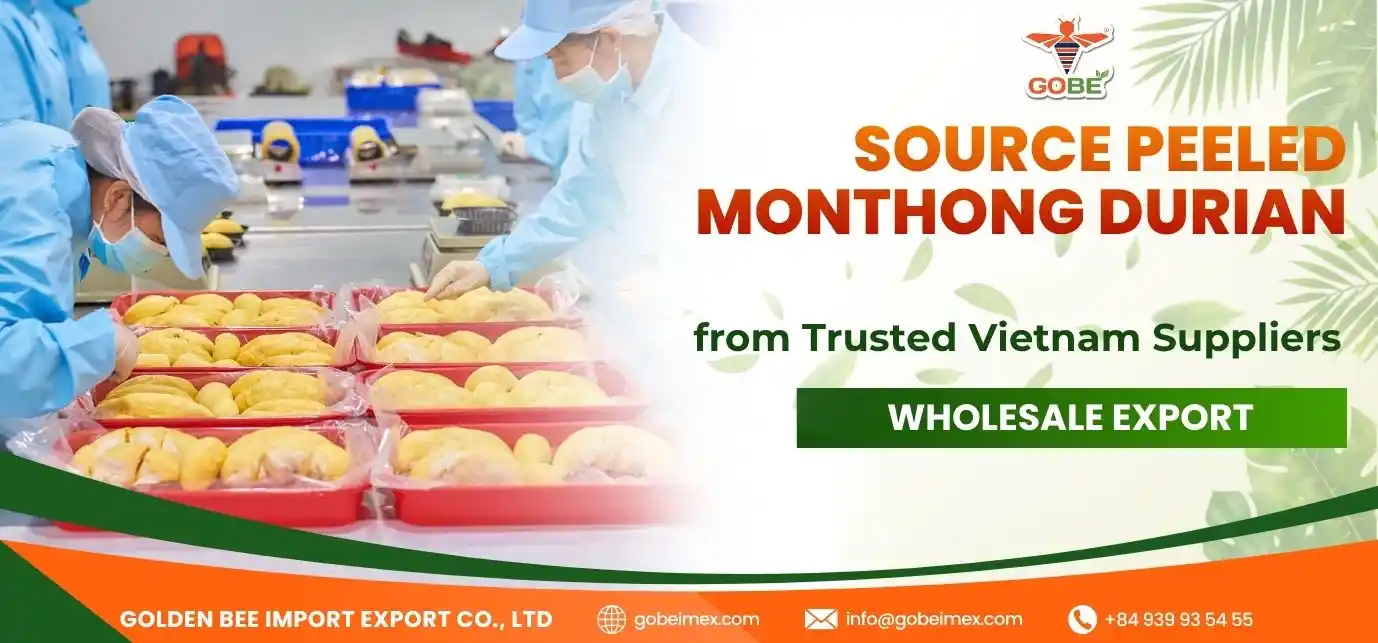
Source Peeled Monthong Durian from Trusted Vietnam Suppliers – Wholesale Export

Source Peeled Monthong Durian from Trusted Vietnam Suppliers – Wholesale Export

Peeled Monthong Durian from Vietnam is the preferred wholesale export format for importers, supermarket chains, and food distributors across the Middle East, Europe, Japan, and North America. Pre-portioned into 500g consumer units with

Read More
Top 10 Largest Durian Exporters 2026: A Sourcing Guide for Importers & Buyers

Top 10 Largest Durian Exporters 2026: A Sourcing Guide for Importers & Buyers

The top 10 largest durian exporters in 2026 are Gobeimex (Golden Bee Vietnam), Charoen Pokphand Foods (Thailand), Musang King Exporter Group (Malaysia), Viet Nam Fresh Export Joint Stock Company, Golden Fresh (Thailand), Big

Read More
How can importers find a reliable wholesale durian supplier with the best price?

How can importers find a reliable wholesale durian supplier with the best price?

A reliable wholesale durian supplier is defined by trustworthiness, certification depth, supply consistency, and cold chain integrity evaluated simultaneously. When all four align, importers gain premium-quality product and the commercial stability needed to

Read More
peeled durian supplier vietnam

Buy Peeled Durian in Vietnam: Trusted Fresh & Frozen Suppliers for Wholesale Importers

Peeled durian from Vietnam is available in two export formats: fresh peeled (air freight, 7-day shelf life, 3 to 5°C) and frozen peeled (sea or air freight, extended shelf life), sourced from Mekong

Read More