Subtotal $0.00

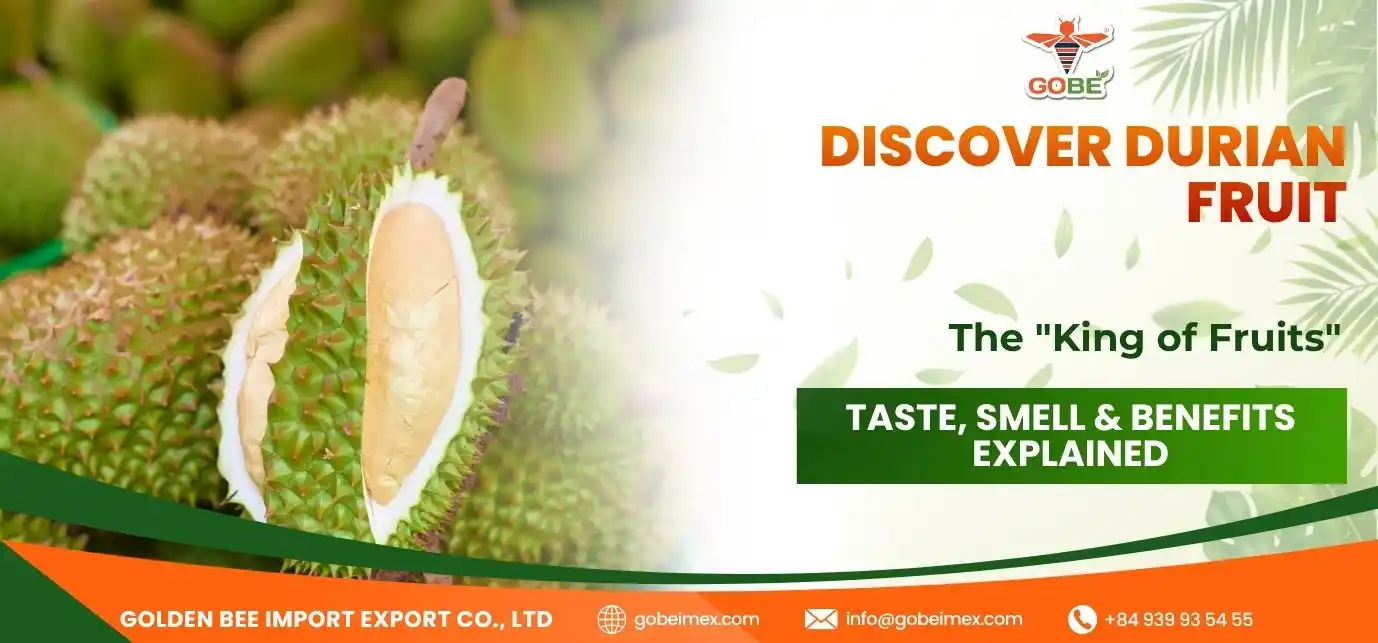
Durian fruit is a large, spiky tropical drupe native to Southeast Asia, widely recognized as the “King of Fruits” for its extraordinary flavor complexity, remarkable nutritional density, and unmistakable cultural significance across Thailand, Malaysia, Indonesia, and Vietnam. No other fruit commands the same level of passionate devotion and fierce debate simultaneously. From bustling wet markets in Hanoi to premium fruit boutiques in Tokyo, durian occupies a category entirely its own.
When it comes to taste and smell, durian delivers a sensory experience unlike anything else in the fruit kingdom. The flavor is intensely rich, custard-sweet, and deeply savory all at once, while the aroma ranges from caramel and vanilla to fermented onion and sulfur. This striking duality is precisely why durian has become one of the most searched tropical fruits globally, attracting curious first-timers and devoted fans alike.
Beyond its legendary reputation, durian is a powerful source of nutrition. Packed with Vitamin C, B-vitamins, potassium, manganese, dietary fiber, and natural antioxidants, this fruit delivers measurable health benefits that researchers and nutritionists have begun to document with increasing rigor. Understanding what durian offers, and how to eat it responsibly, transforms it from a curiosity into a meaningful addition to a balanced diet.
This article covers every essential angle: what durian is and where it comes from, how it tastes, why it smells the way it does, and what science says about its health benefits.
Durian belongs to the species Durio zibethinus of the Malvaceae family, originating from the rainforests of Borneo and Sumatra, and it earns the title “King of Fruits” through its dramatic appearance, unmatched flavor complexity, nutritional density, and centuries of cultural reverence across Southeast Asia. This section covers durian’s physical form, geographic roots, cultural meaning, and seasonal availability.
Understanding durian from the outside in clarifies why it holds such a singular position in global food culture.
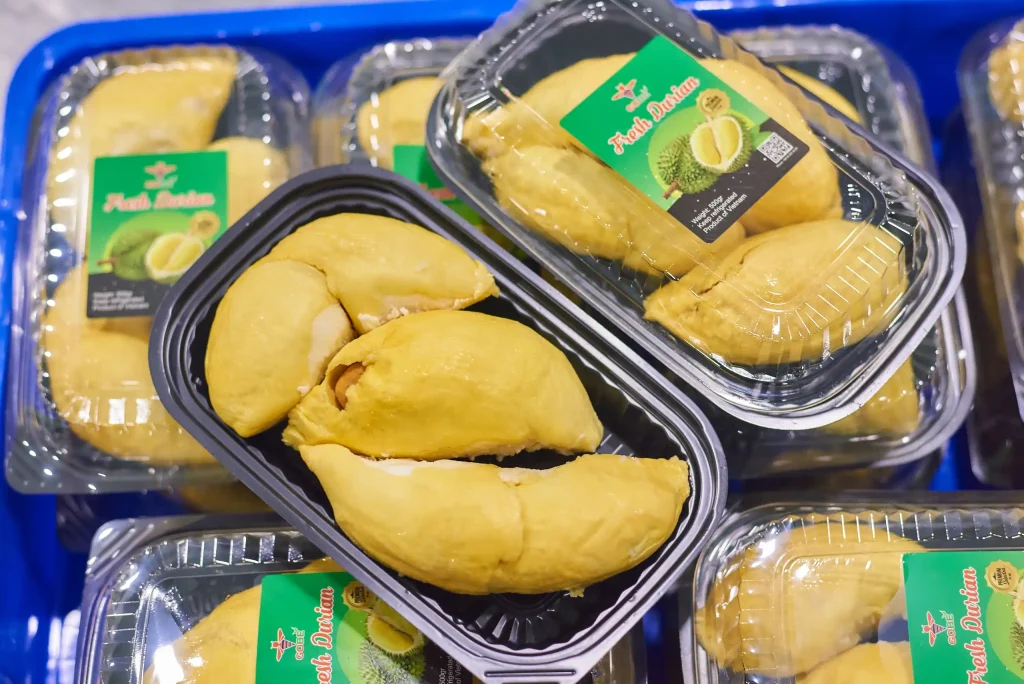
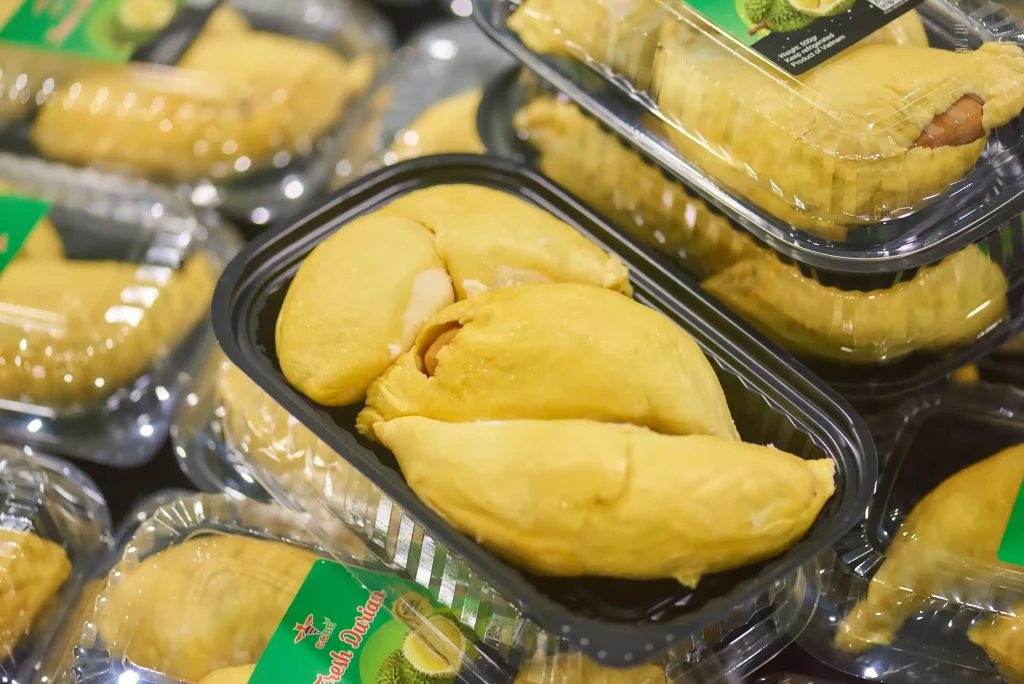
Durian is immediately recognizable by its armored exterior, weighing between 1 and 4 kilograms, covered in sharp conical thorns ranging from pale green to brownish-yellow depending on ripeness and variety. Beneath this formidable husk lie five segments of soft, creamy flesh, each surrounding a large seed.
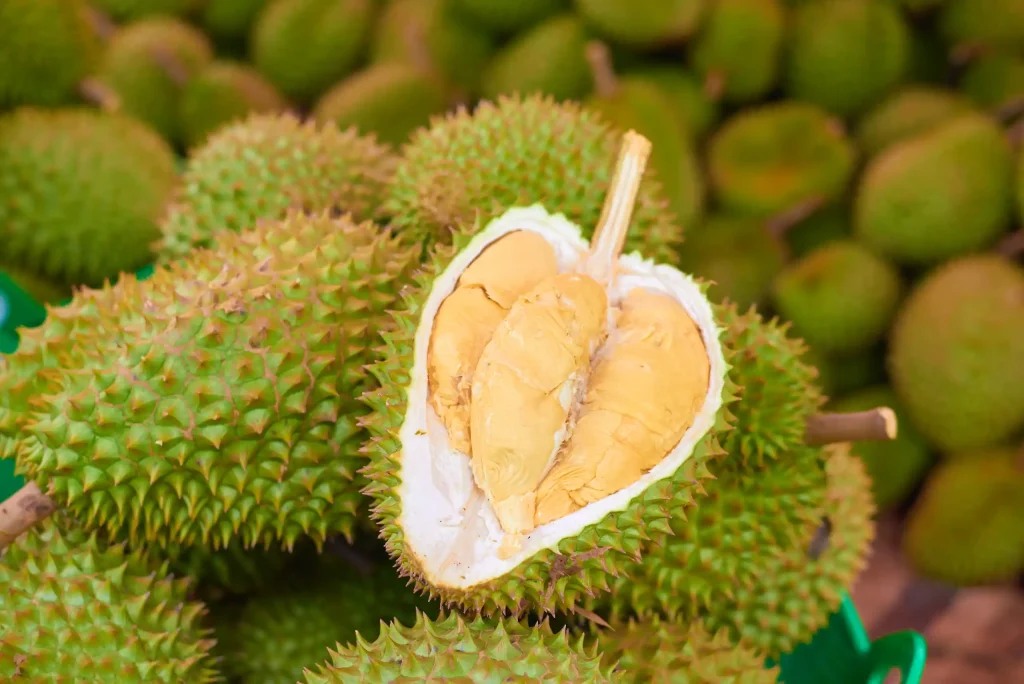
The flesh ranges in color from pale ivory to deep golden yellow. Richly hued varieties such as Musang King from Malaysia command premium prices in export markets. The texture of ripe durian flesh resembles thick custard or soft butter, melting on the tongue rather than requiring significant chewing. This textural quality is one of the primary reasons durian fans describe the eating experience as unlike any other fruit.
Durian is indigenous to the tropical rainforests of Borneo and Sumatra, with cultivation now spread across mainland Southeast Asia, led commercially by Thailand, Malaysia, Indonesia, and Vietnam. Thailand is the world’s largest exporter, Malaysia produces the most celebrated premium varieties, and Indonesia leads in total volume for domestic consumption.
Vietnam has emerged as a rapidly growing durian exporter, with the Mekong Delta and Central Highlands producing significant volumes for markets in China, the United States, Europe, and the Middle East. Golden Bee Vietnam (Gobeimex) exports premium Vietnamese durian from GlobalGAP-certified growing areas to international buyers across four continents, reflecting the growing global appetite for this fruit.
The title “King of Fruits” reflects a deeply held cultural belief across Southeast Asia that durian occupies a supreme position among tropical fruits in flavor richness, nutritional value, and culinary prestige. In Malaysian and Indonesian tradition, durian season is treated as a festive occasion, with families gathering at roadside stalls to eat freshly cracked durian together, a ritual without equivalent in any other fruit culture worldwide.
Commercially, premium durian reinforces its royal status through price. A single Musang King durian sells for USD 50 to over USD 200 in markets such as China, Japan, and Singapore, where demand for export-grade Vietnamese and Malaysian durian has surged over the past decade. This economic reality, combined with centuries of cultural reverence, makes the designation thoroughly earned.
Durian availability depends on the growing region and variety, with Thailand’s main harvest running from April to August, Malaysia’s Musang King peaking from June to August, and Vietnamese durian harvested primarily from May through August. A shorter secondary season in Malaysia occurs around December to February, and some Vietnamese farms produce a secondary crop later in the year.
Year-round availability on global markets is made possible through refrigerated shipping and frozen durian products. This allows importers and supermarkets to stock durian 52 weeks per year, giving exporters like Gobeimex the capacity to guarantee uninterrupted supply to buyers worldwide.
Durian tastes intensely sweet and richly savory simultaneously, with a creamy custard-like texture, notes of caramel and vanilla, a hint of fermented fruit, and a mild bitter finish, while its smell combines fruity esters and sulfur compounds into a penetrating aroma that permeates enclosed spaces within minutes of the fruit being opened. This section covers flavor profiles across major varieties, the chemistry behind the smell, and why the aroma is a biological marker of peak ripeness rather than spoilage.
This complexity is what divides people into passionate camps, and understanding it requires exploring both the taste and aroma in detail.
The first sensation when eating ripe durian is deep sweetness resembling condensed milk or thick honey, followed immediately by a creamy, fatty quality that coats the mouth like ripe avocado, then a savory, custardy layer reminiscent of egg yolk or soft cheese, finishing with a subtle bitterness. This sequence of layered sensations is what food writers and chefs describe as making durian unlike any other fruit.
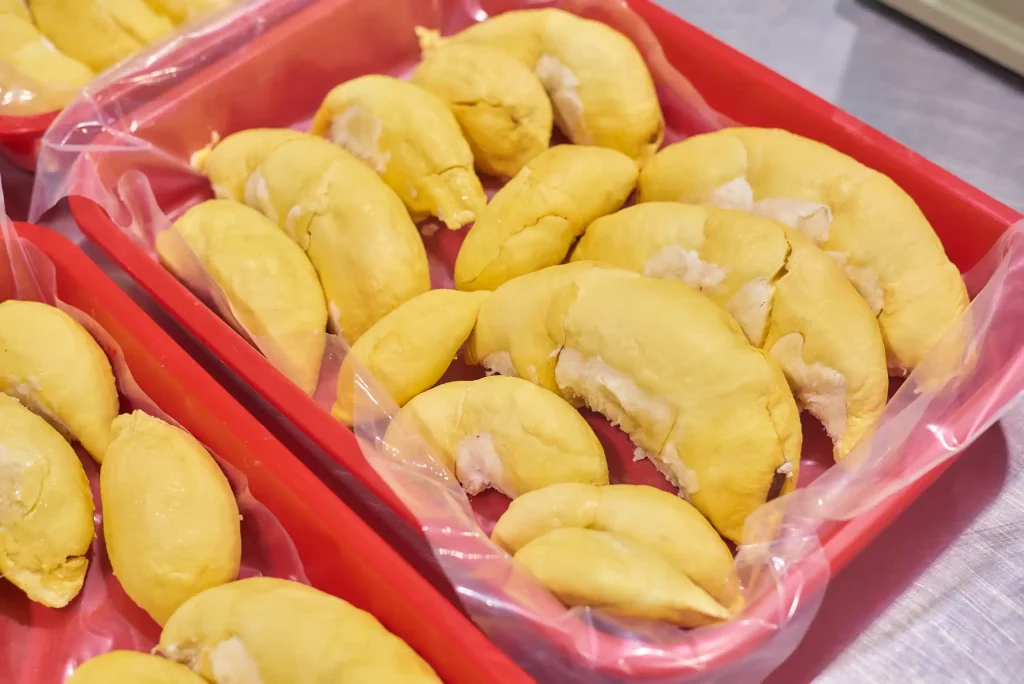
Food writer Richard Sterling described durian’s aroma as “pig-sh*t, turpentine, and onions, garnished with a gym sock,” while naturalist Alfred Russel Wallace described the flavor itself as “a rich custard highly flavored with almonds” with “cream-cheese, onion-sauce, sherry-wine, and other incongruities.” This contrast between smell and flavor is one of durian’s most paradoxical characteristics. Many first-time eaters who push past the aroma discover that the taste is far more approachable and even deeply pleasurable than they anticipated.
Variety selection is one of the most important factors determining whether a first-time eater enjoys or rejects durian, with Monthong being the most approachable, Musang King the most complex, and Vietnamese RI6 gaining recognition for intense sweetness. Below is a comparison of the four most commercially significant varieties.
The table below compares the key flavor, texture, and market characteristics of major durian varieties to help buyers and consumers identify the best option for their needs.
| Variety | Origin | Flavor Profile | Bitterness | Best For |
|---|---|---|---|---|
| Monthong | Thailand | Mild, sweet, lightly aromatic | Low | First-time eaters, export volume |
| Musang King (Mao Shan Wang) | Malaysia, Vietnam | Bittersweet, complex, deeply creamy | Medium-High | Enthusiasts, premium retail |
| D24 | Malaysia | Balanced sweetness, mild bitterness | Medium | Experienced eaters, balanced palate |
| RI6 / Chuang Mah | Vietnam, Indonesia | Intensely sweet, thick flesh, rich | Low-Medium | Export markets, growing retail demand |
Research published in food science journals suggests that the human brain processes durian’s simultaneous sweetness and sulfurous aroma as cognitively dissonant, triggering either fascination or rejection depending on prior exposure and individual sensory sensitivity. Vietnamese varieties grown in the Mekong Delta, including Musang King and RI6 certified under GlobalGAP standards, are increasingly being introduced to global buyers by exporters such as Gobeimex.
Durian’s smell is a multi-layered olfactory experience composed of vanilla, caramel, fermented onion, ripe cheese, and sulfur compounds, produced by 50 distinct volatile organic compounds identified by researchers from the German Cancer Research Center in a landmark 2012 study published in the Journal of Agricultural and Food Chemistry. The dominant contributors include fruity esters such as ethyl propanoate alongside sulfur-containing compounds including diethyl disulfide, which produce the onion and sulfurous tones that many people find overwhelming.
The aroma intensifies when the husk cracks or is cut open, as volatile compounds release rapidly into surrounding air. Temperature plays an equally important role: durian at room temperature in a tropical climate releases aromatic compounds far more aggressively than durian stored at refrigeration temperatures. Freshly harvested durian at peak ripeness has a cleaner, more balanced aroma than either unripe durian, dominated by harsh chemical notes, or overripe durian, which develops fermented and alcohol-like undertones as sugars break down further. According to researchers at the German Cancer Research Center (2012), the interplay between fruity esters and sulfurous molecules creates what food scientists classify as a “uniquely complex” aroma profile with no close parallel in the fruit kingdom.
Yes, durian’s intense smell is completely normal and is a biological marker that the fruit has reached optimal ripeness, not a sign of spoilage, because it results from a natural enzymatic ripening process that generates volatile sulfur compounds as a byproduct of accelerating metabolic activity. In the wild, this powerful aroma functions as a long-range signal to natural seed dispersers including elephants, orangutans, and tigers, alerting them that the fruit has fallen and is ready to eat.
The human olfactory system responds strongly to sulfurous compounds because smell receptors evolved to detect rotting organic matter and fermentation as potential food-safety signals. When the brain receives a sulfurous smell simultaneously with sweet and creamy flavor signals, the cognitive mismatch produces the intense and often contradictory reactions durian is famous for. Frozen durian, available in increasing volumes at international supermarkets, has a noticeably reduced aroma compared to fresh durian. The freezing process disrupts some of the enzymatic activity responsible for volatile compound production, resulting in a milder smell profile while largely preserving flavor and texture. For consumers outside Southeast Asia, frozen durian often serves as a more practical and socially manageable introduction to the fruit.
Durian provides six major, research-supported health benefits: cardiovascular support, immune system reinforcement, natural energy supply, digestive health improvement, anti-inflammatory action, and bone strength support, making it one of the most nutritionally dense tropical fruits available globally. These benefits stem directly from durian’s exceptional nutrient composition, which is substantially richer in vitamins, minerals, and bioactive compounds than most tropical fruits of comparable calorie density.
This section covers both the core nutrient profile and the specific mechanisms behind each health benefit.
Yes, durian is good for you when consumed in appropriate quantities, containing an impressive array of essential vitamins, minerals, dietary fiber, and natural antioxidants that support multiple body systems simultaneously. Its thiamine content alone provides nearly one-third of the adult recommended daily intake per 100g serving.
The table below presents the core nutritional values of raw durian flesh per 100g serving, sourced from the USDA FoodData Central database, giving buyers, retailers, and health-conscious consumers a precise reference for product positioning and dietary guidance.
| Nutrient | Amount per 100g | % Daily Value (approx.) |
|---|---|---|
| Calories | 147 kcal | 7% |
| Carbohydrates | 27.1 g | 10% |
| Dietary Fiber | 3.8 g | 14% |
| Total Fat | 5.3 g | 7% |
| Protein | 1.5 g | 3% |
| Vitamin C | 19.7 mg | 22% |
| Thiamine (B1) | 0.37 mg | 31% |
| Vitamin B6 | 0.32 mg | 19% |
| Potassium | 436 mg | 9% |
| Manganese | 0.33 mg | 14% |
| Folate | 36 mcg | 9% |
| Copper | 0.21 mg | 23% |
Source: USDA FoodData Central, NDB No. 09087
The dietary fiber content of 3.8g per 100g supports healthy gut motility, feeds beneficial probiotic bacteria in the colon, and contributes to stable post-meal blood glucose levels. Durian also contains natural antioxidants including flavonoids, carotenoids, and polyphenolic compounds that neutralize free radicals and reduce oxidative stress linked to chronic disease. According to a study published in Food Chemistry (2013), durian flesh extracts demonstrated significant antioxidant activity comparable to several well-regarded antioxidant-rich fruits. According to research published in Nutrients (2020), dietary fiber from tropical fruits plays a significant role in modulating gut microbiota composition, with downstream effects on metabolic health and immune function.
Durian delivers six scientifically supported health benefits across cardiovascular, immune, metabolic, digestive, anti-inflammatory, and skeletal systems, each linked to identifiable nutrients and supported by peer-reviewed research. Below is a detailed breakdown of each benefit.
Important note on consumption: Durian is calorie-dense at 147 kcal per 100g and contains approximately 16g of natural sugars per 100g. Most nutrition professionals recommend limiting intake to 2 to 4 sections (approximately 80 to 100g) per sitting for healthy adults, consumed as part of a diverse diet rather than as a daily staple. Individuals managing blood sugar or weight should be especially mindful of portion control.
No, combining durian with alcohol is not safe, because durian contains compounds that inhibit the enzyme aldehyde dehydrogenase (ALDH), causing toxic acetaldehyde to accumulate in the bloodstream and producing symptoms including flushing, rapid heart rate, nausea, and severe headache even from modest amounts of alcohol. This interaction is the most significant safety concern associated with durian and is insufficiently known among casual consumers outside Southeast Asia.
When the human body metabolizes alcohol (ethanol), it first converts it to acetaldehyde via alcohol dehydrogenase. Acetaldehyde must then be broken down by ALDH into harmless acetic acid. Sulfur-containing compounds in durian, particularly disulfide derivatives, inhibit ALDH activity, slowing acetaldehyde clearance and allowing it to accumulate to symptomatic levels. A study conducted at the University of Tsukuba, Japan, published in 2009, confirmed that durian extract significantly inhibited ALDH activity in vitro, providing biochemical evidence for what Southeast Asian folk wisdom has long cautioned. The practical recommendation is clear: do not consume durian and alcohol within the same 2 to 4 hour window, whether the beverage is beer, wine, or spirits.
Eating too much durian causes four main, dose-dependent side effects: elevated body heat, blood sugar spikes, unwanted weight gain, and gastrointestinal discomfort, all of which are largely avoidable with moderate, controlled consumption. Starting with small portions and increasing gradually allows the digestive system to adjust to the fruit’s high fiber and fat content.
For healthy adults without underlying conditions, 2 to 3 sections (approximately 80 to 100g) per day represents a sensible upper limit that captures the fruit’s nutritional benefits without significant side effects.
Durian is banned from a specific and growing list of public spaces across Southeast Asia, most notably the Singapore MRT system, numerous hotel chains in Thailand and Malaysia, and several international airports including Changi in Singapore and Suvarnabhumi in Bangkok, with fines in Singapore reaching SGD 500 (approximately USD 370). The reason for these bans is entirely olfactory: durian’s volatile aromatic compounds permeate enclosed, air-conditioned spaces with extraordinary efficiency.
The paradox is culturally striking: the fruit celebrated as “King of Fruits” and sold at premium prices in luxury fruit stores is simultaneously subject to legal bans in public transportation. This contradiction reflects durian’s essential nature. It is a fruit of extremes, beloved with fierce intensity by its fans and rejected with equal conviction by those who find its smell intolerable.
Despite these restrictions, global demand continues to climb. China alone imported over USD 4.23 billion worth of fresh and frozen durian in 2023, primarily from Thailand and Vietnam, according to data from China’s General Administration of Customs. Regulatory inconvenience has done nothing to diminish durian’s commercial and cultural ascent on the global stage.
For international importers, distributors, and retailers seeking reliable, export-grade Vietnamese durian, Golden Bee Vietnam (Gobeimex) supplies GlobalGAP-certified durian from its own growing areas and partner farms across Vietnam’s premier fruit-producing regions. With a cold-chain logistics network that maintains fruit quality from farm to port and year-round supply capacity across more than 10 global markets, Gobeimex represents a trusted source for buyers who prioritize both quality assurance and supply reliability.
To learn more about Gobeimex’s durian export program or request a product catalog, visit gobeimex.com or contact the team directly at Info@gobeimex.com.