Subtotal $0.00

Peeled durian from Vietnam is available in two export formats: fresh peeled (air freight, 7-day shelf life, 3 to 5°C) and frozen peeled (sea or air freight, extended shelf life), sourced from Mekong Delta growing regions where Ri 6 and Monthong varieties consistently deliver 30 to 40% Brix sugar content. Wholesale importers gain access to premium tropical flavor at competitive prices with year-round supply from a single country of origin.
A trusted fresh and frozen peeled durian supplier in Vietnam must hold five internationally recognized certifications: GlobalGAP, FDA, ISO, GRASP, and Sedex. Suppliers who process peeled durian within 12 hours of harvest and maintain an unbroken cold chain from farm to port protect shelf life across long-haul import routes to Canada, the UAE, Japan, the UK, and Germany.
For wholesale importers, MOQ structures, lead times, seasonal availability calendars, and logistics partnerships determine whether a supplier can sustain reliable 52-week supply. Importers serving supermarket chains across North America, Europe, and the Middle East need a supplier who understands the phytosanitary requirements and retail-ready packing standards of each destination market.
Related posts
Peeled durian from Vietnam is export-grade durian flesh fully removed from the husk and seed, portioned, packed, and shipped in chilled or frozen format, making it immediately ready for retail, food service, or further processing upon arrival. This article covers the consumer demand drivers, supply chain advantages, variety specifications, and supplier selection criteria wholesale importers need to make informed sourcing decisions.
Demand is accelerating across multiple channels simultaneously.
Vietnamese-origin peeled durian has built a verified reputation across Canada, the UAE, Japan, the Netherlands, Germany, and Kuwait for rich, creamy texture and high natural sugar content, with growth now driven by mainstream supermarket expansion beyond the original diaspora consumer base. Peeled durian eliminates the logistical burden of husk disposal, reduces shipping weight, and lowers the barrier to entry for supermarkets and HoReCa buyers who lack equipment or space to process whole fruit on-site.
Three buyer categories are driving current volume growth:
Markets with large Southeast Asian diaspora communities, particularly in North America and Europe, have sustained baseline demand for years. What is accelerating growth now is the category’s crossover into mainstream retail and food manufacturing, where product consistency, food safety certification, and year-round availability are non-negotiable supplier requirements.
Vietnam’s Mekong Delta, and Tien Giang Province specifically, concentrates the country’s highest-volume durian-growing areas, allowing suppliers located directly within these regions to move fruit from harvest to packing house within 12 hours, a logistical advantage that directly translates into longer remaining shelf life at destination. No other sourcing geography currently matches this combination of volume, variety quality, and farm-to-pack speed for export-grade peeled durian.
Gobeimex (Golden Bee Import Export Company Limited) operates its main packing house in Tien Giang Province, placed in the heart of Vietnam’s fruit-growing region to capture this 12-hour farm-to-pack window. The company manages 30+ hectares of company-owned farmland and partnerships spanning 200+ GlobalGAP-certified hectares, supporting continuous export operations across all four seasons. The result for wholesale importers is a product that arrives with maximum freshness, verifiable origin traceability, and a quality profile that satisfies food safety regulators in North America, Europe, the Middle East, and Asia simultaneously.
Fresh peeled durian and frozen peeled durian serve fundamentally different import business models: fresh peeled is designed for premium retail and rapid-turnover channels via air freight, while frozen peeled supports high-volume food manufacturing, sea freight logistics, and extended distribution networks. The right choice depends on your cold storage infrastructure, target sales channel, order frequency, and acceptable landed cost per kilogram.
Both formats share the same Vietnamese tropical origin and export-grade quality standard. However, they diverge significantly on shelf life, storage requirements, shipping method, and compatible end markets.
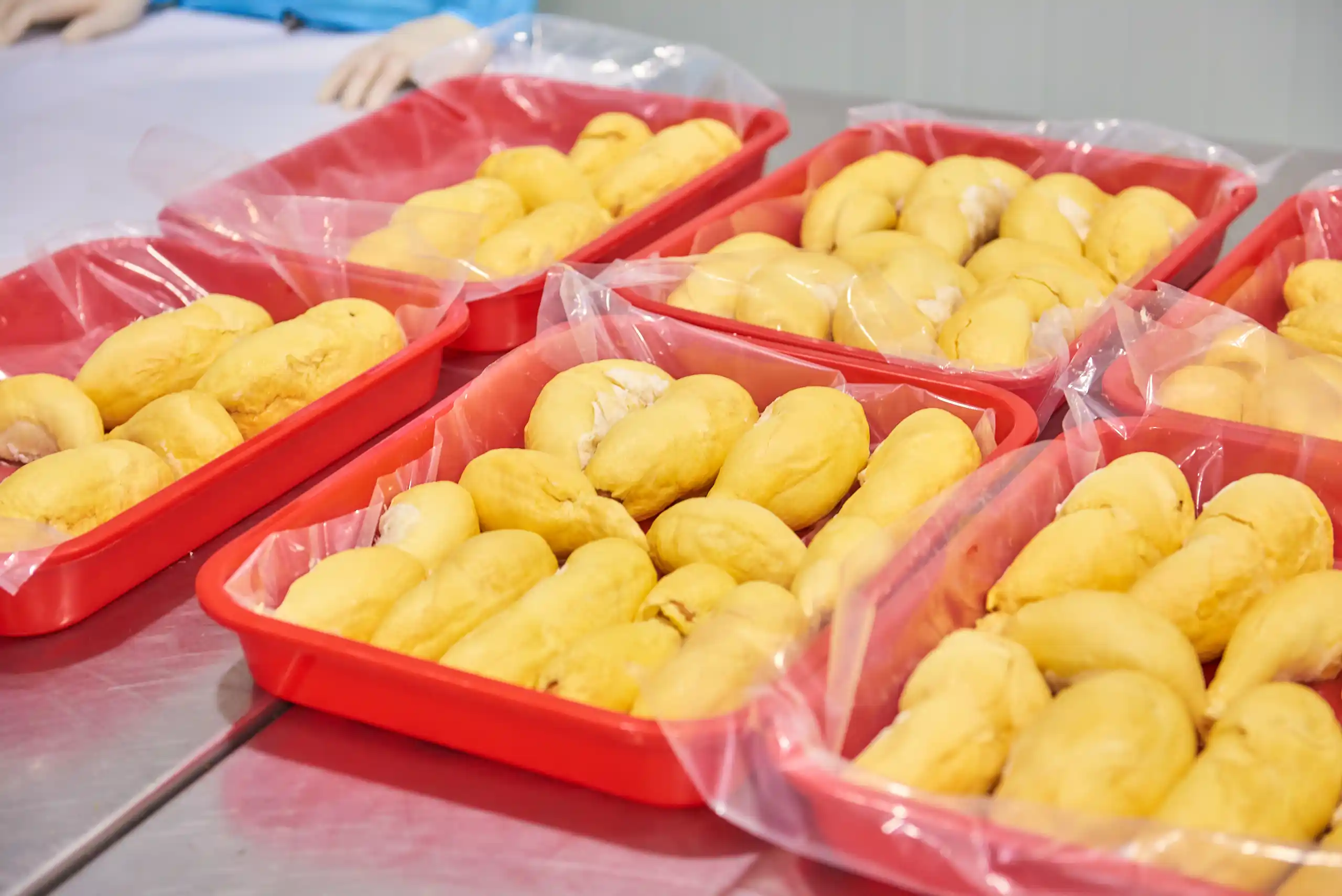
Fresh peeled durian from Vietnam is available in 500g units packed into 4kg or 8kg boxes, with a 7-day shelf life at 3 to 5°C, shipped exclusively by air freight, making it a premium time-sensitive product designed for markets with strong air cargo infrastructure and fast retail turnover. Gobeimex exports fresh peeled durian using the Ri 6 variety, which delivers a sugar content of 32 to 40% Brix in peeled meat format, the highest Brix range among Vietnam’s commercially exported durian varieties.
This makes fresh peeled Ri 6 particularly attractive for premium Asian grocery chains, specialty fruit retailers, and supermarket fresh sections targeting consumers who prioritize authentic tropical flavor.
The table below provides complete technical specifications for fresh peeled Ri 6 durian as exported by Gobeimex. Use this data to evaluate air freight logistics timelines and retail shelf life planning against your specific market requirements.
| Specification | Ri 6 Peeled Meat |
|---|---|
| Sugar Content (Brix) | 32 to 40% |
| Unit Weight | 500g per unit |
| Box Weight | 4kg or 8kg per box |
| Shelf Life | 7 days |
| Storage Temperature | 3 to 5°C |
| Shipping Method | By air only |
The 7-day shelf life begins at the point of packing, not at departure from Vietnam. Air freight from Ho Chi Minh City typically reaches Canada, the UAE, Japan, and key European hubs within 24 to 48 hours of departure, leaving importers with 5 to 6 days of usable shelf life upon arrival. This is a workable timeline for direct supermarket delivery, but it requires tight coordination between supplier, freight forwarder, and receiving logistics.
Fresh peeled durian is best suited to:
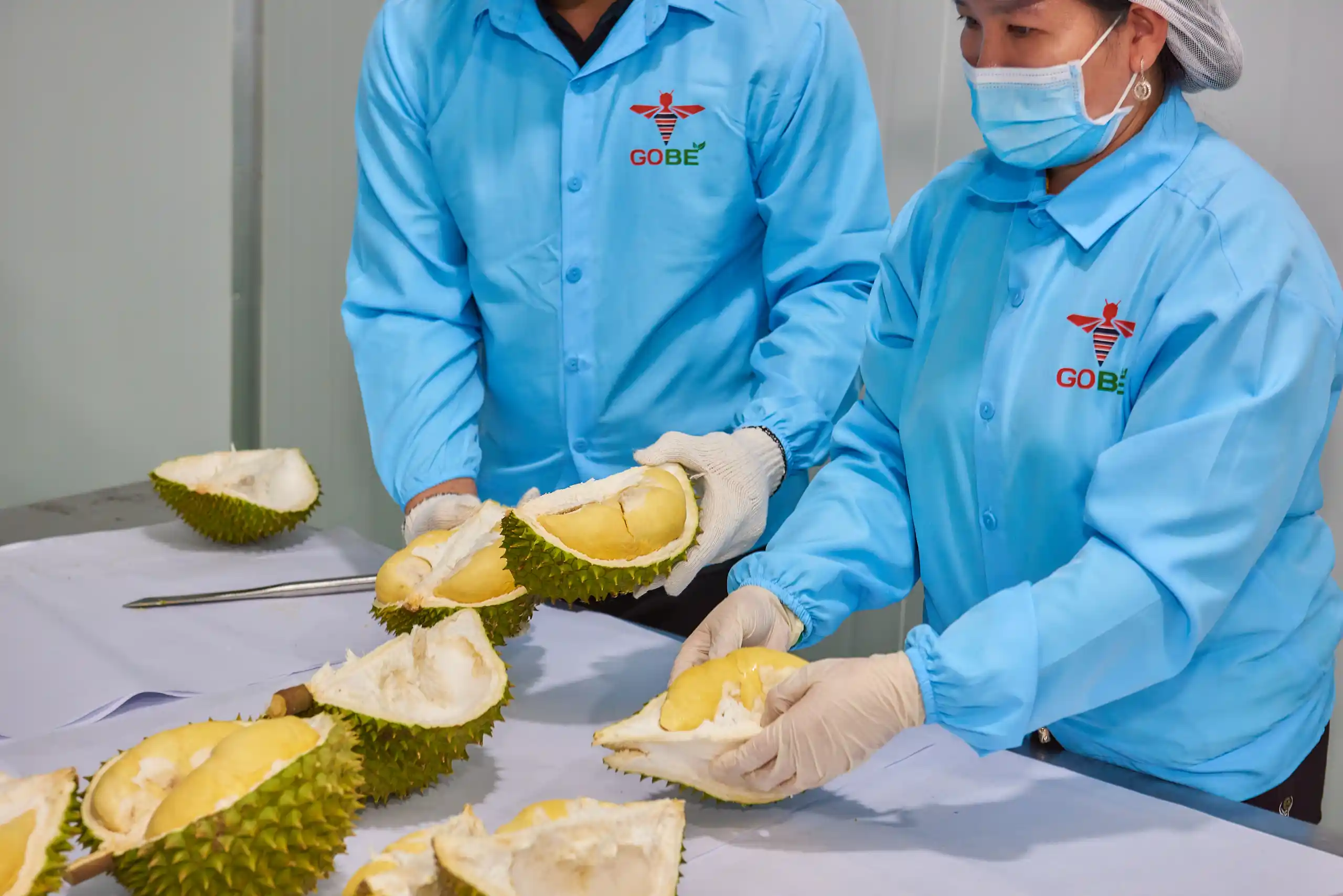
Frozen peeled durian offers wholesale importers extended shelf life and dramatically lower per-unit logistics costs by enabling sea freight shipping, making it the preferred format for food manufacturers, dessert brands, and large-volume frozen food distributors. Storage at or below -18°C allows frozen peeled durian to maintain product integrity across long-haul sea freight routes to the EU, Middle East, and North America without the air freight cost premium.
Sea freight costs per kilogram are a fraction of air freight costs on equivalent routes. For importers ordering full container loads (FCL), frozen peeled durian makes it economically viable to carry high volumes without the per-unit landed cost penalty that comes with fresh air freight product.
Key commercial applications for frozen peeled durian include:
From a cold chain perspective, frozen peeled durian requires an unbroken freeze chain from the packing house through transit to the importer’s receiving warehouse. Gobeimex operates its own fleet of refrigerated container trailers, ensuring temperature integrity is maintained at every handoff point within Vietnam before product reaches the port of export.
Wholesale importers can source two primary durian varieties from Vietnam for export: Ri 6 and Monthong, each with distinct flavor profiles, packaging specifications, seasonal availability windows, and suitable end markets. The variety selection directly affects sugar content, shelf life, packaging format, shipping options, and the months when peak-quality product is available for order.
Ri 6 peeled durian and Monthong differ on five commercially critical dimensions: format availability, unit size, Brix content, shelf life, and seasonal peak, with Ri 6 currently the primary variety available in peeled meat format for export and Monthong predominantly exported as whole fruit. This distinction determines whether you are sourcing a ready-to-retail ingredient or a whole fruit that your distribution chain will need to process downstream.
The table below provides a direct side-by-side comparison using verified product data from Gobeimex’s export specifications. Wholesale importers should use this table when aligning variety selection with target market positioning and logistics planning.
| Specification | Ri 6 Peeled Meat | Monthong Whole Fruit |
|---|---|---|
| Sugar Content (Brix) | 32 to 40% | 30 to 38% |
| Export Format | Peeled meat | Whole fruit |
| Unit Weight | 500g per unit | 1.8 to 5.5 kg per piece |
| Box Weight | 4kg or 8kg | 10kg, 12kg, or 18kg |
| Shelf Life | 7 days | 14 days |
| Storage Temperature | 3 to 5°C | 13 to 18°C |
| Shipping Method | By air only | By air and sea |
| High Season | April to July | May to September |
| Low Season | January to March and August to December | January to April and October to December |
From a flavor standpoint, Ri 6 peeled durian delivers a peak Brix range of up to 40% compared to Monthong whole fruit at up to 38%, making Ri 6 peeled meat the preferred choice for premium dessert applications and consumer markets that prioritize sweetness intensity, including Japan, South Korea, and the Gulf Cooperation Council countries.
From a logistics standpoint, Monthong’s 14-day shelf life and sea freight compatibility give it a cost advantage for importers shipping whole fruit to distant markets. However, buyers who specifically need peeled, ready-to-use durian flesh will find Ri 6 peeled meat the commercially available export option from Vietnam.
On seasonal planning, Ri 6 and Monthong high seasons partially overlap from May to July, creating a window of simultaneous peak supply. Outside this overlap, importers requiring continuous supply must coordinate with suppliers capable of bridging between varieties or maintaining frozen inventory to cover low-season gaps. Gobeimex’s 52-week supply capability addresses this gap through owned farm schedules and partner farm network coordination across 230+ hectares.
A trusted peeled durian supplier in Vietnam must demonstrate five core capabilities: internationally recognized food safety certifications, verified cold chain infrastructure, transparent farm-to-pack traceability, flexible packaging options tailored to each market, and the operational capacity to meet wholesale order volumes with consistent lead times. These criteria separate genuine export-grade suppliers from intermediaries who cannot guarantee product quality across the full supply chain.
Supplier evaluation is a risk management exercise as much as a quality assessment. A failed shipment caused by cold chain breakdown, certification non-compliance, or inconsistent sugar content does not just result in a financial loss. It damages relationships with retail buyers, distributors, and end consumers that can take years to rebuild.
A peeled durian supplier exporting to global markets must hold at minimum GlobalGAP, ISO, and FDA certifications, with GRASP and Sedex increasingly required by European supermarket chains and ethically-driven retail procurement programs. Each certification signals compliance with a different layer of the international supply chain’s requirements, covering farm-level agricultural practices, food safety management systems, social responsibility standards, and ethical business conduct.
The table below maps each certification to its scope and the markets or buyer types that most commonly require it. Use this reference when auditing a prospective supplier’s certification portfolio against your destination market requirements.
| Certification | Scope | Key Markets and Buyers Requiring It |
|---|---|---|
| GlobalGAP | Good agricultural practices at farm level, sustainable production | EU, UK, Japan, and major supermarket chains globally |
| FDA | U.S. Food and Drug Administration food safety standard | United States and Canada |
| ISO | International quality management system for processing operations | Required across most B2B export channels |
| GRASP | Social and labor responsibility at farm level | European supermarket chains and ethical procurement programs |
| Sedex | Ethical supply chain management and supplier transparency | Large retail chains in the UK and Europe |
Gobeimex holds all five certifications simultaneously: GlobalGAP, GRASP, ISO, FDA, and Sedex. This multi-certification portfolio means that a single supplier relationship with Gobeimex satisfies the compliance requirements of virtually every major international import market, removing the need for importers to audit and manage multiple sourcing relationships across different certification levels.
When evaluating any peeled durian supplier, importers should request copies of all active certification documents, verify expiry dates, and confirm which specific farm locations and processing facilities are covered under each certification scope. A supplier whose certifications cover the packing house but not the partner farms presents a traceability gap that can create regulatory problems at the border.
Wholesale peeled durian orders from Vietnam are structured around air freight pallet quantities for fresh product and FCL volumes for frozen product, with custom packaging available to match private label, retail-ready, or foodservice specifications. Lead times from order confirmation to port departure generally range from 3 to 7 days for fresh peeled durian and 7 to 14 days for frozen, depending on inventory availability and current harvest season.
Wholesale importers should plan around the following operational parameters when placing orders:
For quotations or catalog downloads, contact Gobeimex directly at Info@gobeimex.com or via WhatsApp at +84 939 93 54 55. A full product catalog with specifications is available at gobeimex.com.
The best time to buy fresh peeled durian from Vietnam at peak quality and volume is April through July for Ri 6 and May through September for Monthong, with an overlapping peak window from May to July when both varieties are simultaneously in high season. Importers requiring year-round continuity should combine seasonal fresh purchasing during peak months with frozen inventory procurement to bridge low-season supply gaps.
Strategic sourcing planning is essential for any importer who needs peeled durian 52 weeks per year. The sections below provide detailed guidance on both the harvest calendar and the cold chain system that preserves product integrity from farm to port.
Ri 6 peaks from April to July and Monthong peaks from May to September, creating a combined high-quality supply window of April through September, after which importers must rely on frozen stock or low-season supply to maintain year-round continuity. Peeled durian harvested during peak season delivers the highest Brix readings (Ri 6 up to 40%, Monthong up to 38%), while off-season fruit may show lower sugar concentration, directly affecting premium positioning in destination markets.
The recommended annual procurement strategy for importers requiring 52-week supply is:
Gobeimex’s network of owned and partner farms spanning 230+ hectares supports year-round supply by staggering harvest schedules across multiple growing zones. This makes Gobeimex one of the few Vietnam-based suppliers capable of guaranteeing 52-week availability without seasonal interruption.
Gobeimex protects peeled durian quality through an unbroken cold chain that begins at the Tien Giang packing house, where fruit is processed within 12 hours of harvest, and continues through dedicated refrigerated container transport to the port of export. This integrated process eliminates quality loss points that occur when peeled durian passes through multiple intermediaries or travels long distances between harvest and packing.
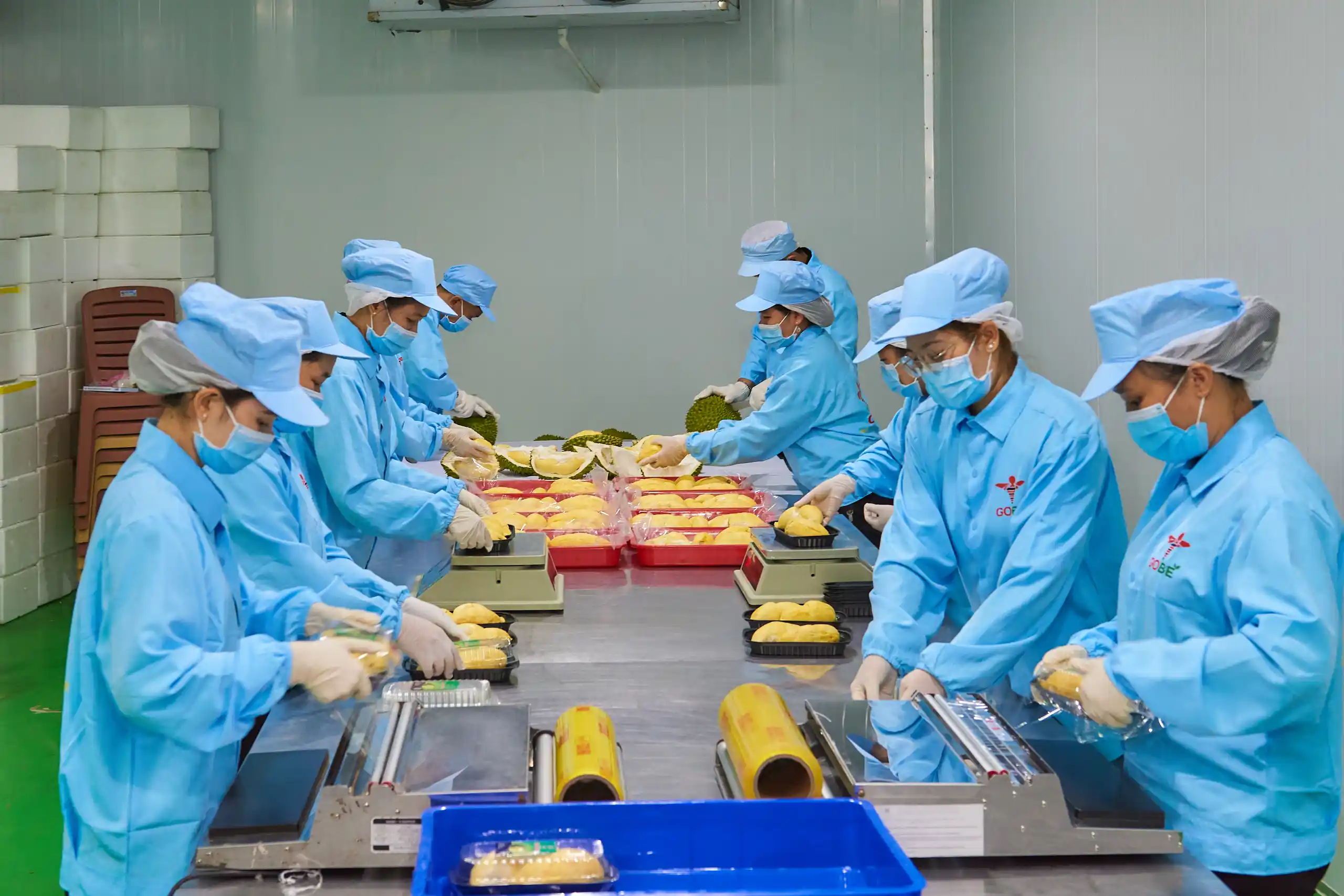
The operational sequence that protects product integrity is as follows:
For importers, this process delivers a measurable commercial benefit: maximum remaining shelf life upon arrival at destination. Product that has experienced cold chain interruptions, even briefly, during the post-harvest window will have already begun biological degradation that reduces remaining shelf life. This degradation is often invisible to receiving quality control teams but becomes visible to consumers within 1 to 2 days of purchase. Gobeimex’s vertically integrated cold chain removes this risk from the equation.
To request a detailed quotation, product samples, or a copy of Gobeimex’s full certification portfolio, wholesale importers are encouraged to contact the team directly:
Email: Info@gobeimex.com
Phone and WhatsApp: +84 939 93 54 55
Website: http://gobeimex.com
Product Catalog: Download here
Gobeimex supplies peeled durian and a full range of premium Vietnamese fresh fruits and vegetables to importers, distributors, and supermarket chains across Canada, the UAE, the UK, Germany, the Netherlands, Japan, Kuwait, and other international markets. With 12+ years of expertise in agriculture and export, five international certifications, and a 52-week supply guarantee, Gobeimex is positioned to serve as a long-term, reliable partner for wholesale importers who need consistent quality and dependable service from a single trusted source.
Yes: three operational realities can complicate peeled durian importing for buyers who have not previously sourced fresh produce from Vietnam, specifically the phytosanitary documentation requirements of each destination country, the air freight cost structure for fresh peeled product, and the seasonal Brix variation that affects product consistency across the calendar year. Importers who plan for these factors in advance avoid the most common sourcing failures in this category.
Phytosanitary and customs documentation requirements for peeled durian vary significantly by destination market, and non-compliance at the border results in shipment rejection or costly quarantine procedures that destroy the product’s shelf life. Importers sourcing for the first time must verify the specific certification, labeling, and documentation requirements of their country’s plant health authority before placing their first order.
Key phytosanitary considerations by market include:
Gobeimex’s five-certification portfolio (GlobalGAP, GRASP, ISO, FDA, Sedex) and 12+ years of export experience across all four of these regulatory environments means the company’s documentation and residue control processes are already aligned with destination market requirements. Importers benefit from a supplier who has already resolved these compliance challenges rather than navigating them as a first-time exporter.
Fresh peeled durian’s dependence on air freight creates a structurally higher per-kilogram landed cost compared to frozen product, which limits its scalability to high-margin retail channels and restricts its viability for price-competitive mass-market distribution. Importers who need peeled durian at food manufacturing volumes will find frozen product via sea freight the economically rational format, while importers targeting premium retail will find the air freight cost premium justified by the product’s superior freshness, texture, and consumer appeal.
The practical cost structure for fresh peeled durian importers to model includes:
Importers who build reliable weekly or bi-weekly air freight programs with consistent order volumes will negotiate better freight rates over time, improving the economics. Gobeimex’s two packing facilities (Tien Giang for durian processing and Ho Chi Minh City for broader product range consolidation) provide the logistical flexibility to combine peeled durian with other fresh Vietnamese produce on the same air freight consignment, distributing the per-kilogram freight cost across a diversified product mix.