Subtotal $0.00


A reliable wholesale durian supplier is defined by trustworthiness, certification depth, supply consistency, and cold chain integrity evaluated simultaneously. When all four align, importers gain premium-quality product and the commercial stability needed to build long-term market positions. This guide breaks down exactly how to identify, evaluate, and negotiate with the right wholesale durian partner.
Getting the best price on wholesale durian requires importers to move beyond one-off spot purchases. Volume commitments, seasonal planning, smart shipping method selection, and long-term partnership building are the four strategies that consistently deliver the most competitive unit costs. The lowest price per kilogram is only valuable if the supplier maintains consistent quality across every shipment throughout the year.
For importers operating across international markets, sourcing channels matter as much as supplier criteria. Trade fairs such as Fruit Logistica, Asia Fruit Logistica, and Fruit Attraction remain the most direct and verifiable sourcing environments available. Combined with direct outreach to Vietnam-based integrated exporters and established B2B platforms, these channels give importers access to suppliers whose reliability can be verified before a contract is signed.
The durian variety itself shapes sourcing decisions in ways many importers underestimate. The choice between Ri 6 and Monthong affects flavor profile, shelf life, shipping method, packaging configuration, and cold chain requirements a supplier must meet. Understanding these distinctions before selecting a supplier ensures the partnership is built on commercial alignment, not assumptions.
A reliable wholesale durian supplier is an integrated farm-to-export operator with verifiable certifications, a documented export track record across multiple international markets, and full supply chain control from growing area to port, without dependence on uncontrolled third parties. Distinguishing between supplier types that appear similar on the surface but differ significantly in operational depth clarifies what reliability means in practice.
An integrated farm-to-export supplier provides higher and more consistent reliability than a trading company because it controls quality at every stage rather than depending on external growers whose practices it cannot fully govern. The difference becomes visible whenever a quality issue arises.
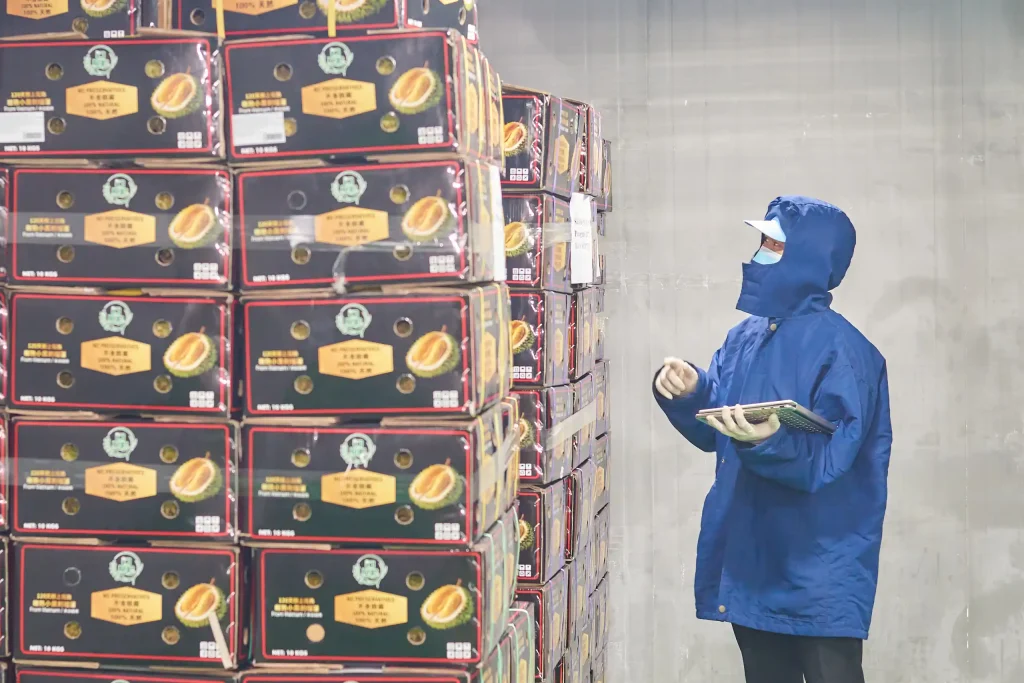
A trading company sources durian from multiple farms and resells it, meaning quality consistency depends on those farms rather than on the trading company itself. When problems occur, the trading company often lacks authority to resolve them at the source. An integrated supplier owns or directly manages growing areas, operates its own packing house, and controls cold chain logistics with its own refrigerated transport fleet.
Importers benefit from this model across three specific areas. First, quality consistency: integrated suppliers implement uniform post-harvest protocols across all product. Second, traceability: lot-level documentation becomes possible when one entity controls the entire chain. Third, accountability: when a shipment issue occurs, the integrated supplier can investigate and correct it within its own system rather than deflecting to external parties.
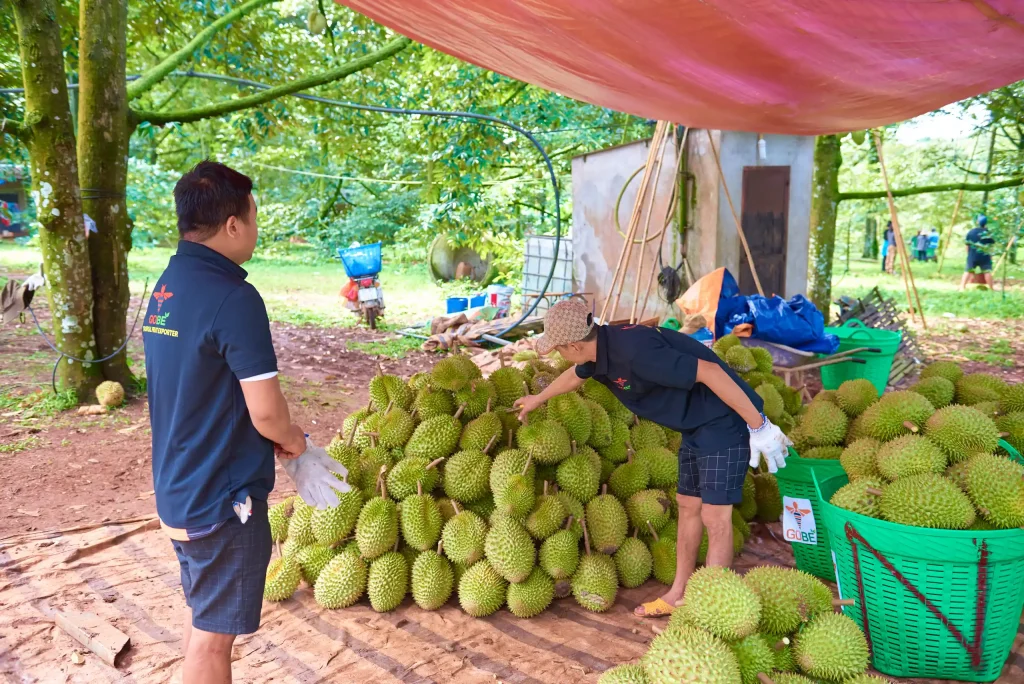
A supplier managing 230 or more hectares of growing area, combining company-owned farms with closely supervised partner farms, and operating packing houses positioned directly in the growing regions, represents the model that consistently delivers the reliability importers require for long-term commercial relationships.
A reliable wholesale durian supplier should hold a minimum of five internationally recognized certifications: GlobalGAP, FDA, ISO, GRASP, and Sedex, each addressing a distinct dimension of operational compliance. These certifications are not interchangeable, and importers should understand what each one verifies before using it as an evaluation criterion.
The table below maps each certification to its verified scope and primary market relevance, giving importers a direct comparison framework when screening prospective suppliers.
| Certification | What It Verifies | Primary Market Relevance |
|---|---|---|
| GlobalGAP | Good Agricultural Practices from field to packing | Europe, Japan, Gulf markets |
| FDA | U.S. food safety standards compliance | United States and FDA-regulated markets |
| ISO | Consistent quality management system across operations | All international markets |
| GRASP | Social and labor standards within the supply chain | European retail and supermarket buyers |
| Sedex | Ethical business conduct and responsible sourcing | UK, Germany, Netherlands retail supply chains |
Certifications are only meaningful when they are current and subject to regular third-party audits. Importers should request updated certificate copies with valid audit dates, not simply confirm that a supplier claims to hold them. A supplier holding all five certifications simultaneously has demonstrated readiness for the most demanding import markets, including Canada, the UAE, the United Kingdom, Germany, the Netherlands, Japan, and Kuwait.
A supplier’s cold chain capability should be assessed by verifying that the packing house is located within the growing region, that the supplier operates its own refrigerated transport fleet, and that temperature data can be provided continuously from harvest to port. Cold chain integrity directly determines shelf life outcomes at the destination market.
For whole durian fruit, standard storage temperature is 13 to 18 degrees Celsius, and maximum shelf life of 14 days is only achievable when this range is maintained without interruption from farm through packing to container loading. For Ri 6 peeled meat, the required temperature drops to 3 to 5 degrees Celsius, and shelf life is 7 days, making cold chain breaks even more consequential.
Importers should ask four specific questions when assessing cold chain capability. Does the supplier own refrigerated container trailers, or does it rely on third-party transport? Can the supplier provide temperature logs for each shipment? Is the packing house located in the growing region, enabling processing within 12 hours of harvest? Does the packing house operate under ISO-certified quality management protocols? A packing house positioned in a fruit-growing region such as the Mekong Delta, processing product within 12 hours of harvest and supported by a proprietary refrigerated fleet, represents the cold chain standard that protects shelf life and justifies the premium pricing importers pay for consistent quality.
There are four groups of evaluation criteria importers should apply: legal and certification standing, production capacity, product quality specifications, and logistics and service capability. Each group addresses a different risk category, and together they cover the full range of supplier reliability that determines import success.
Legal and certification criteria reduce compliance risk. Production capacity criteria address supply continuity risk. Product quality criteria protect commercial reputation in the destination market. Logistics criteria determine landed cost and shelf life outcome. The sections below develop each group in detail.
Product quality specifications provide importers with a standardized framework for comparing suppliers on measurable, objective criteria rather than on subjective claims about freshness or flavor. Requesting and comparing specifications across suppliers removes ambiguity from supplier screening.
The key specifications to request are sugar content, weight per piece, shelf life, storage temperature, box weight configurations, and shipping method compatibility. The table below presents verified specifications for the two primary durian varieties exported from Vietnam, Ri 6 and Monthong, giving importers documented benchmarks to cross-check against any supplier’s commercial proposal.
| Specification | Ri 6 Whole Fruit | Ri 6 Peeled Meat | Monthong Whole Fruit |
|---|---|---|---|
| Sugar Content (%) | 30 to 40 | 32 to 40 | 30 to 38 |
| Size per Piece | 1.8 to 4.5 kg | 500 g | 1.8 to 5.5 kg |
| Shelf Life | 14 days | 7 days | 14 days |
| Box Weight | 10 or 12 kg | 4 or 8 kg | 10, 12, or 18 kg |
| Shipping Method | Air and sea | Air only | Air and sea |
| Storage Temperature | 13 to 18°C | 3 to 5°C | 13 to 18°C |
When a supplier’s quoted specifications deviate significantly from these benchmarks, importers should request clarification and physical samples before committing to a purchase order. Suppliers who cannot provide clear specification documentation are a reliability risk regardless of how competitive their pricing appears.
A supplier’s ability to deliver consistently for 52 weeks per year is confirmed by three indicators: total growing area under management, diversification between company-owned and partner farms, and possession of packing facilities in multiple growing regions. Volume output alone is insufficient without these structural factors in place.
A supplier managing only company-owned farmland is constrained by the output of that land. A supplier combining owned growing areas with a network of certified partner farms can buffer seasonal variation and regional weather impacts. For importers requiring year-round supply, the partner farm network is a strategic asset, provided those farms are subject to the same quality standards as the owned land.
Packing house location diversity adds an additional layer of supply continuity. A supplier operating one packing house in a major fruit-growing region and a second facility near a major port city creates two complementary sourcing channels: the first optimized for freshness through proximity to orchards, the second capable of consolidating diverse products from multiple growing zones to meet the varied requirements of international buyers.
Importers can access reliable wholesale durian suppliers through four primary channels: international fresh produce trade fairs, direct sourcing from Vietnam-based integrated exporters, specialized B2B trade platforms, and industry network referrals. Each channel offers a different combination of verification depth and time investment.
The sections below detail how to use each channel effectively and which verification steps apply at each stage.
Yes, international fresh produce trade fairs are the most effective single channel for verifying a wholesale durian supplier’s reliability, because they allow importers to assess export orientation, presentation quality, and client base through direct interaction rather than remote due diligence alone. Suppliers who invest in exhibiting at major events have demonstrably committed resources to international market development.
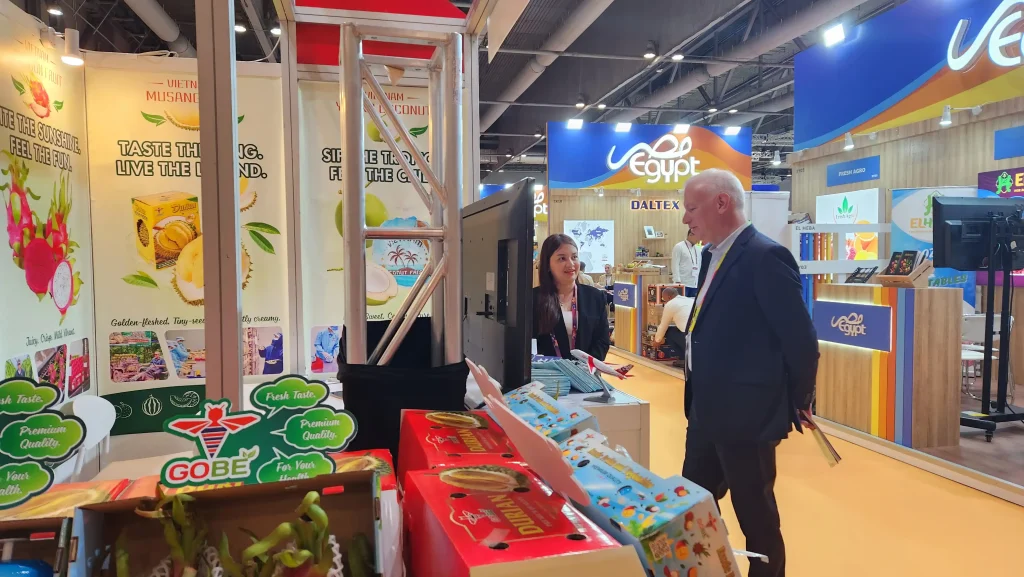
Suppliers exhibiting at Fruit Logistica in Berlin, Asia Fruit Logistica in Hong Kong, or Fruit Attraction in Madrid signal export seriousness, an established product portfolio, and the financial capacity to maintain consistent operations. Suppliers who appear only on B2B listing platforms without any international trade fair presence carry a higher verification burden for importers.
Importers attending these events should prepare a structured supplier evaluation checklist covering the following areas:
Importers who meet suppliers at international trade fairs can also assess team professionalism directly, review marketing materials, and initiate a commercial relationship in an environment where credibility is pre-filtered by the event organizers’ exhibitor selection process. According to industry consensus among fresh produce trade professionals, face-to-face verification at trade fairs significantly reduces due diligence time compared to remote-only sourcing.
Direct sourcing from Vietnam-based exporters with professional websites, complete certification portfolios, and documented export market lists is the most efficient online approach, supplemented by specialized platforms such as FreshPlaza and agricultural sector associations. Transparency in online presentation is a reliable signal of operational maturity.
When evaluating a supplier’s website, importers should look for four elements: a published list of export destination countries, downloadable or requestable certification documentation, product specification sheets with technical data, and identifiable leadership or contact personnel with verifiable professional profiles. Suppliers who present all four elements publicly demonstrate the transparency that underpins reliable partnership.
FreshPlaza serves as an industry news and supplier discovery platform for the global fresh produce trade and surfaces credible exporters through editorial coverage and company profiles. An exporter featured in FreshPlaza editorial content, such as coverage of Vietnamese tropical fruit and vegetable export growth, has undergone at least a baseline level of journalistic verification. Importers can use this as a supplementary credibility signal when building their supplier shortlist.
Importers can negotiate the best price from a wholesale durian supplier by applying four strategies simultaneously: committing to long-term volume agreements, planning purchases around seasonal availability, optimizing shipping method selection to reduce logistics costs, and building partnership relationships that motivate suppliers to offer preferential pricing. Each strategy contributes independently and compounds when applied together.
The sections below analyze each strategy in detail and provide specific data points importers can use as negotiation inputs.
Yes, higher volumes lead to better prices, but only when the volume commitment is accompanied by a clear, confirmed shipment schedule rather than an unstructured promise of future orders. Volume without planning certainty has little value from a supplier’s operational standpoint.
Suppliers need to plan harvest timing, allocate packing house labor, and book refrigerated container slots well in advance of each shipment date. A volume commitment without a defined monthly or quarterly shipment calendar does not give the supplier the planning certainty needed to offer meaningful price reductions. An annual supply agreement with agreed monthly shipment windows enables the supplier to optimize production planning, reduce per-unit processing costs, and pass a portion of those savings to the importer.
Importers should structure negotiation proposals around an annual supply agreement specifying the following:
This level of specificity transforms a volume promise into an operational plan, which is the foundation for genuine price concessions.
Seasonal availability directly determines durian wholesale pricing because supply volume and price move inversely: high season means abundant supply and lower prices, while low season means restricted supply and higher prices regardless of negotiation leverage. Planning purchases around this calendar is one of the highest-impact cost optimization strategies available to importers.
The table below maps the seasonal calendar for both Ri 6 and Monthong, showing the months when pricing is most competitive and when supply becomes constrained. Importers should use this calendar to plan volume concentration and forward purchase commitments.
| Variety | High Season (Best Pricing) | Low Season (Higher Pricing) |
|---|---|---|
| Ri 6 | April to July | January to March and August to December |
| Monthong | May to September | January to April and October to December |
The strategic implication for importers is to avoid single-variety dependency. An importer sourcing only Ri 6 faces seven combined months of low season annually from August through March. By integrating Monthong into the supply plan, the importer extends access to high-season pricing across a combined period from April through September while maintaining year-round supply continuity.
Box weight selection also affects unit cost. Monthong packed in 18-kilogram boxes typically yields a lower cost per kilogram than the same variety packed in 10-kilogram boxes, because larger box configurations reduce per-unit packaging and handling costs. Importers whose destination market distribution logistics can accommodate 18-kilogram boxes should factor this into pricing negotiations.
Sea freight is the correct choice for optimizing wholesale durian landed cost when the product is whole fruit with a 14-day shelf life, while air freight is reserved for Ri 6 peeled meat with its shorter 7-day shelf life. Choosing the wrong method adds unnecessary cost that compounds across high-volume import programs.
Whole fruit for both Ri 6 and Monthong can be shipped by either air or sea, but the cost differential between the two methods is substantial. Sea freight rates per kilogram are significantly lower than air freight rates, making sea the natural choice for high-volume whole fruit shipments where the 14-day shelf life provides sufficient transit time for most destination markets in Europe, the Middle East, and Asia.
Air freight remains necessary for Ri 6 peeled meat, which carries only a 7-day shelf life and requires continuous storage at 3 to 5 degrees Celsius throughout transit. Importers who want to offer peeled meat products must account for the air freight premium in their product pricing and margin calculations before committing to this format with retail or distribution partners.
The practical optimization strategy is to anchor the majority of import volume in whole fruit via sea freight, using air freight selectively for peeled meat formats that command sufficient retail margin to absorb the logistics premium.
Ri 6 excels in sugar intensity and is preferred in Southeast Asian and select European markets, while Monthong leads in fruit size and consistency, making it the dominant choice for the Middle East, Japan, and large-format retail across multiple regions. Not every supplier grows or exports both varieties, which means variety selection directly determines which suppliers qualify for a sourcing shortlist.
Monthong whole fruit is better suited for long-distance sea freight when large piece size and high-volume packaging are required, while Ri 6 whole fruit is equally viable for sea freight but targets different retail configurations and market preferences. Both varieties qualify for sea freight on shelf life grounds, but they serve different commercial purposes at destination.
Both varieties share the same 14-day shelf life for whole fruit and the same storage temperature range of 13 to 18 degrees Celsius. Monthong’s larger piece size of 1.8 to 5.5 kilograms per piece and its availability in 18-kilogram box configurations make it more commercially efficient for container-load sea shipments destined for wholesale distribution in Middle Eastern and Japanese markets. Ri 6 peeled meat at 500 grams per unit with a 7-day shelf life is restricted to air freight, requiring importers to plan separate logistics streams for whole fruit and processed formats.
Suppliers must maintain two distinct cold chain temperature zones to handle both product types correctly: 13 to 18 degrees Celsius for whole fruit and 3 to 5 degrees Celsius for peeled meat. Importers should confirm that a prospective supplier’s packing house and refrigerated transport fleet are equipped to handle both temperature ranges before committing to a mixed-format supply agreement.
A supplier’s farm-to-port traceability system directly affects import compliance by enabling faster customs clearance, satisfying phytosanitary documentation requirements, and providing the evidence chain needed to resolve quality disputes efficiently. Traceability capability has shifted from a buyer preference to a market entry requirement in the European Union, the United States, and Japan.
These markets increasingly require lot-level traceability documentation tracing each shipment back to its specific growing area, harvest date, and processing batch. Suppliers without this capability create compliance delays and potential rejection risk for importers in these markets. Suppliers with full traceability, including cold chain temperature logs integrated with lot documentation, reduce customs processing friction and demonstrate the operational maturity that regulators and retail buyers increasingly mandate.
Importers should request three specific documents during supplier evaluation:
Suppliers who participate in international trade fairs such as Fruit Logistica, Asia Fruit Logistica, and Fruit Attraction and who hold a complete certification portfolio including GlobalGAP, FDA, ISO, GRASP, and Sedex are the suppliers most likely to have already invested in the traceability infrastructure that modern import compliance demands.
Gobeimex — Elevating Vietnamese Produce, Connecting Global Markets.
GOLDEN BEE IMPORT EXPORT COMPANY LIMITED