Subtotal $0.00

Thailand produces the most durian in the world, holding the largest share of global output by annual volume, followed by Indonesia, Malaysia, Vietnam, and the Philippines. Thailand’s lead is built on decades of large-scale cultivation, advanced agricultural infrastructure, and a fully developed export supply chain serving markets across Asia, Europe, and the Middle East.
Comparing the top durian-producing countries reveals clear differences in production volume, cultivated area, export capacity, and market positioning. Thailand leads in raw tonnage and fresh fruit exports, Indonesia holds vast growing land but consumes most of its yield domestically, Malaysia commands premium pricing through exclusive varieties like Musang King, and Vietnam is scaling rapidly with exceptional growth in both production area and certified export volume.
Beyond production rankings, the global durian trade is shaped by variety, food safety standards, and the ability to meet international certification requirements. Each major producing country carries a distinct identity in the world durian market, from Thailand’s commercially optimized Monthong to Vietnam’s rising Ri6, and the sections below examine every dimension in full detail.
The five largest durian-producing countries are Thailand, Indonesia, Malaysia, Vietnam, and the Philippines, with Thailand holding the top position by a considerable margin in annual production volume. To understand the full scope of global durian supply, each major producer must be examined in context, covering where they grow, how much they produce, and what share of the global market they represent.
Thailand is the world’s number one durian producer, contributing an estimated 700,000 to over 1,000,000 metric tons per year depending on the season, which represents roughly 30 to 40 percent of total global durian output. This dominance is the result of systematic agricultural development over several decades, with cultivation concentrated in the eastern and southern regions of the country.
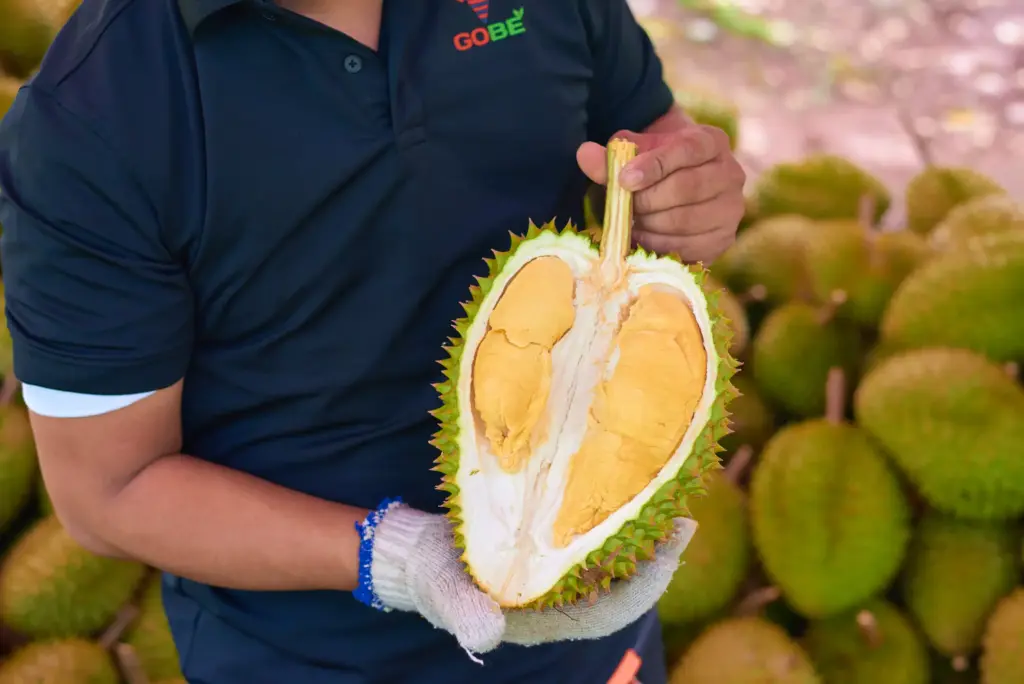
Thailand’s core durian-growing provinces include Chanthaburi, Rayong, and Chumphon, which collectively account for a substantial proportion of national output.
According to Thailand’s Office of Agricultural Economics (2023), durian ranks among the country’s top agricultural export commodities, with export revenue exceeding USD 4 billion in peak years.
Vietnam is firmly among the top five durian-producing countries in the world, growing rapidly in both production area and export volume since the early 2020s, making it one of the most significant agricultural developments in Southeast Asia. Vietnam’s primary durian-growing regions span both the Mekong Delta and the Central Highlands.
Key provinces reflect distinct growing strengths across climate zones and soil profiles.
According to Vietnam’s Ministry of Agriculture and Rural Development (2024), annual production has risen to several hundred thousand metric tons, positioning Vietnam as the fourth or fifth largest durian producer globally depending on the measurement year.
The top durian-producing countries differ substantially across three key dimensions: annual production volume, cultivated area, and export capacity, with Thailand leading across most metrics while other countries occupy distinct competitive positions. Moving from raw numbers to comparative structure reveals which countries compete on volume, which compete on value, and which are still building their export platforms.
The table below compares the five major durian-producing countries across estimated production volume, approximate cultivated area, primary export markets, and global market positioning, drawing on available agricultural trade data and national statistics as of the most recent reporting periods. This comparison gives importers and buyers a reliable reference for sourcing decisions and supply chain planning.
| Country | Est. Annual Production | Cultivated Area | Primary Export Markets | Market Positioning |
|---|---|---|---|---|
| Thailand | 700,000 to 1,000,000+ metric tons | ~700,000 hectares | China, Hong Kong, Japan, South Korea | Volume leader, fresh export dominant |
| Indonesia | 400,000 to 600,000 metric tons | Large, fragmented | Domestic consumption dominant | High production, low export |
| Malaysia | 300,000 to 450,000 metric tons | ~70,000 to 90,000 hectares | China, Singapore, Hong Kong | Premium segment, frozen and fresh |
| Vietnam | 200,000 to 400,000+ metric tons (growing fast) | 150,000+ hectares | China (formal channels from 2022) | Emerging challenger, rapidly scaling |
| Philippines | 60,000 to 120,000 metric tons | Smaller, regional | Domestic, limited ASEAN exports | Niche producer, local consumption focus |
Thailand produces the most in absolute terms, but Vietnam represents the highest growth trajectory among all five countries. Indonesia has substantial raw output but lacks the export infrastructure to convert production into significant international revenue, while Malaysia has built a profitable niche around premium varieties rather than competing on volume.
Thailand grows the most durian by a clear margin, producing more than one million metric tons in strong harvest years, while Indonesia and Malaysia lag significantly behind in total export-oriented output despite holding different scale advantages. The three countries represent three entirely different models of durian production and market strategy.
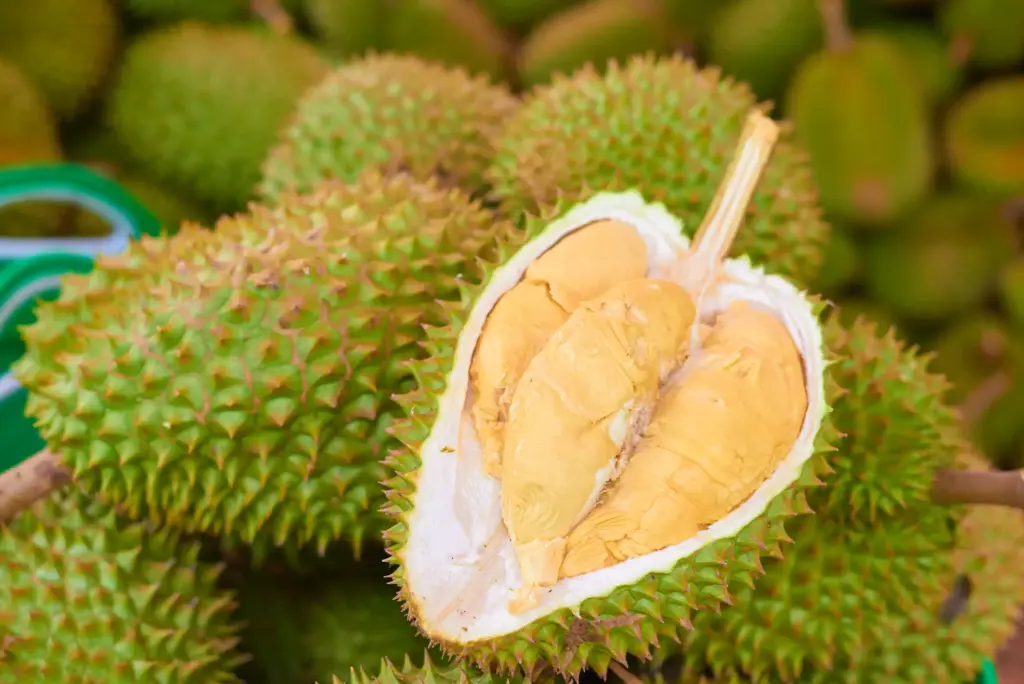
Indonesia’s total durian production can be comparable to or even exceed Malaysia’s in raw tonnage, but Indonesia consumes the vast majority domestically.
According to trade data compiled from Thailand’s Office of Agricultural Economics and Malaysia’s Department of Agriculture (2023), Thailand’s export volume exceeds Malaysia’s by a ratio of approximately four to one by weight, while Malaysia’s average export price per kilogram can exceed Thailand’s by a factor of two to three for premium varieties.
Thailand exports the most durian to global markets in terms of fresh fruit volume, but Malaysia holds an important niche in premium frozen durian exports, and Vietnam is rapidly increasing its share of formal durian exports to China. Total production and actual export volume diverge significantly across countries, making it essential to distinguish between the two metrics.
China absorbs an estimated 80 to 90 percent of all internationally traded durian by volume, and Thailand has historically supplied the majority of that demand.
According to Vietnam’s General Department of Customs (2023), durian became one of Vietnam’s most valuable single-commodity agricultural exports within a period of less than two years following formal market access to China.
Each major durian-producing country is distinguished by a unique combination of endemic varieties, flavor profiles, market positioning, and quality certification standards, which together determine how fruit from each origin is perceived and priced internationally. Moving beyond raw production numbers, the real story of global durian differentiation lies in what makes each country’s fruit taste, perform, and travel differently through the supply chain.
Each major durian-producing country is associated with specific varieties that are either exclusive to their growing regions or have become strongly identified with that country’s agricultural identity in international trade. Understanding variety differences is the foundation for understanding how each country competes for buyer preference and premium pricing.
The breakdown by country reveals contrasting strategies across breeding, commercialization, and consumer targeting.
Malaysia is globally associated with Musang King (D197) and Black Thorn (Duri Hitam), which connoisseurs worldwide consider the pinnacle of durian quality. Musang King is prized for its intensely bitter-sweet flavor, pale yellow flesh, small seeds, and high dry matter content. Black Thorn, sometimes called Ochee, offers reddish-orange flesh with a complex flavor profile that commands even higher prices in limited quantities. Both varieties are typically sold frozen or fresh at premium price points in China, Singapore, and Hong Kong.
Thailand is known for Monthong (Golden Pillow), by far the world’s most commercially traded fresh durian variety. Monthong is favored by exporters for its mild, sweet flavor, thick flesh with small seeds, and relatively low odor intensity, which makes it more accessible to first-time consumers and easier to manage in international logistics. Thailand’s breeding programs have prioritized varieties that travel well over long distances while retaining palatability, a deliberate trade-off that has maximized export reach.
Vietnam has developed Ri6 as its most recognized export variety, known for golden-yellow flesh, balanced sweetness and bitterness, and a high flesh-to-seed ratio. Vietnam also grows the Dona variety, a localized adaptation of Thai Monthong, and the Cai Mon durian from Ben Tre province. Vietnamese varieties have improved substantially through government-supported breeding programs and private sector investment, and the best examples are increasingly competitive with premium Thai and Malaysian fruit on flavor.
Indonesia is home to dozens of endemic varieties, with Petruk and Bawor among the more recognized regional cultivars. Indonesian varieties tend to have stronger odor profiles and more complex, pungent flavors prized domestically but presenting challenges for export logistics and international market acceptance. Efforts to develop a structured export sector around premium domestic varieties are still in early stages.
Philippines grows durian primarily in the Davao Region of Mindanao, with the Puyat variety among the more commercially cultivated types. Philippine durian is consumed largely within the country, and the country’s export footprint in global durian trade remains small compared to the other major producers.
According to Malaysia’s Department of Agriculture (2022), Musang King accounts for the majority of Malaysia’s durian export revenue by value, even though it represents a fraction of total production volume by weight, illustrating how variety-driven premium positioning can generate disproportionate commercial returns.
Yes, Vietnam is becoming a genuine and credible challenger to Thailand’s dominance in global durian exports, particularly in the critical Chinese import market, and the pace of this challenge has accelerated significantly since 2022. The most defining event in Vietnam’s durian export trajectory was the signing of a bilateral protocol between Vietnam and China in July 2022, granting Vietnam official authorization to export fresh durian to China through formal customs channels.
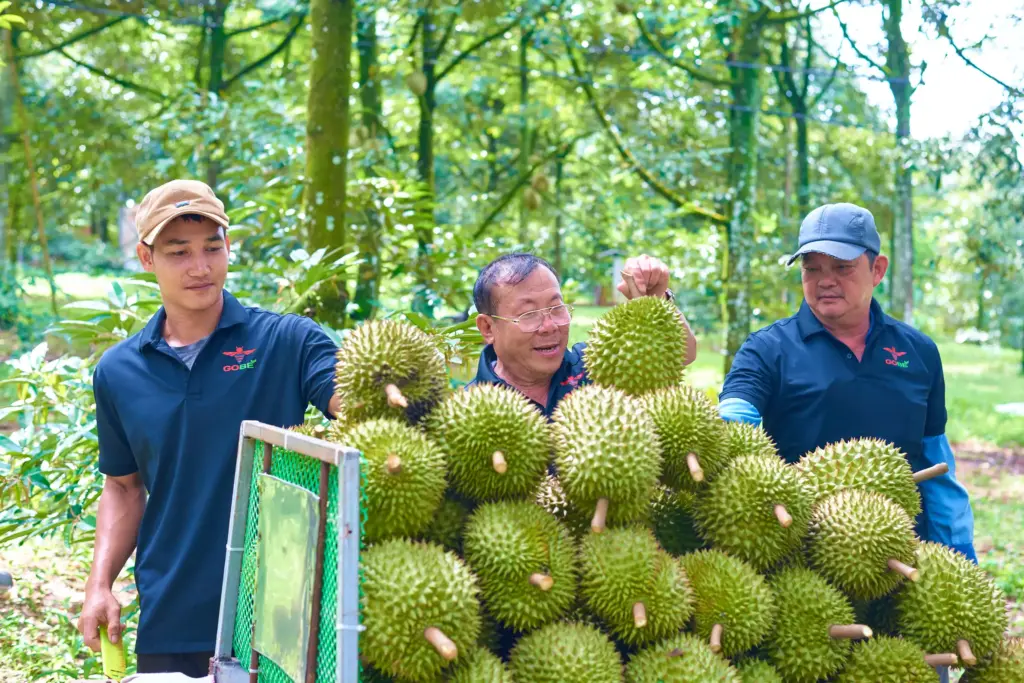
Before this agreement, Vietnamese durian entering China was either consumed domestically, traded informally, or moved through unofficial channels, none of which contributed to building a sustainable, high-value export industry.
Vietnam’s exporters have also invested significantly in meeting international quality standards, pursuing GlobalGAP certification for growing areas, ISO-certified packing operations, and FDA-compliant food safety practices. A representative example of this standards-driven approach is Gobeimex (Golden Bee Import Export Co., Ltd.), a Vietnamese fresh produce exporter holding certifications including GlobalGAP, GRASP, ISO, FDA, and Sedex. With packing facilities in Tien Giang that process fruit within 12 hours of harvest through an unbroken cold chain, and supplying markets across North America, Europe, the Middle East, and Asia year-round for 52 weeks annually, Gobeimex represents the kind of vertically integrated, certification-backed export operation that is elevating Vietnamese tropical produce to the level required by the most demanding international buyers.
According to Vietnam’s General Department of Customs (2024), durian has become Vietnam’s single highest-value agricultural export commodity, surpassing seafood categories in peak quarters and cementing Vietnam’s position as a structurally permanent competitor in the global durian trade.
Thailand’s position as the largest durian producer globally remains secure in the near term, but it faces real structural pressures from Vietnam’s rapid expansion, Malaysia’s premium brand strength, and evolving buyer demands for certified supply chains. Understanding the nature of these pressures provides a more complete picture of where the global durian market is heading.
Vietnam cannot yet match Thailand in total durian export value, but the gap is narrowing faster than most industry forecasts anticipated, driven by formal market access to China, geographic proximity advantages, and rapid investment in certified production infrastructure. The conditions for a meaningful challenge are now structurally in place.
Vietnam’s structural advantages over Thailand in the Chinese market are permanent rather than cyclical.
According to the United Nations Food and Agriculture Organization (FAO) agricultural outlook data and regional trade reports (2023), Vietnam’s durian export growth rate is the fastest of any major fresh fruit category in Southeast Asia, outpacing all comparable commodity export expansions in the region over the same period.
Malaysia’s premium variety strategy limits its total export volume but generates higher revenue per kilogram than any other major durian-producing country, making it a profitable but structurally constrained competitor in global markets. This positioning is a deliberate choice rather than a limitation, built around Musang King and Black Thorn varieties that cannot be replicated at scale in other countries without decades of cultivar development.
Malaysia’s premium model presents specific trade-offs that define its global role.
According to Malaysia’s Department of Agriculture (2022), Musang King commands export prices averaging three to five times the price per kilogram of Thai Monthong in the Chinese retail market, a price premium that justifies the country’s strategic focus on quality over quantity.
Gobeimex, elevating Vietnamese produce and connecting global markets.