Subtotal $0.00

Durian B2B export delivers the highest unit value among fresh tropical fruits in Southeast Asia, with global demand accelerating across China, the Middle East, Europe, and North America. For importers, distributors, and supermarket buyers seeking a reliable supply chain, mastering the full procurement journey from sourcing certified growing areas to navigating cold chain logistics and phytosanitary documentation determines whether a partnership delivers consistent profitability or costly shipment failures.
Sourcing premium durian for export begins with identifying vetted growing regions and evaluating exporters against internationally recognized quality benchmarks. B2B buyers must assess growing area certifications, packing house capacity, minimum order flexibility, and an exporter’s ability to supply year-round, because supermarket buyers and distributors cannot afford seasonal supply gaps. Exporters like Gobeimex (Golden Bee), with 12+ years of experience supplying durian and fresh produce to 10+ global markets, demonstrate exactly what a reliable B2B supply chain looks like in practice.
Quality control and global logistics form the two pillars that protect the value of every durian shipment after sourcing is complete. From GlobalGAP-certified farms and pesticide residue testing at the packing house to unbroken cold chain management and market-specific export documentation, each step requires precision. This guide covers every stage of the durian B2B export process to help importers, distributors, and retail buyers make confident, informed procurement decisions.
Durian B2B export is a structured commercial trade model where certified exporters supply fresh or frozen durian in bulk to international importers, distributors, and supermarket chains, operating under formal contracts, quality standards, and consistent volume commitments that distinguish it from retail or spot trading. To understand why this market commands serious attention, it helps to examine what sets durian B2B apart from other fresh produce categories and who benefits most from entering this supply chain.
Durian B2B export operates under long-term supply agreements, formal quality specifications, and structured procurement cycles rather than one-off transactions or retail-facing sales. This structural difference creates predictability for both the importer and the exporter that spot trading cannot replicate.
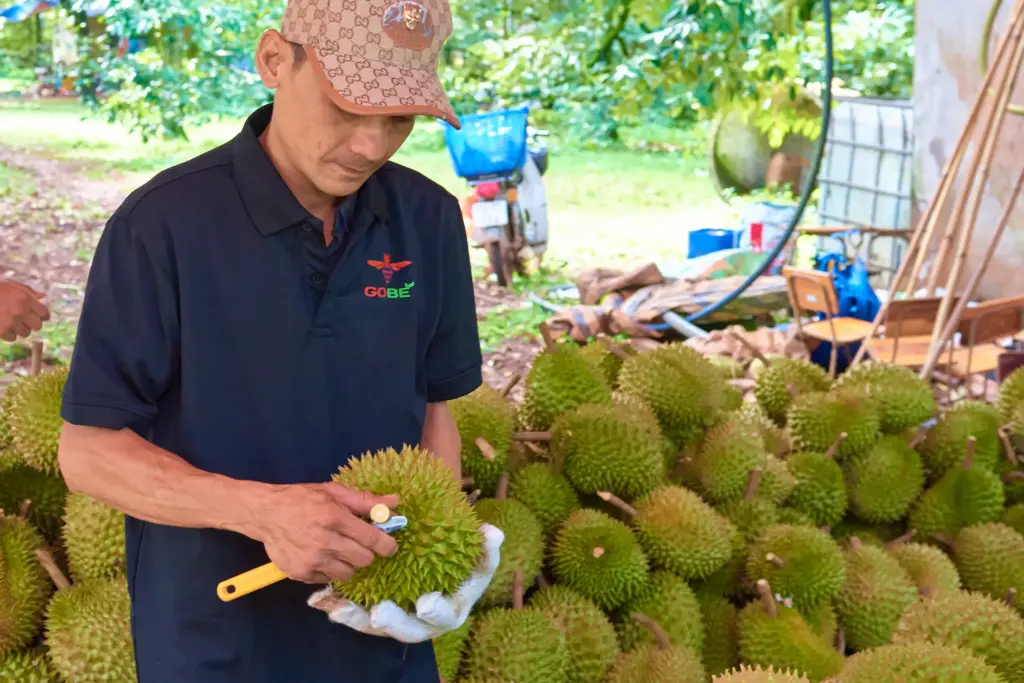
In a B2B model, an importer or distributor agrees on consistent volume, packaging standards, delivery schedules, and pricing terms directly with a certified exporter. Spot trading involves purchasing available inventory opportunistically, which exposes buyers to inconsistent quality, unreliable volume, and price volatility. Retail-facing export targets end consumers through e-commerce or individual storefronts, requiring entirely different labeling, packaging, and logistics configurations. B2B export demands that suppliers hold international certifications, maintain auditable supply chains, and demonstrate the operational capacity to fulfill recurring purchase orders across 52 weeks per year.
Durian commands the highest unit value among fresh tropical fruits in international trade, driven by its premium price positioning, strong cultural demand across East and Southeast Asia, and rapidly growing interest from Western markets. This combination of factors makes it a category where entering as a B2B buyer at scale carries significant margin potential.
The global durian market was valued at over USD 15 billion in 2023 and is projected to grow at a compound annual growth rate exceeding 6% through 2030, according to multiple agri-trade research institutions tracking Southeast Asian commodity exports. China remains the dominant import market, absorbing more than 90% of Thailand’s durian exports at peak season. Demand from the United Arab Emirates, Germany, the Netherlands, the United Kingdom, Canada, and Japan is growing at double-digit rates year over year. For B2B importers, this means entering a high-margin, demand-driven category where certified, reliable suppliers are still relatively scarce compared to the scale of market opportunity.
The durian B2B supply chain involves four core participants: growing areas and farms, packers and exporters, importers and distributors, and supermarkets or food service operators. Each link performs a specific function, and weakness at any stage creates cascading quality or delivery failures.
Farms cultivate certified fruit; packers and exporters process and prepare shipments to international standards; importers and distributors receive and redistribute in-market; supermarkets or food service operators sell to end consumers. Exporters who own or directly manage growing areas offer B2B buyers a measurable advantage: fewer intermediaries, faster traceability, and more rigorous quality control from the field to the shipping container. Gobeimex (Golden Bee Import Export Co., Ltd.) manages 30+ hectares of company-owned farmland and coordinates with 200+ hectares of partner farms across Vietnam’s key growing regions, providing buyers with the supply depth and traceability that purely broker-dependent exporters cannot match.
B2B buyers source premium durian through four key areas: selecting certified growing regions, evaluating owned versus partner farm networks, establishing proximity between harvest sites and packing facilities, and verifying year-round supply capacity. Each dimension directly determines whether a durian supply relationship holds up under real-world commercial pressure.
Effective sourcing combines geographic knowledge with rigorous supplier assessment. Below is a detailed breakdown of each dimension that separates a resilient B2B sourcing arrangement from one that fails under commercial pressure.
Three dominant durian varieties drive B2B export demand: Monthong from Thailand, Ri6 and Dona from Vietnam, and Musang King from Malaysia, each commanding different premiums and targeting distinct import markets. Aligning variety selection with target market preferences directly affects margin and sell-through velocity for downstream distributors.
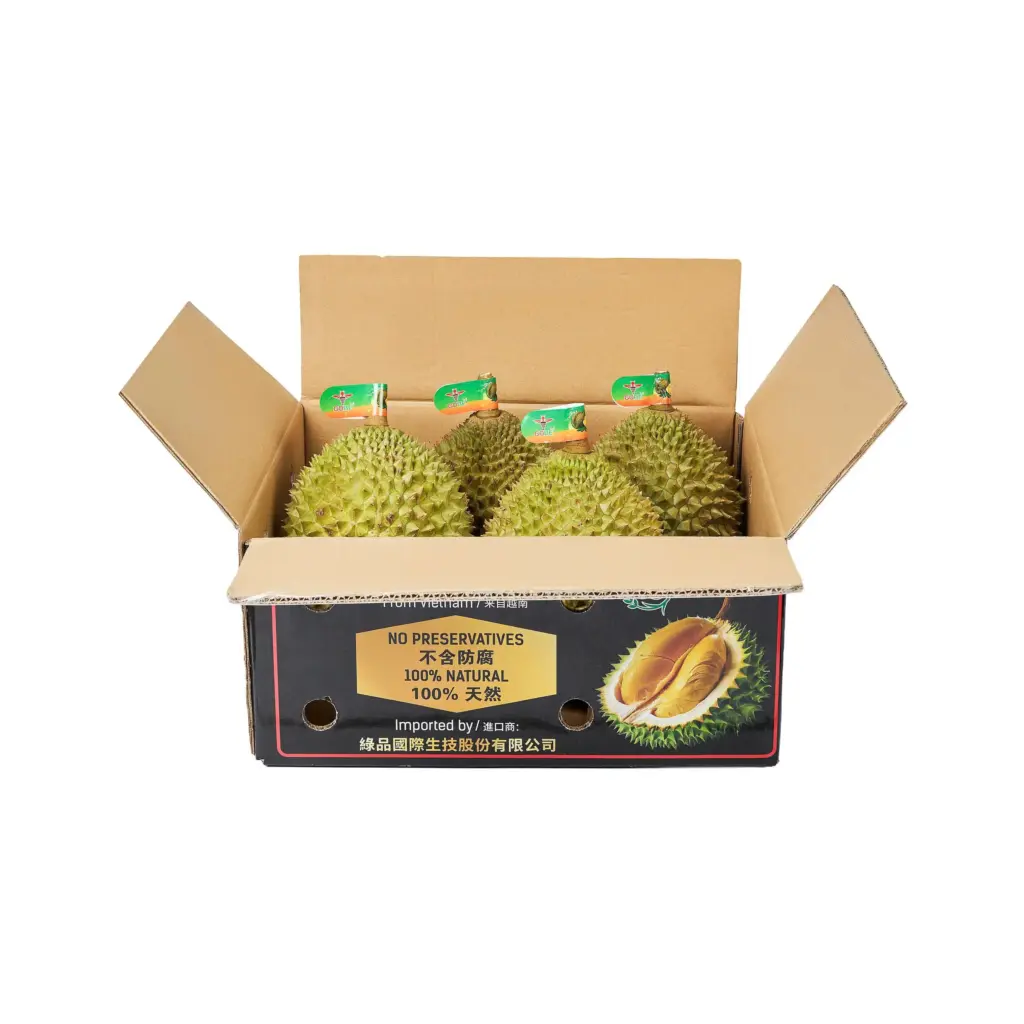
The table below summarizes the key commercial characteristics of each variety across flavor profile, average fruit weight, harvest window, and primary B2B import market to help buyers align sourcing decisions with their target customer base.
| Variety | Origin | Flavor Profile | Average Weight | Primary B2B Markets |
|---|---|---|---|---|
| Monthong | Thailand | Mild, creamy, low bitterness | 3 to 5 kg | China, Japan, Southeast Asia |
| Ri6 | Vietnam | Rich, buttery, slightly bitter | 2 to 3.5 kg | Middle East, EU, Canada |
| Dona | Vietnam | Sweet, thick pulp, minimal fiber | 2.5 to 4 kg | Europe, UK, Maldives |
| Musang King | Malaysia | Intensely bitter, complex aroma | 1.5 to 3 kg | China, Singapore, premium Asia |
Vietnamese varieties Ri6 and Dona are increasingly preferred by Middle Eastern and European supermarket buyers because their flavor intensity aligns with premium consumer expectations, and Vietnam’s proximity to major shipping routes enables faster transit times compared to Malaysian alternatives. A notable emerging trend is the development of high-yield hybrid varieties bred for consistent fruit size and elevated pulp-to-seed ratios, reducing waste during industrial processing and gaining traction in the frozen durian pulp segment targeting food service and manufacturing B2B buyers.
B2B buyers should evaluate durian exporters across five critical criteria: international certifications held, growing area ownership and scale, packing house infrastructure, cold chain self-sufficiency, and verified year-round supply capacity. Following this framework protects buyers from the most common B2B sourcing failures, including mid-season supply shortages, shipment rejections at the destination port, and cold chain breaks that compromise shelf life.
International Certifications: The exporter must hold, at minimum, GlobalGAP for agricultural practices and a valid Phytosanitary Certificate issued by the national plant protection authority. Certifications such as ISO, FDA, GRASP, and Sedex signal a higher level of operational maturity and are increasingly required by European and North American supermarket chains as non-negotiable supplier conditions.
Growing Area Scale and Ownership: Exporters who own or directly manage their growing areas offer greater traceability and more responsive quality control than those relying entirely on open-market procurement. Gobeimex operates 30+ hectares of company-owned farms and coordinates with 200+ hectares of GlobalGAP-certified partner farms, giving it the raw material depth to fulfill consistent B2B orders without depending on volatile spot market availability.
Packing House Proximity to Growing Areas: The closer the packing house is to the harvest site, the fresher the product at the point of packing. Exporters with packing facilities located directly within key growing regions, such as Tien Giang in Vietnam’s Mekong Delta, can process fruit within 12 hours of harvest, a benchmark that directly preserves pulp quality, color, and aroma for international transit.
Cold Chain Infrastructure: B2B buyers should verify whether the exporter owns refrigerated transport vehicles or relies on third-party logistics providers, because third-party handoffs increase the risk of temperature deviation during inland transit.
Year-Round Supply Capacity: Supermarkets and distributors require stable weekly or biweekly replenishment. Exporters capable of guaranteeing 52-week-per-year supply through a combination of staggered harvest calendars across multiple farm partnerships and frozen inventory buffers are significantly more valuable B2B partners than those constrained to single-season availability.
Red flags to avoid include exporters who cannot provide current certification documents on request, those without verifiable packing house facilities, suppliers offering MOQ flexibility without clarifying sourcing mechanisms, and any partner unwilling to allow pre-shipment quality audits.
Quality control in durian export is managed across three sequential checkpoints: at the certified growing area, during packing house processing, and at pre-shipment inspection before loading, each governed by internationally recognized standards including GlobalGAP, ISO, FDA, and Sedex. For B2B buyers, a rigorous quality control system serves two practical purposes: it minimizes the risk of destination-port rejection, and it protects the importer’s reputation with downstream retail or distribution customers who expect consistent product standards across every delivery.
Five internationally recognized certifications are required to access major B2B import markets: GlobalGAP, FDA registration, EU Phytosanitary Certificate compliance, Sedex membership, and GRASP assessment, each addressing a different dimension of agricultural, food safety, and ethical compliance. The breakdown below explains what each certification requires and why it matters to B2B buyers sourcing from Vietnam or other Southeast Asian origins.
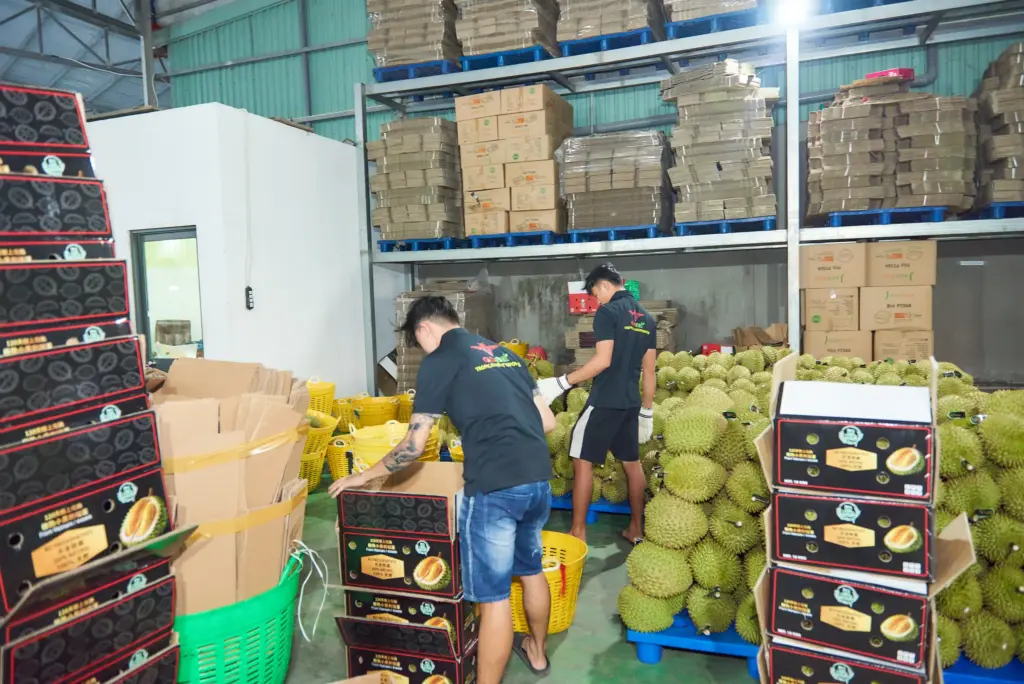
GlobalGAP is the foundational certification for durian growing areas, covering soil management, water use, fertilizer and pesticide application records, worker hygiene, and post-harvest handling. It is mandatory for accessing European supermarket chains and is increasingly requested by Middle Eastern and Japanese importers.
FDA Registration and Prior Notice are required for any fresh produce shipment entering the United States. Exporters must be registered with the U.S. Food and Drug Administration and submit prior notice of each shipment before it arrives at a U.S. port of entry. The FDA’s FSMA Produce Safety Rule mandates that growing areas meet specific water quality, worker training, and sanitary standards that align closely with GlobalGAP requirements but include additional documentation requirements for the American market.
EU Phytosanitary Certificate and MRL Compliance are non-negotiable for durian entering European Union member states. The certificate must be issued by Vietnam’s Plant Protection Department and must confirm that the shipment meets the EU’s Maximum Residue Levels for pesticide chemicals. EU MRL thresholds are among the strictest globally, making pre-shipment pesticide residue testing an essential step for any exporter targeting European buyers.
GRASP (GlobalGAP Risk Assessment on Social Practice) evaluates labor conditions, worker rights, and social compliance at the farm level. European and British supermarket buyers increasingly require GRASP alongside GlobalGAP as a condition of supplier approval, reflecting growing consumer and regulatory pressure around ethical sourcing.
Sedex Membership provides a shared data platform where exporters disclose audited information on labor practices, health and safety, environmental performance, and business ethics. B2B buyers supplying large supermarket chains in the UK, Germany, and Canada routinely require that suppliers hold an active Sedex membership and complete a SMETA (Sedex Members Ethical Trade Audit) before contracts are finalized.
At the durian packing house, quality checks cover five sequential stages before export: visual and sensory inspection, grading and sizing, pesticide residue and microbiological testing, packaging and labeling compliance verification, and final pre-shipment weight audit. Each stage serves a distinct function in ensuring that the product reaching the import market matches the specifications agreed in the B2B purchase order.
Visual and Sensory Inspection involves trained quality control staff examining each fruit for shell color uniformity, spine integrity, signs of surface cracking or pest damage, and ripeness stage. Durian intended for long-distance sea freight is typically harvested at 75 to 80% ripeness to allow natural ripening during transit without over-softening before reaching the consumer.
Grading and Sizing ensures that fruit weight and dimensions conform to the buyer’s specifications. European buyers may specify fruit between 2.5 and 4 kg with no visible defects, while Middle Eastern buyers may accept a broader size range but require a minimum pulp weight percentage per fruit. This grading step directly determines the commercial value of each pallet and reduces post-arrival disputes.
Pesticide Residue Testing is conducted by accredited laboratories using standardized chromatographic analysis methods. For EU-bound shipments, exporters must test against EU MRL thresholds for each active pesticide compound used during cultivation, and test certificates must accompany export documentation for customs authorities at the destination port.
Packaging and Labeling Compliance varies by market. UAE and Gulf Cooperation Council shipments require Arabic-language labeling and Halal certification documentation where applicable. European shipments require country of origin, net weight, and exporter details in the language of the destination country. Japanese buyers often request additional product-of-origin traceability data printed on inner packaging.
The 12-Hour Harvest-to-Pack Benchmark is one of the most critical quality assurance measures in fresh durian export. Packing houses located directly within growing regions, such as Gobeimex’s Tien Giang facility in the heart of Vietnam’s Mekong Delta fruit-growing zone, can receive and process freshly harvested fruit within this 12-hour window, locking in peak aroma, pulp texture, and shelf life before refrigerated storage begins.
Durian export logistics follow a six-stage chain from farm to final destination: farm harvest, inland refrigerated transport to the packing house, packing and pre-cooling, port-bound reefer truck transport, ocean or air freight, and destination port clearance followed by in-market distribution. Two primary freight methods serve B2B durian shipments: sea freight via reefer container, preferred for high-volume orders on established trade lanes, and air freight, used for premium fresh product requiring faster transit or serving markets without direct ocean shipping connections.
Maintaining an unbroken cold chain is essential throughout the entire durian export journey, with fresh whole-fruit shipments requiring 13 to 15 degrees Celsius and frozen durian pulp or frozen whole fruit requiring minus 18 degrees Celsius or below. Cold chain integrity failures represent the single greatest risk factor in durian B2B export, and a temperature deviation sustained for even a few hours can lead to irreversible quality loss.
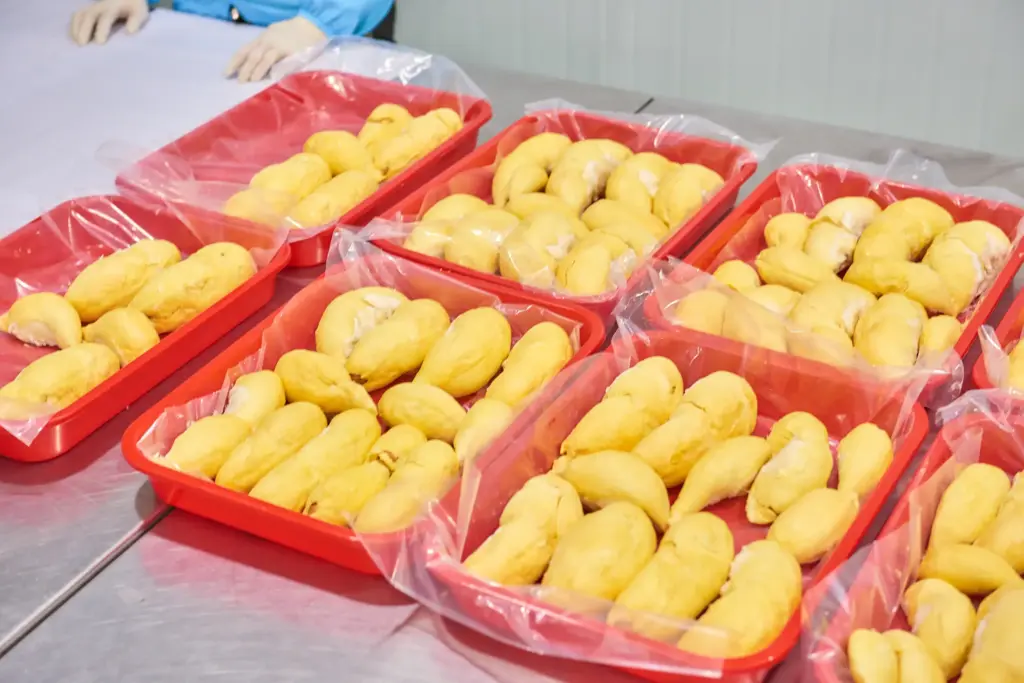
A temperature deviation of a few degrees Celsius during inland transport or container loading can accelerate ripening irreversibly, leading to over-softened fruit, fermentation, or total loss of commercial value upon arrival. The following components are required to maintain an unbroken cold chain across the full export journey.
Farm-to-Packing House Transport must use pre-cooled refrigerated vehicles. Exporters who operate their own fleet of refrigerated transport trucks, rather than relying on general cargo vehicles or third-party logistics, can monitor and document temperature conditions at every point during this leg. Gobeimex maintains a self-owned fleet of refrigerated container trailers that transport durian directly from growing areas to its Tien Giang packing house, eliminating the temperature risks associated with third-party handoffs.
Pre-Cooling and Packing House Storage bring fruit core temperature down to the target range before container loading. Skipping or shortening the pre-cooling phase is a common error that causes condensation inside reefer containers, accelerates fungal growth on the fruit surface, and shortens effective shelf life.
Reefer Container Standards for sea freight require active refrigerated containers capable of maintaining setpoint temperature within plus or minus 0.5 degrees Celsius throughout the voyage. Container integrity must be verified before loading, and data loggers placed inside containers record continuous temperature readings that can be shared with the B2B buyer as part of shipment documentation.
Shelf life reference benchmarks: fresh whole durian under controlled cold chain conditions achieves a shelf life of 3 to 5 weeks from harvest; frozen durian pulp at minus 18 degrees Celsius can maintain commercial quality for 12 to 18 months, making it a more logistics-flexible format for distant markets.
Six core export documents are required for all B2B durian shipments: the Phytosanitary Certificate, Certificate of Origin, Commercial Invoice, Packing List, Bill of Lading or Airway Bill, and the exporter’s quality or test certificates, with additional market-specific documents required depending on the destination. The breakdown below outlines each document’s purpose and the additional requirements imposed by key B2B import markets.
Phytosanitary Certificate is issued by Vietnam’s Plant Protection Department (MARD) following physical inspection of the shipment. It certifies that the durian consignment is free from regulated pests and diseases and meets the plant health standards of the importing country. This document is universally required and must accompany every shipment regardless of destination.
Certificate of Origin (C/O) confirms the product’s country of origin and is required for customs clearance at the destination port. For ASEAN member country trade, Form D is used to claim preferential tariff rates. For exports to non-ASEAN markets, Form B (general C/O) is issued by Vietnam’s Ministry of Industry and Trade.
Market-Specific Additional Documents include the EU Health Certificate for shipments entering European Union member states, FDA Prior Notice submitted electronically through the FDA’s PREDICT system for U.S.-bound shipments, and Halal Certificates for durian entering UAE, Kuwait, Saudi Arabia, and other Gulf Cooperation Council markets where Halal certification is required by importers or mandated by specific retail chains.
Processing Timeline Impact: Phytosanitary inspection in Vietnam typically requires 3 to 5 working days from application to certificate issuance. B2B buyers should factor this into delivery planning, because delays in documentation processing directly compress the product’s remaining shelf life upon arrival for perishable fresh durian shipments.
Frozen durian export outperforms fresh on logistics flexibility and shelf life, while fresh durian commands higher price premiums and stronger retail differentiation, making the optimal format choice dependent on the B2B buyer’s target market, distribution infrastructure, and customer segment. This question becomes relevant once a B2B buyer has understood the sourcing, quality control, and logistics fundamentals covered above, and is ready to make a strategic product format decision that affects purchasing cost, cold chain investment, and downstream pricing.
Blockchain traceability is becoming a competitive differentiator in durian B2B export, with QR-code-enabled tracking systems allowing importers to verify farm origin, harvest date, packing records, and cold chain history for every shipment lot in real time. European supermarkets and Japanese retail buyers are increasingly making supply chain transparency a supplier selection criterion rather than a value-added extra.
The EU Deforestation Regulation (EUDR), which entered enforcement in 2025, requires importers of agricultural commodities to demonstrate that products have not contributed to deforestation, making traceable supply chains a legal compliance requirement rather than merely a marketing feature. Vietnamese fresh produce exporters integrating farm-coded QR traceability systems into their packing house operations are better positioned to meet these requirements and win long-term contracts with compliance-focused B2B buyers. According to the European Commission (2024), EUDR applies to a broad range of agricultural commodities entering the EU and mandates documented supply chain due diligence as a condition of market access.
Durian exporters holding GRASP, Sedex, and ISO certifications alongside GlobalGAP gain a measurable competitive advantage in B2B markets where European, British, and Canadian supermarket buyers require ethical sourcing compliance as a non-negotiable contract condition. Sustainability certifications are no longer optional differentiation tools; they are standard contract prerequisites for B2B suppliers targeting regulated markets.
GRASP certification demonstrates that farm labor conditions meet internationally recognized social standards, while Sedex membership signals that the exporter has submitted to third-party ethical trade auditing, which major retail chains in the UK and Germany conduct as part of annual supplier evaluation. The emerging trend toward carbon footprint disclosure in agri-export is reshaping B2B negotiations, with some European buyers beginning to include maximum Scope 3 emissions thresholds in supplier contracts. Exporters like Gobeimex, which holds the full five-certification portfolio (GlobalGAP, GRASP, ISO, FDA, and Sedex), are positioned to meet these evolving requirements without requiring buyers to manage certification gaps in their supply chain.
Gobeimex (Golden Bee Import Export Co., Ltd.) is a Vietnam-based packer and exporter of premium fresh fruits and vegetables, including durian, with 12+ years of industry expertise, 5 international certifications (GlobalGAP, GRASP, ISO, FDA, Sedex), 230+ hectares of managed growing areas, and 52-week-per-year supply capacity serving importers, distributors, and supermarkets across 10+ global markets including Canada, UAE, UK, Germany, Netherlands, Japan, and Kuwait.
For B2B sourcing inquiries, partnership discussions, or product catalog requests, contact the Gobeimex team directly:
📩 Info@gobeimex.com | 🌐 gobeimex.com | 📞 +84 939 93 54 55