Subtotal $0.00

Custard apple and soursop both deliver 18–24% sugar content, making them the sweetest of the three fruits, while papaya leads in shelf life at 15 days compared to the 7-day window shared by the other two. Custard apple weighs between 220 g and 600 g per piece, soursop ranges from 0.8 kg to 2.0 kg, and papaya falls between 0.5 kg and 1.6 kg. Each fruit carries a distinct size profile, sweetness level, and packing format that importers must evaluate before finalizing a sourcing plan.
For buyers assessing supply continuity, the seasonal calendar is equally important. Custard apple maintains high-season availability across approximately eight months per year. Soursop concentrates its peak output in a four-month window from October through January. Papaya covers roughly seven high-season months and gains a logistics edge from its extended 15-day shelf life across longer shipping routes. Gobeimex supplies all three fruits 52 weeks per year through its GlobalGAP-certified growing network across the Mekong Delta.
This article compares all three fruits across the metrics that matter most in export trade: size classification, sugar content, seasonal calendar, packing format, storage requirements, and target market fit. Every section draws directly from Gobeimex’s verified product specifications and supply chain data, giving importers, distributors, and supermarket buyers a reliable reference for procurement decisions.
Custard apple, soursop, and papaya are three distinct tropical fruits native to Vietnam’s growing regions, each recognized internationally for unique flavor profiles, export-grade specifications, and strong commercial demand across Europe, the Middle East, North America, and Asia. The following sections introduce each variety’s defining characteristics and its position within Gobeimex’s export portfolio before the side-by-side comparison begins.
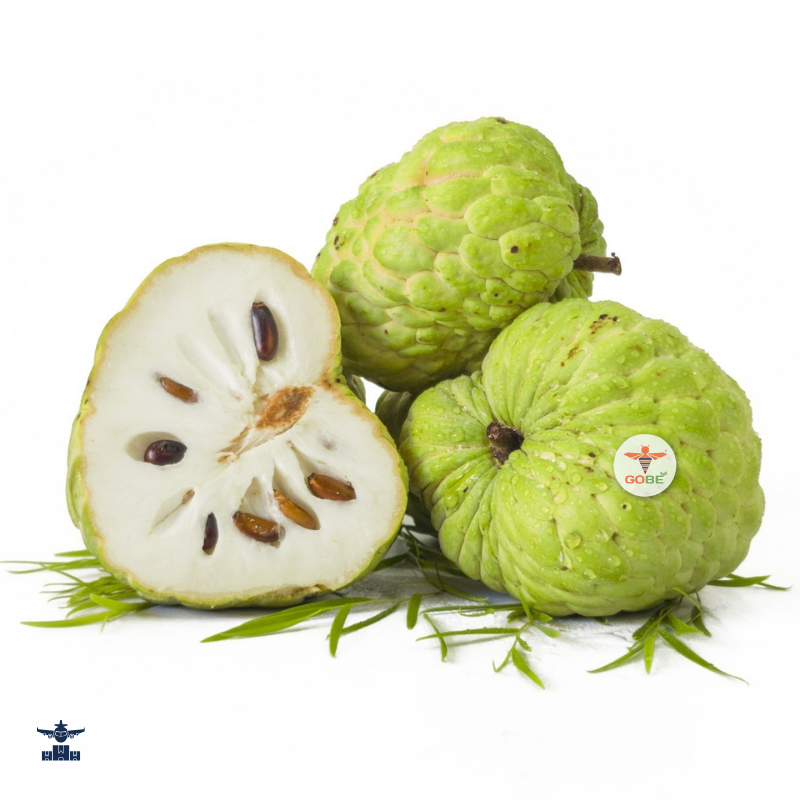
Custard apple (Annona squamosa) delivers one of the most intensely sweet flavor profiles among Vietnam’s exported produce, with sugar content consistently measured between 18% and 24% Brix in weights of 220–600 g per piece. Its characteristic granular-custard texture and intensely fragrant flesh drive strong demand in Middle Eastern and Asian markets where sweetness and aroma are key purchasing factors. From a logistics standpoint, custard apple is classified as a delicate fruit with a 7-day shelf life at 8–12°C.
Gobeimex packs custard apple at 2 pieces per inner pack to prevent bruising during air freight transit. Box weights are configured at either 2.5 kg for specialty retail accounts or 11 kg for wholesale distributors. Two size tiers give importers channel flexibility: small (220–350 g per piece) and large (400–600 g per piece).
Soursop (Annona muricata) is the heaviest of the three fruits, ranging from 0.8 kg to 2.0 kg per piece, and shares the same 18–24% Brix sweetness level as custard apple while delivering a very different tart-and-tropical sensory profile. Its flavor, which carries distinct citrus undertones alongside tropical sweetness, has driven consistent demand among diaspora communities in Europe and North America. Soursop is packed loose rather than individually wrapped, with box weights of 5 kg or 6 kg per carton.
All soursop shipments are conducted by air given the 7-day shelf life constraint at 8–12°C. Because soursop’s high season is concentrated from October through January, importers targeting this variety should secure advance allocation with Gobeimex before the season opens.
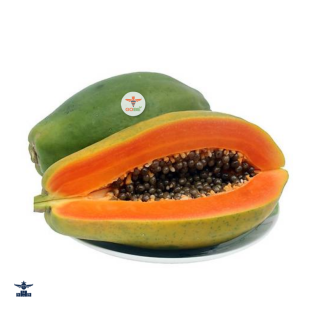
Papaya (Carica papaya) delivers a mild, honey-like sweetness of 15–18% Brix, making it the most approachable flavor profile of the three for diverse international palates, with a commercially significant shelf life of 15 days at 8–12°C. This extended window is more than double that of custard apple and soursop, expanding the range of feasible destinations and allowing shipment consolidation without the same urgency constraints. Papaya’s global recognition and broad culinary application across both fresh-cut retail and foodservice establish it as the most versatile fruit in Gobeimex’s highlighted portfolio.
Papaya is packed loose in boxes of 5 kg or 8 kg and shipped by air across all markets. Size options span from 0.5–1.1 kg per piece in the small tier to 1.2–1.6 kg per piece in the large tier. Its milder sweetness makes it the most universally accepted of the three across diverse consumer demographics worldwide.
Custard apple is the smallest unit of the three at 220–600 g per piece, soursop is the largest at 0.8–2.0 kg per piece, and custard apple and soursop tie for the highest sugar content at 18–24% Brix, both outperforming papaya at 15–18%. This section covers unit weight classifications, sugar content rankings, packing formats, and the practical implications of each metric for import channel planning. The table below enables direct comparison before each dimension is examined in detail.
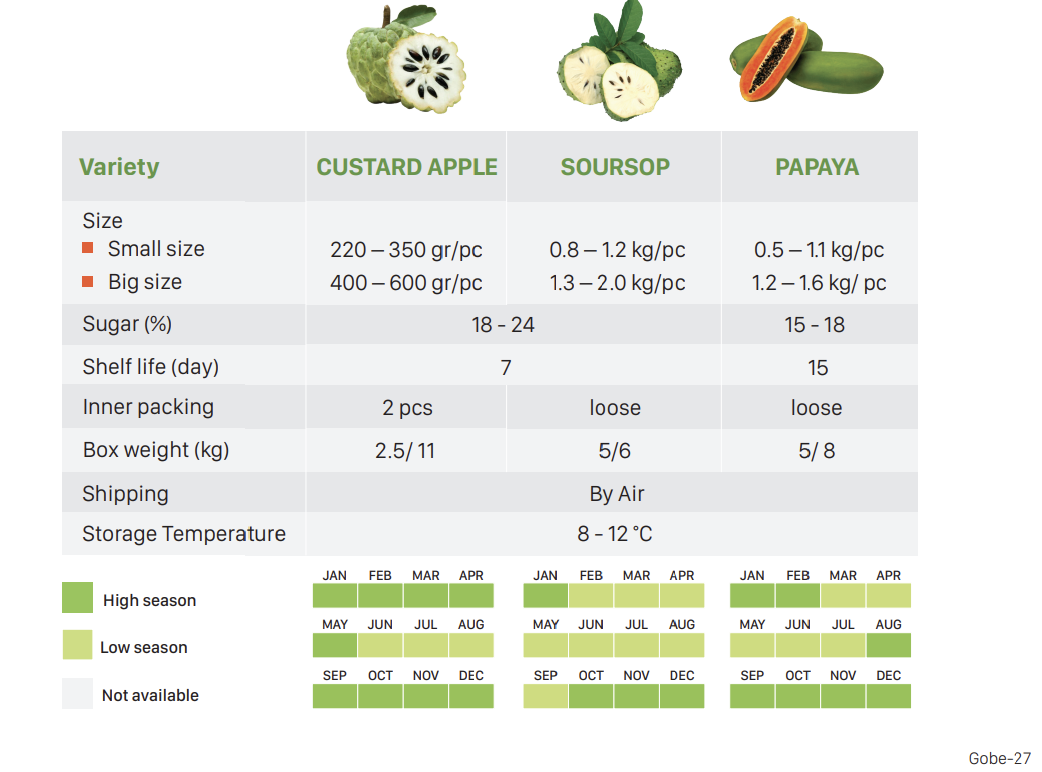
The table below presents key size and sugar content specifications for custard apple, soursop, and papaya as exported by Gobeimex. Reviewing these figures in parallel allows buyers to evaluate size and sweetness criteria together before moving to seasonal availability.
| Specification | Custard Apple | Soursop | Papaya |
| Small size | 220–350 g/pc | 0.8–1.2 kg/pc | 0.5–1.1 kg/pc |
| Large size | 400–600 g/pc | 1.3–2.0 kg/pc | 1.2–1.6 kg/pc |
| Sugar content (%) | 18–24 | 18–24 | 15–18 |
| Box weight (kg) | 2.5 / 11 | 5 / 6 | 5 / 8 |
| Inner packing | 2 pcs/pack | Loose | Loose |
Understanding how size and sweetness translate into sourcing decisions requires examining each dimension separately, starting with physical weight classifications.
Custard apple ranges from 220 g to 600 g per piece, soursop commands 0.8–2.0 kg per piece, and papaya occupies the middle range at 0.5–1.6 kg per piece, with each tier carrying direct implications for retail and wholesale channel positioning. These size differences determine how each fruit is packaged, priced, and shelved in the importing country. The small-size classifications for each fruit are better suited to individual retail packaging, where single-serve or household-size units drive purchase decisions at supermarket level.
The large-size tier for each fruit addresses wholesale buyers, foodservice operators, and ethnic grocery distributors who prioritize volume per unit:
The size overlap between papaya’s large tier (1.2–1.6 kg) and soursop’s small tier (0.8–1.2 kg) creates cross-substitution opportunities during soursop’s low season months. Gobeimex’s team advises on size-specific allocation planning to help buyers maintain consistent shelf presence across both categories throughout the year.
Custard apple and soursop share the highest sugar content at 18–24% Brix, both measurably sweeter than papaya at 15–18%, and this ranking directly affects shelf life, cold chain requirements, and target market fit for each fruit. Higher sugar content in custard apple and soursop accelerates the ripening process once fruits move above 12°C, which is precisely why both require strict cold chain maintenance throughout transit and are shipped exclusively by air. For buyers receiving these fruits at destination, the high Brix value signals a short and predictable quality consumption window of 7 days from the packing house.
Papaya’s lower sugar range of 15–18% Brix contributes directly to its 15-day shelf life, as slower sugar-driven enzymatic activity extends post-harvest stability at the same 8–12°C storage band. From a market-fit perspective, papaya’s milder sweetness profile makes it the most universally accepted of the three across EU consumer demographics, where preference for less intensely sweet produce is more common than in Middle Eastern or Southeast Asian markets. All three fruits fall within the same optimal storage temperature band of 8–12°C, which means it is technically feasible to consolidate custard apple, soursop, and papaya within a single refrigerated container without conflicting temperature requirements, provided shelf life timelines are managed to ensure arrival within each fruit’s quality window.
October through December is the only three-month window when custard apple, soursop, and papaya all reach high season simultaneously, making it the strongest convergence point for importers seeking to consolidate multi-fruit orders from a single supplier. Custard apple peaks across the widest annual spread of approximately eight months. Soursop is concentrated in its narrowest four-month window. Papaya offers the broadest logistical flexibility through its extended 15-day shelf life. Gobeimex’s 52-week supply capability, supported by 200-plus hectares of owned and partner growing areas across the Mekong Delta, ensures that low-season months for any individual fruit are managed through multi-farm sourcing.
The availability calendar below summarizes monthly high and low season designations for each fruit across the full year, giving importers a consolidated reference for annual procurement planning. Buyers can use this table to identify the strongest multi-fruit sourcing windows and plan advance allocation accordingly.
| Month | Custard Apple | Soursop | Papaya |
| January | Low | High | Low |
| February | High | Low | High |
| March | High | Low | Low |
| April | High | Low | Low |
| May | High | Low | Low |
| June | Low | Low | Low |
| July | Low | Low | Low |
| August | Low | Low | High |
| September | High | Low | High |
| October | High | High | High |
| November | High | High | High |
| December | High | High | High |
The table above reveals a clear pattern: October through December represents the strongest multi-fruit supply convergence, while June and July present the most constrained supply environment with all three fruits simultaneously in low season. The following sections examine each fruit’s peak season individually and address whether simultaneous availability can be achieved outside the October-to-December window.
Custard apple peaks across approximately eight months per year, soursop concentrates its peak in four months from October through January, and papaya covers roughly seven high-season months with the greatest logistical flexibility of the three. These differences in seasonal spread determine how much advance planning each fruit requires and how reliably it can be incorporated into a year-round product assortment. The seasonal breakdown for each variety is as follows:
Custard Apple (Annona squamosa)
Soursop (Annona muricata)
Papaya (Carica papaya)
The data confirms that papaya offers the most commercially convenient seasonal profile for importers managing complex logistics, while soursop demands the most precise advance planning due to its concentrated supply window.
Yes, October, November, and December are the three months when custard apple, soursop, and papaya all reach high season simultaneously, creating the optimal procurement window for importers seeking to diversify their tropical fruit assortment from a single supplier. This three-month overlap is the strongest convergence point in the annual calendar and represents the best period for buyers to consolidate orders, negotiate container-level shipments, and maximize volume efficiency. Beyond this October-to-December window, no other month in the full year delivers simultaneous high-season availability across all three fruits.
February comes closest as a partial overlap month, with custard apple and papaya both in high season, but soursop remains in low season throughout February. Similarly, September offers custard apple and papaya at high season, while soursop has not yet reached its peak. For months where one or more fruits are in low season, Gobeimex addresses supply continuity through its network of 200-plus hectares of partner-managed growing areas across the Mekong Delta and surrounding provinces.
These partner farms operate under Gobeimex’s quality and inspection protocols, allowing the company to draw on alternative cultivation zones when primary growing areas enter seasonal transitions. This multi-source model is the operational foundation of Gobeimex’s 52-week supply guarantee, which reduces the risk of supply interruption for importers who have built custard apple, soursop, or papaya into their year-round product assortments. Importers planning annual purchasing calendars should contact Gobeimex’s export team directly to receive a month-by-month supply schedule tailored to their destination market and volume requirements. Early engagement, particularly for soursop during its September pre-season period, ensures preferred allocation before peak-season demand compresses available supply.
All three fruits are shipped exclusively by air freight, with custard apple and soursop constrained to a 7-day shelf life and papaya extended to 15 days, and each fruit is processed within 12 hours of harvest at Gobeimex’s Tien Giang packing house to lock in peak freshness before departure. Knowing when to order is only half the procurement picture. The sections below address how each fruit is handled operationally from farm gate to flight departure, covering storage conditions, transit requirements, and destination market fit.
Papaya has a shelf life of 15 days, more than double the 7-day shelf life shared by custard apple and soursop, and all three fruits require identical storage temperatures of 8–12°C, which allows consolidation within a single refrigerated container without temperature conflict. For custard apple and soursop, the 7-day window from harvest to delivery is non-negotiable. Both fruits must be processed, packed, and dispatched within hours of harvest to preserve maximum quality at the point of arrival.
Gobeimex’s Tien Giang packing house is positioned in the heart of Vietnam’s Mekong Delta fruit-growing region to enable this requirement: fruit moves from field to pack within 12 hours of harvest, and from the packing house directly to the refrigerated vehicle fleet for transfer to the export airport without breaking the cold chain at any stage. Papaya’s 15-day shelf life opens routing options that are not viable for custard apple or soursop, including one-stop air routing or minor scheduling adjustments without compromising arrival quality. This flexibility makes papaya the most accessible of the three fruits for importers in smaller or more remotely connected distribution markets. Gobeimex maintains its own fleet of refrigerated container trailers to ensure unbroken temperature control from packing house to port or airport, removing reliance on third-party cold-chain handling during the critical post-harvest window.
Papaya reaches the widest range of international markets including Germany, the Netherlands, the UK, Canada, the UAE, Kuwait, Japan, and the Maldives, while custard apple is most strongly positioned in the Middle East and Asian diaspora markets, and soursop finds its most established demand base among Caribbean and Latin American diaspora communities in Europe and North America. Each fruit’s phytosanitary compliance requirements vary by importing country, and Gobeimex’s export team manages documentation and inspection protocols on a market-by-market basis.
Phytosanitary requirements for papaya export to Japan require specific farm-level certification and pre-export inspection, all of which Gobeimex manages as part of its standard Japan-bound documentation process. For importers ready to evaluate sourcing plans for custard apple, soursop, or papaya from Vietnam, Gobeimex’s export team is available to provide destination-specific phytosanitary guidance, confirmed seasonal availability calendars, and the full product catalog including packaging specifications and minimum order quantities.
To request the complete Gobeimex product catalog and current-year supply schedule, contact the team directly:
📧 Info@gobeimex.com
📞 +84 939 93 54 55
📄 Download the full Gobeimex Product Catalog (PDF)
Gobeimex — Elevating Vietnamese Produce, Connecting Global Markets.