Subtotal $0.00


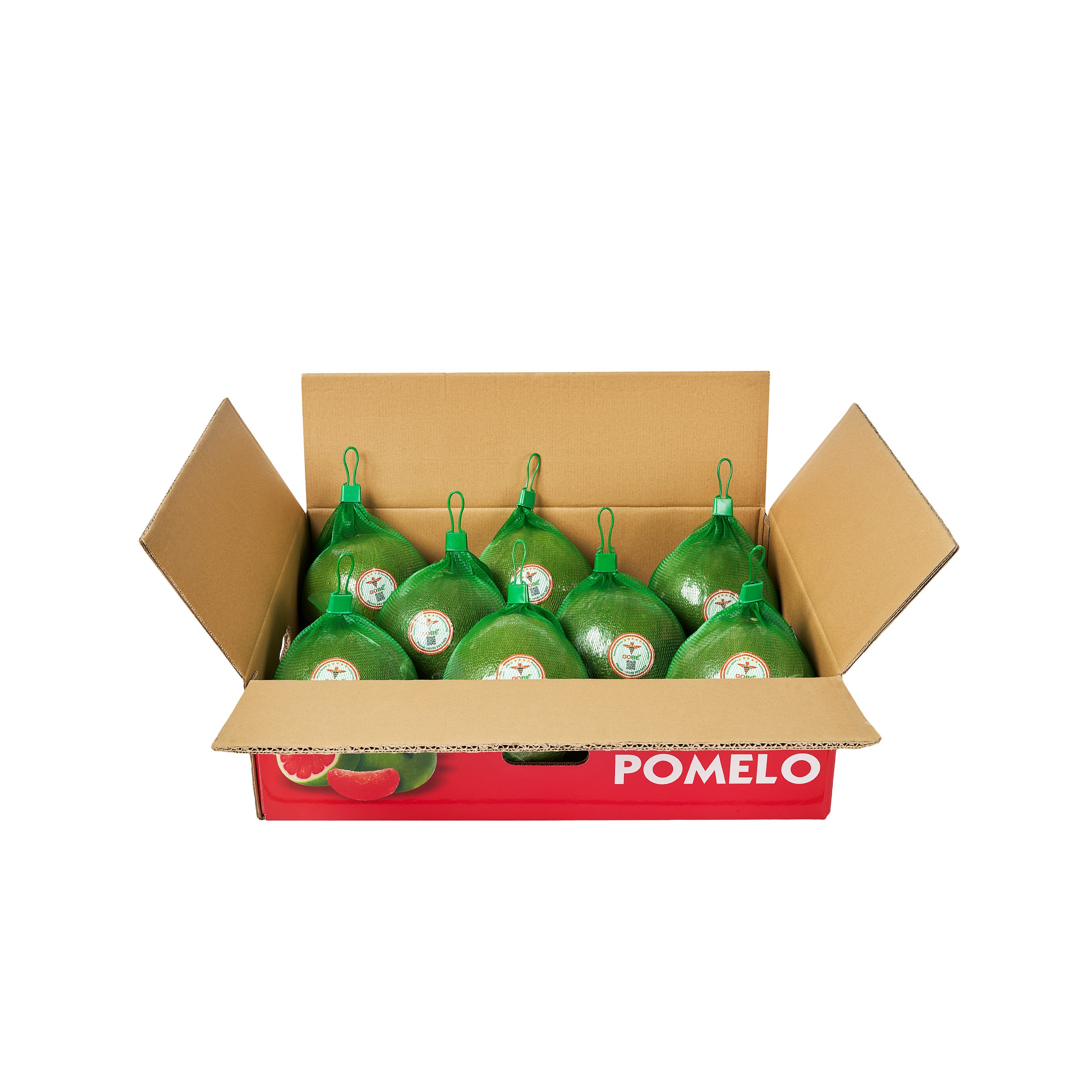
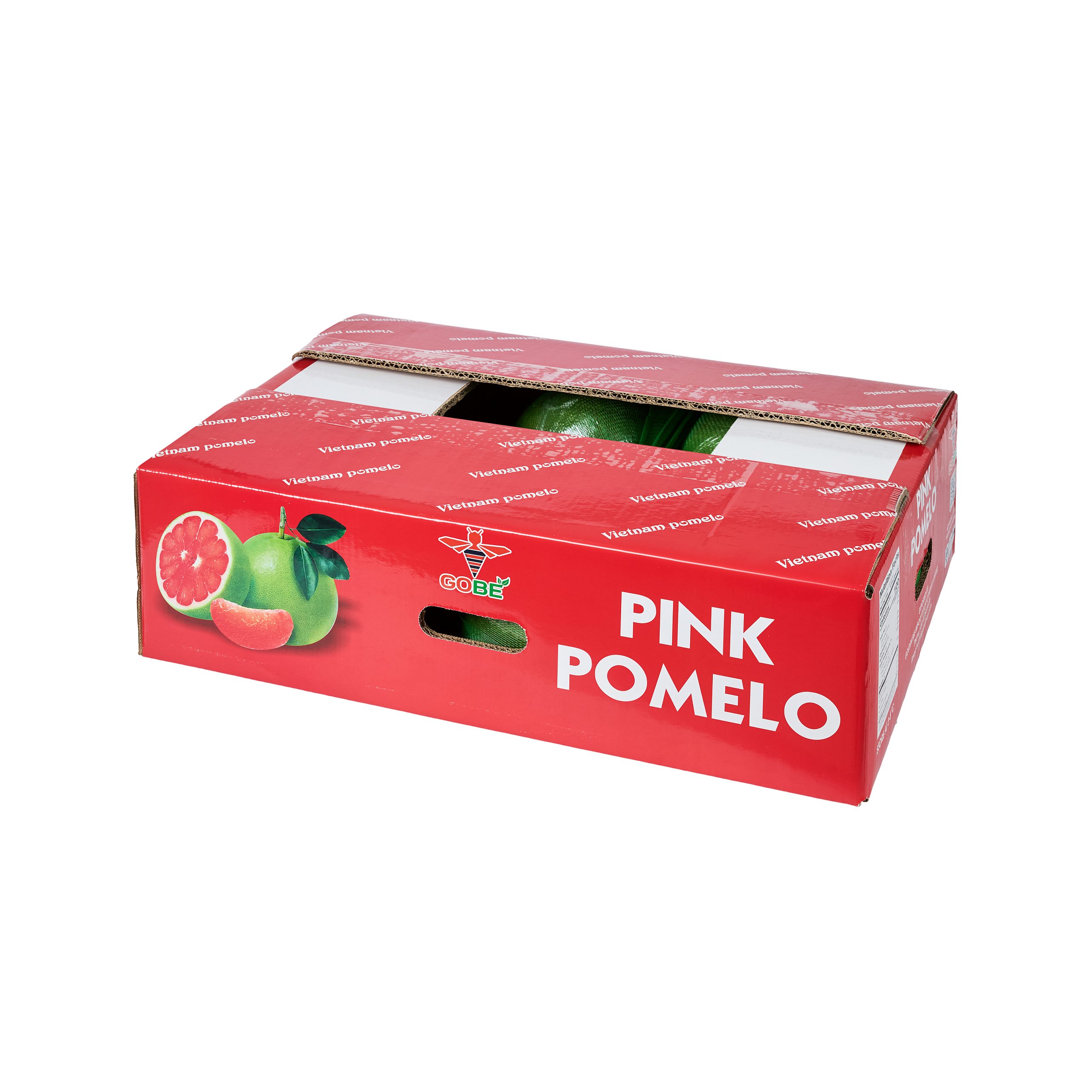
Pomelo fruit (Citrus maxima) is the largest citrus fruit in the world, originating from Southeast Asia and classified within the Rutaceae family. It features a thick rind, pale green to yellow skin, and flesh ranging from white-yellow to deep pink depending on the variety. Two dominant varieties, Da Xanh and Nam Roi, form the backbone of Vietnamese pomelo exports to Europe, the Middle East, North America, and Asia.
For importers evaluating pomelo as a sourcing category, understanding variety differences is essential for matching the right product to the right market. Da Xanh delivers pink flesh with a Brix range of 9 to 13%, making it a strong fit for premium and supermarket channels. Nam Roi offers yellow flesh with a Brix of 8 to 11%, well-positioned for mainstream and ethnic retail segments. Both varieties share a 60-day shelf life at 2 to 4°C and ship by air or sea freight.
Reliable sourcing depends on three operational pillars: certified supply chains backed by GlobalGAP, GRASP, ISO, FDA, and Sedex standards; year-round availability through multi-farm networks in Vietnam’s key growing regions; and unbroken cold chain logistics from farm to port. This guide covers every specification category importers need to evaluate pomelo as a commercially viable, compliant fresh fruit category.
Pomelo (Citrus maxima, also called Citrus grandis) is the largest member of the citrus family, recognized by its thick outer rind, round-to-pear shape, and sweet-to-mildly-tart flesh in yellow or pink tones. It covers three dimensions of commercial relevance: botanical identity, geographic origin, and the structural advantages that make it a logistically practical long-haul import category.
Understanding these three dimensions gives importers the foundational knowledge to source pomelo with confidence and position it correctly within their retail or distribution channel.
Pomelo belongs to the genus Citrus, species maxima or grandis, within the Rutaceae (rue) family, and is the largest naturally occurring citrus fruit, with individual fruits weighing between 0.8 kg and 1.6 kg depending on the variety and size grade. Its outer skin ranges from pale green to bright yellow at maturity, and the notably thick rind acts as a natural protective layer that contributes directly to the commercially advantageous shelf life of up to 60 days under proper cold chain conditions.
The flesh of pomelo comes in two commercially relevant color profiles: yellow, as found in Nam Roi, and pink, as found in Da Xanh. The flavor profile is sweeter and less acidic than grapefruit, which is a hybridized descendant of pomelo. The aroma is fresh and subtly floral, making pomelo appealing for fresh consumption in retail and gifting segments. Pomelo segments are large and relatively easy to separate, adding to its appeal as a premium table fruit in international markets.
Pomelo’s thick rind provides structural resilience during long-haul sea freight, a rare advantage among tropical fruits that enables reliable distribution to distant markets such as Canada, Germany, and Japan without compromising product integrity.
Pomelo is native to Southeast Asia, with commercial cultivation concentrated in Vietnam, Thailand, China, and Malaysia. Vietnam stands out as one of the most reliable pomelo exporters globally, driven by its tropical climate, fertile river delta soil, and well-established farming networks in the Mekong Delta region.
The two primary growing regions in Vietnam are Tien Giang Province and Ben Tre Province, with Tien Giang being home to the Da Xanh variety’s most productive cultivation areas. The proximity of packing facilities to growing areas in Tien Giang allows produce to move from farm to pack within approximately 12 hours of harvest, a critical factor in preserving Brix levels, firmness, and overall commercial quality at the point of delivery. Gobeimex operates its main packing house directly in Tien Giang to leverage this geographic advantage for international buyers.
Vietnam’s export infrastructure, including refrigerated container logistics and access to major ports, enables both air and sea freight options to markets across Europe, the Middle East, and Asia. This logistical flexibility, combined with 52-week supply availability across Gobeimex’s owned and partner farm network of 230+ hectares, positions Vietnamese pomelo as a dependable year-round import category.
Two main pomelo varieties are commercially available for international import from Vietnam: Da Xanh (Green Skin, pink flesh) and Nam Roi (yellow flesh), each occupying a distinct market segment based on flesh color, sweetness level, and consumer visual appeal. Understanding the differences between these two varieties is the first decision point for any importer, as Brix range, pack weight options, and market fit vary meaningfully between them.
Da Xanh pomelo is characterized by its vibrant pink flesh, relatively high sugar content, and premium visual appeal, making it the preferred choice for supermarket shelves, gift box formats, and high-end retail channels in the EU, Middle East, and Japanese markets.
Da Xanh’s pink flesh color distinguishes it immediately from other pomelo varieties on the retail shelf, and its Brix range of 9 to 13% delivers a consistently sweet, refreshing flavor that resonates with consumers seeking premium tropical fruit experiences. The table below presents the full commercial specifications for Da Xanh pomelo, covering flesh color, size grades, sugar content, shelf life, carton options, shipping modes, and cold storage requirements. Importers use this specification profile to align procurement with retailer-specific shelf-ready requirements.
| Specification | Da Xanh Pomelo |
|---|---|
| Flesh color | Pink |
| Small size | 0.8 to 1.2 kg per fruit |
| Big size | 1.2 to 1.6 kg per fruit |
| Sugar content (Brix) | 9 to 13% |
| Shelf life | 60 days |
| Carton weight options | 6.5 / 10 / 11 / 13 kg |
| Shipping methods | Air freight and sea freight |
| Storage temperature | 2 to 4°C |
Da Xanh pomelo is well-suited for premium supermarket formats and specialty fruit retailers in markets such as Canada, the UAE, Germany, the Netherlands, and Japan, where consumers associate pink-fleshed citrus with premium quality and are willing to pay a higher unit price. The multiple carton weight options, ranging from 6.5 to 13 kg, allow importers to customize packing configurations to match retailer-specific shelf-ready requirements or wholesale formats.
Nam Roi pomelo offers yellow flesh, a slightly lower Brix range of 8 to 11%, and a more compact fruit size profile, positioning it as a reliable and commercially accessible option for mainstream supermarkets, ethnic food retail channels, and wholesale distributors serving Asian and Middle Eastern communities.
The yellow flesh of Nam Roi is consistent with consumer expectations in traditional Asian markets, where this variety is widely recognized and trusted. Its lighter sweetness profile also makes it appealing in markets where a less intensely sweet citrus experience is preferred. The table below outlines the full specification profile for Nam Roi pomelo across all key parameters relevant to importers, including sizing, Brix, shelf life, packaging, logistics, and cold chain requirements. This profile enables side-by-side comparison with Da Xanh when building a dual-variety sourcing portfolio.
| Specification | Nam Roi Pomelo |
|---|---|
| Flesh color | Yellow |
| Small size | 0.8 to 1.0 kg per fruit |
| Big size | 1.0 to 1.2 kg per fruit |
| Sugar content (Brix) | 8 to 11% |
| Shelf life | 60 days |
| Carton weight options | 6 / 10 / 11 kg |
| Shipping methods | Air freight and sea freight |
| Storage temperature | 2 to 4°C |
Nam Roi pomelo’s compact size range makes it easier to display in standard retail formats and well-suited to bulk purchasing in ethnic grocery channels across markets such as Russia, Kuwait, the Maldives, and Southeast Asian destinations. Its consistent availability through Gobeimex’s partner farm network across 200+ GlobalGAP-certified hectares ensures that importers can rely on stable supply even during periods of high demand.
Da Xanh excels in sugar content (9 to 13% Brix) and premium visual appeal with pink flesh, while Nam Roi is stronger in size consistency and mainstream market accessibility with yellow flesh. Both varieties share identical shelf life and cold chain requirements, making logistics planning uniform across both SKUs.
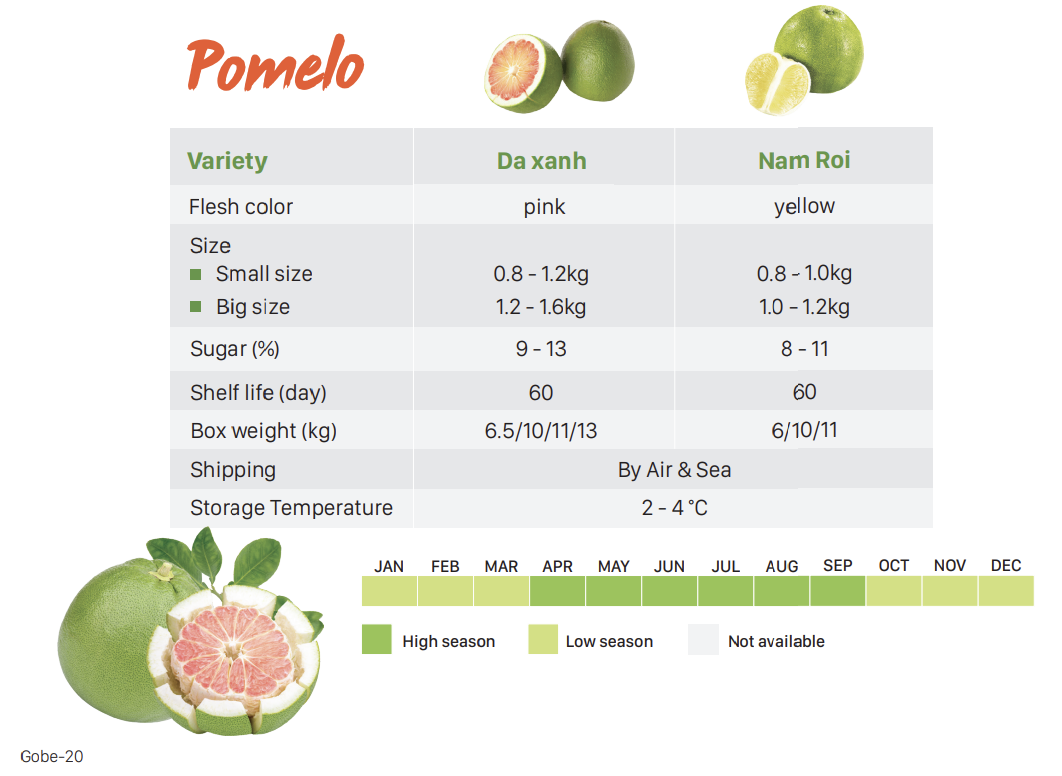
For importers managing multiple market destinations simultaneously, this comparison helps determine whether to consolidate sourcing into a single variety or to build a dual-variety portfolio matched to different retail channels. The table below directly compares Da Xanh and Nam Roi pomelo across every key commercial parameter, enabling importers to make variety selection decisions based on target market, consumer preference, and logistics constraints.
| Specification | Da Xanh | Nam Roi |
|---|---|---|
| Flesh color | Pink | Yellow |
| Small size | 0.8 to 1.2 kg | 0.8 to 1.0 kg |
| Big size | 1.2 to 1.6 kg | 1.0 to 1.2 kg |
| Sugar content (Brix) | 9 to 13% | 8 to 11% |
| Shelf life | 60 days | 60 days |
| Carton weight options | 6.5 / 10 / 11 / 13 kg | 6 / 10 / 11 kg |
| Shipping | Air and sea | Air and sea |
| Storage temperature | 2 to 4°C | 2 to 4°C |
| Market fit | Premium / supermarket | Mainstream / ethnic retail |
The Brix differential between the two varieties is the single most impactful factor for market positioning. Markets in Western Europe and Gulf Cooperation Council countries consistently show stronger consumer preference for high-Brix, visually distinctive fruits, making Da Xanh the more commercially compelling option for premium retail in Germany, the Netherlands, the UAE, and Kuwait. Asian and Eastern European markets, including Japan, Russia, and the Maldives, tend to purchase both varieties but show higher volume movement for Nam Roi at competitive price points.
Da Xanh’s larger carton format options, up to 13 kg, accommodate bulk wholesale buyers and large-format retailers. Nam Roi’s 6 kg small-carton option is well-suited to specialty fruit shops and convenience-scale distribution. Importers building a premium gifting or celebration-season program for Chinese New Year or Eid should strongly consider Da Xanh given its visual premium and gift-box compatibility.
Vietnamese pomelo has a high season running from April through September and a low season from January through March and October through December. Year-round supply at 52 weeks per year is achievable through Gobeimex’s multi-farm sourcing network across multiple growing regions in Vietnam.
For importers planning annual procurement schedules, understanding the seasonal calendar prevents stockouts during key retail periods and allows advance contracting at optimal pricing. The table below presents the full seasonal calendar for Vietnamese pomelo, showing which months fall within the high-supply period and which represent lower-volume availability, enabling importers to plan procurement timelines accordingly.
| Month | Season Status |
|---|---|
| January | Low season |
| February | Low season |
| March | Low season |
| April | High season |
| May | High season |
| June | High season |
| July | High season |
| August | High season |
| September | High season |
| October | Low season |
| November | Low season |
| December | Low season |
The high season from April to September represents the period of maximum fruit availability, peak Brix levels, and the broadest range of size grades. This is the optimal window for importers to secure the highest volumes at the most competitive FOB pricing and to build safety stock for autumn and winter retail programs.
During the low season, from January to March and October to December, supply volumes decrease but do not reach zero. Gobeimex maintains availability throughout the low season by leveraging its partner farm network across 200+ certified hectares and multiple growing sub-regions, ensuring that contracted buyers face no supply interruption. This 52-week continuity of supply is a key differentiator for importers supplying supermarket chains or subscription-based fresh produce programs that require uninterrupted replenishment.
Low-season procurement requires closer lead time management, and air freight becomes a more viable tool during these months to ensure freshness upon arrival despite lower harvest volumes. Importers should establish advance purchase agreements with their exporter covering both seasons to lock in pricing stability and guaranteed allocation.
Pomelo importers need to understand five specification categories: size grading (small vs. big per variety), carton weight configurations (6 to 13 kg), shipping mode selection (air vs. sea), cold chain maintenance at 2 to 4°C, and the 60-day shelf life window that governs transit planning for both short-haul and long-distance routes. Together, these five categories form the complete logistics and compliance framework that determines whether a pomelo shipment arrives commercially viable.
Size grading is the first layer of commercial specification. For Da Xanh pomelo, small grade covers 0.8 to 1.2 kg per fruit and big grade covers 1.2 to 1.6 kg per fruit. For Nam Roi, small grade is 0.8 to 1.0 kg and big grade is 1.0 to 1.2 kg. Retailers and wholesale buyers specify their preferred size grade based on shelf presentation standards, price-per-kilogram targets, and consumer portion expectations. Mismatched size grades are a common source of commercial claims, so importers should confirm size grade requirements precisely before placing orders.
Carton weight options directly affect pallet efficiency, shipping cost per kilogram, and shelf-ready convenience for retail partners. Da Xanh pomelo is available in 6.5, 10, 11, and 13 kg cartons, while Nam Roi is available in 6, 10, and 11 kg configurations. Importers should align carton weight selection with their downstream customer’s ordering unit to avoid unnecessary repackaging at destination.
Sea freight is the recommended mode for markets within a 20-day transit window from Vietnam, such as the Middle East, while air freight is better suited for markets requiring faster delivery or for low-season shipments where the freshness margin is tighter. The 60-day shelf life provides sufficient buffer for both modes under a properly maintained cold chain at 2 to 4°C.
A sea freight shipment from Ho Chi Minh City to the UAE typically takes 12 to 16 days transit time, leaving 44 to 48 days of remaining shelf life upon arrival. This provides importers and their retail customers with adequate time for distribution, shelf display, and consumer purchase cycles. For markets such as Canada or the UK, transit times of 25 to 35 days via sea freight still yield 25 to 35 days of remaining shelf life, which is commercially workable for importers with efficient inland distribution.
Air freight is most valuable during the low season when harvest volumes are lower and fruit must move quickly from farm to export to maximize the available shelf life window. It is also the preferred mode for high-value, time-sensitive programs such as gift-season campaigns or premium retail launches where freshness is a central selling point. Gobeimex operates its own fleet of refrigerated container trailers to maintain an unbroken cold chain from farm to port, ensuring that temperature integrity is preserved regardless of shipping mode.
A reliable pomelo exporter must hold at minimum five internationally recognized certifications: GlobalGAP, GRASP, ISO, FDA, and Sedex. These certifications serve as the primary qualification filter for importers evaluating supplier credibility across different market regulatory environments.
Each certification addresses a distinct compliance requirement relevant to pomelo importers:
Gobeimex holds all five certifications, providing importers with a single-source supplier that meets the regulatory and ethical sourcing requirements of every major pomelo import market simultaneously.
Pomelo and grapefruit are not the same fruit. Grapefruit is a natural hybrid of pomelo (Citrus maxima) and sweet orange (Citrus sinensis), meaning pomelo is the parent species. This distinction carries direct consequences for importers in customs classification, retail labeling, and market positioning.
For importers, this confusion is not merely botanical; it is commercial. Misclassifying pomelo as grapefruit in a customs declaration can trigger incorrect HS code filing, which may result in wrong tariff rates, phytosanitary compliance failures, or product holds at the border. Positioning pomelo as grapefruit in retail markets also misinforms consumers and undermines the premium differentiation that makes pomelo commercially valuable.
Pomelo is significantly larger than grapefruit, sweeter, less bitter, and less acidic, and is primarily sold as a fresh whole fruit in premium and gifting segments, while grapefruit is more commonly used in juice processing and mainstream citrus retail. Pomelo’s thick rind makes it shelf-stable for up to 60 days, far exceeding the typical 20 to 30-day shelf life of grapefruit.
Importers should communicate this taste and format distinction clearly to retail buyers to avoid merchandising errors. The premium positioning of pomelo, particularly Da Xanh, depends on accurate variety labeling and consumer education at the point of sale.
Pomelo import compliance requirements vary significantly by destination market, and importers must confirm destination-specific post-harvest treatment requirements with their exporter before booking shipments to avoid customs holds or consignment rejection.
The EU requires phytosanitary certificates and residue testing aligned with GlobalGAP-certified farming practices. The US requires FDA registration and compliance with FSMA import safety rules. Japan mandates strict cold treatment protocols for certain pest management requirements. Waxing and fumigation requirements also differ by market. Gobeimex’s export team is experienced in meeting the phytosanitary and documentation requirements of all active markets, including Canada, the UAE, the UK, Germany, the Netherlands, Russia, Japan, and Kuwait, enabling importers to proceed with shipment bookings with confidence.
Gobeimex supplies Da Xanh and Nam Roi pomelo to global markets 52 weeks a year, backed by GlobalGAP, GRASP, ISO, FDA, and Sedex certifications. For sourcing inquiries, variety specifications, pricing, and logistics consultation, contact the Gobeimex export team at Info@gobeimex.com, call or WhatsApp +84 939 93 54 55, or visit gobeimex.com.