Subtotal $0.00


Vietnam currently exports five primary mango varieties to international markets: Chu, Hoa Loc, R2E2, Keo, and Elephant. Each variety carries a distinct profile across size, sugar content, shelf life, and shipping method, making direct comparison essential for importers who need to match the right fruit to the right market. Understanding these differences upfront reduces costly mismatches between product specification and end-market expectation.
No single Vietnamese mango variety leads across every metric. Hoa Loc tops sugar content at 19 to 21 percent Brix, R2E2 and Keo share the longest shelf life at 20 days, Elephant Mango delivers the largest fruit size at 600 to 700 grams and above, and Chu Mango provides reliable volume during Vietnam’s peak harvest season from March through June. Each trade-off between sweetness, size, and logistics compatibility reflects a different commercial use case.
The combination of all five varieties makes year-round supply from Vietnam viable across 52 weeks. Gobeimex, operating packing houses in Tien Giang and Ho Chi Minh City with a farm-to-pack processing window of 12 hours, supplies all five varieties under GlobalGAP, FDA, ISO, GRASP, and Sedex certifications. This article breaks down each variety individually, then compares them across the export attributes that matter most to importers.
Five Vietnamese mango varieties are currently exported to international markets: Chu, Hoa Loc, R2E2, Keo, and Elephant, all sourced from growing areas concentrated in the Mekong Delta and managed under GlobalGAP standards. These five varieties serve buyers across the Americas, Europe, the Middle East, and Asia, covering markets including Canada, the UAE, the United Kingdom, Germany, the Netherlands, Japan, and Kuwait. Each variety meets export-grade quality requirements in size uniformity, residue control, and cold chain integrity. The sections below define each variety using its core technical export attributes.
Chu Mango is a Vietnamese export variety with a fruit size of 280 to 300 grams and above, a sugar content of 15 to 19 percent Brix, a shelf life of 7 days, and exclusive air freight shipping at a storage temperature of 10 to 13 degrees Celsius. It is one of the most consistently available Vietnamese mango varieties for export, with a high season running from March through June. The variety packs in 4 or 5-kilogram boxes, compatible with standard air freight consolidation formats favored by importers in the Middle East and Asia.
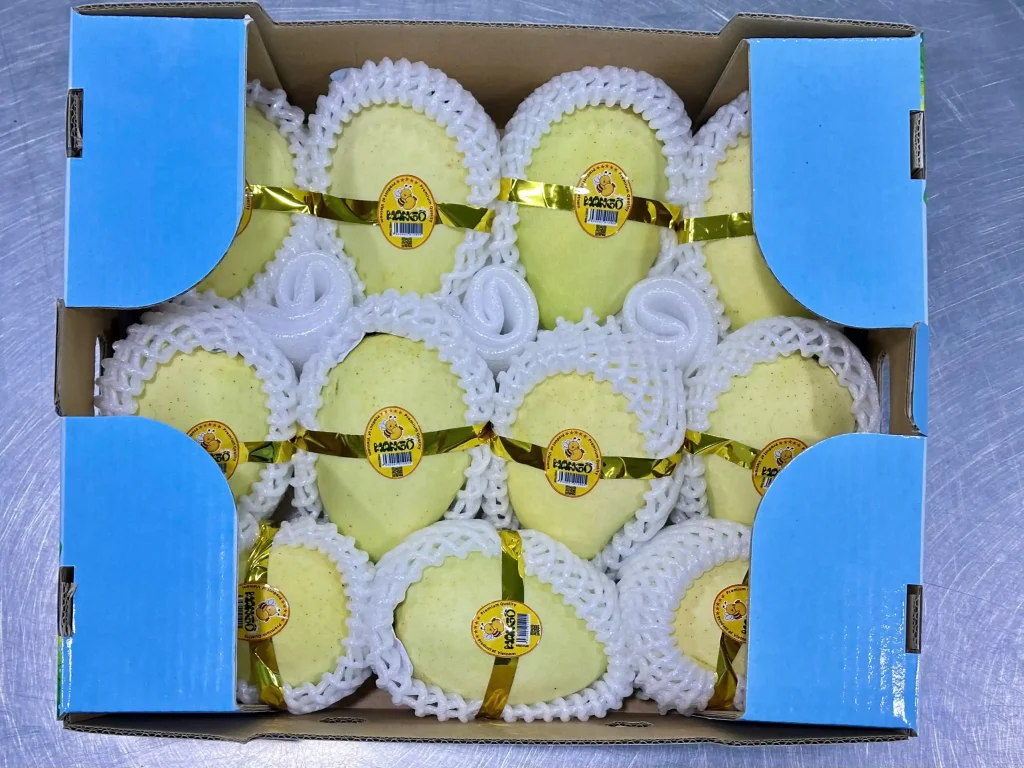
The 7-day shelf life is the most critical logistical constraint for Chu Mango. This post-harvest window means Chu Mango suits markets within short air freight distances of Vietnam, or buyers with distribution networks capable of moving product from port to retail shelf within 48 to 72 hours of arrival. For UAE, Japan, or Southeast Asian importers, this timeline is typically manageable. For markets requiring longer transit times such as Canada or the United Kingdom, careful scheduling and pre-ripening protocols are necessary.
Key export specifications for Chu Mango:
Hoa Loc Mango is Vietnam’s most celebrated premium export variety, distinguished by the highest sugar content among the five varieties at 19 to 21 percent Brix, a fruit weight of 400 to 500 grams and above, and air freight shipping at 10 to 13 degrees Celsius. Hoa Loc is widely recognized among international buyers as Vietnam’s flagship mango variety, sought after for its intensely sweet flavor and smooth, fiberless flesh. For high-end retail channels and premium supermarkets in Europe, Japan, and Gulf Cooperation Council markets, Hoa Loc represents the clearest expression of Vietnamese mango quality.
One critical supply planning note: Hoa Loc Mango has no available stock in September, the only complete gap month in its annual calendar. High-season peaks run from April through June, with lower but present availability in January through March, July, August, and October through December. Buyers planning Hoa Loc promotions for September must substitute with another variety or accept a supply pause. The absence of a confirmed shelf life in Hoa Loc’s technical data reflects its high sugar content, which accelerates post-harvest ripening. Importers should treat Hoa Loc as a fast-turnover product paired with rapid distribution infrastructure.
Key export specifications for Hoa Loc Mango:
R2E2 Mango is an Australian-origin variety commercially cultivated in Vietnam, offering the longest shelf life among all air-freighted Vietnamese export mangoes at 20 days, a fruit weight of 450 to 550 grams and above, and a sugar content of 15 to 19 percent Brix. Originally developed in Australia, R2E2 has been successfully adapted to Vietnam’s Mekong Delta growing conditions. For export buyers, R2E2’s most commercially significant feature is its 20-day shelf life, which, combined with air freight capability, makes it the most logistically flexible variety in the Vietnamese mango export portfolio for distant markets.
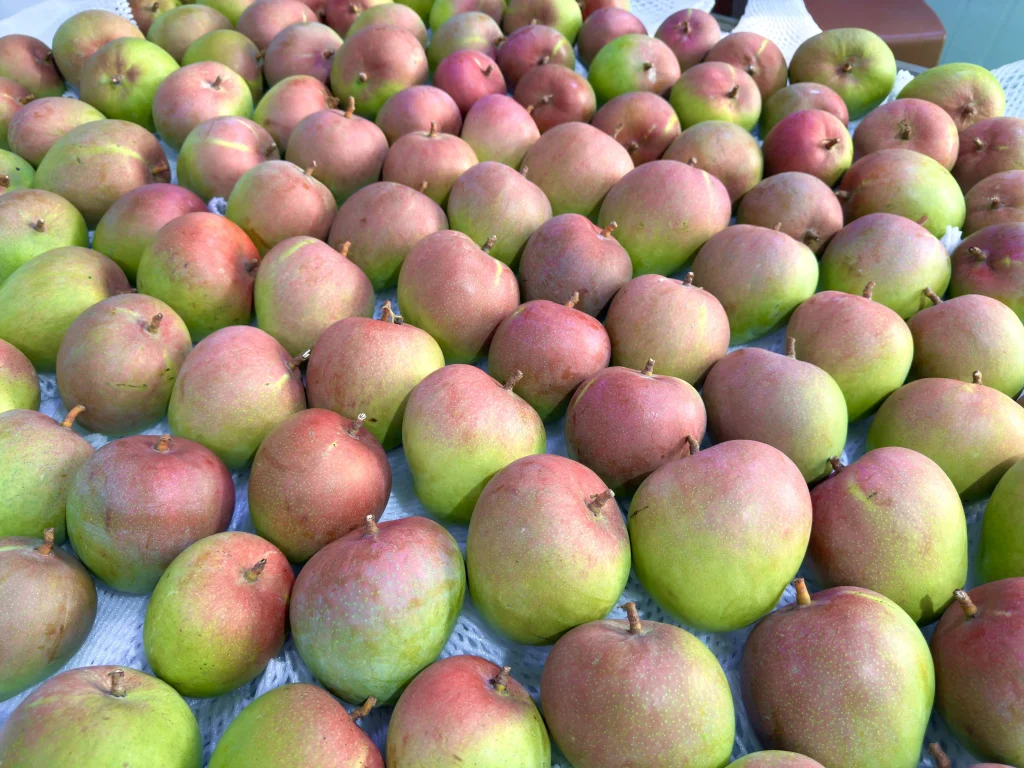
R2E2 also offers the widest range of box weight configurations among the five varieties, available in 4, 5, 7.5, and 10-kilogram formats. This flexibility accommodates both retail-oriented smaller packs and bulk wholesale formats, giving importers and distributors more options when structuring orders. From a seasonal perspective, R2E2 delivers high-season supply from January through June and again in December, making it one of the strongest varieties for first-half-of-year promotional calendars. August is the only complete gap month, with lower but present availability in July and September through November.
Key export specifications for R2E2 Mango:
Keo Mango is a Vietnamese export variety notable for dual air and sea freight shipping, a shelf life of 20 days, a fruit weight of 300 to 350 grams, a Brix of 15 to 19 percent, and a lower storage temperature of 4 to 8 degrees Celsius. Keo is one of only two Vietnamese export mangoes approved for sea freight, which broadens its commercial appeal for price-sensitive import markets or buyers managing high-volume, lower-margin product categories. The storage temperature of 4 to 8 degrees Celsius, compared to the 10 to 13 degrees required for Chu, Hoa Loc, and R2E2, reflects Keo’s compatibility with standard refrigerated container conditions used in ocean freight logistics.
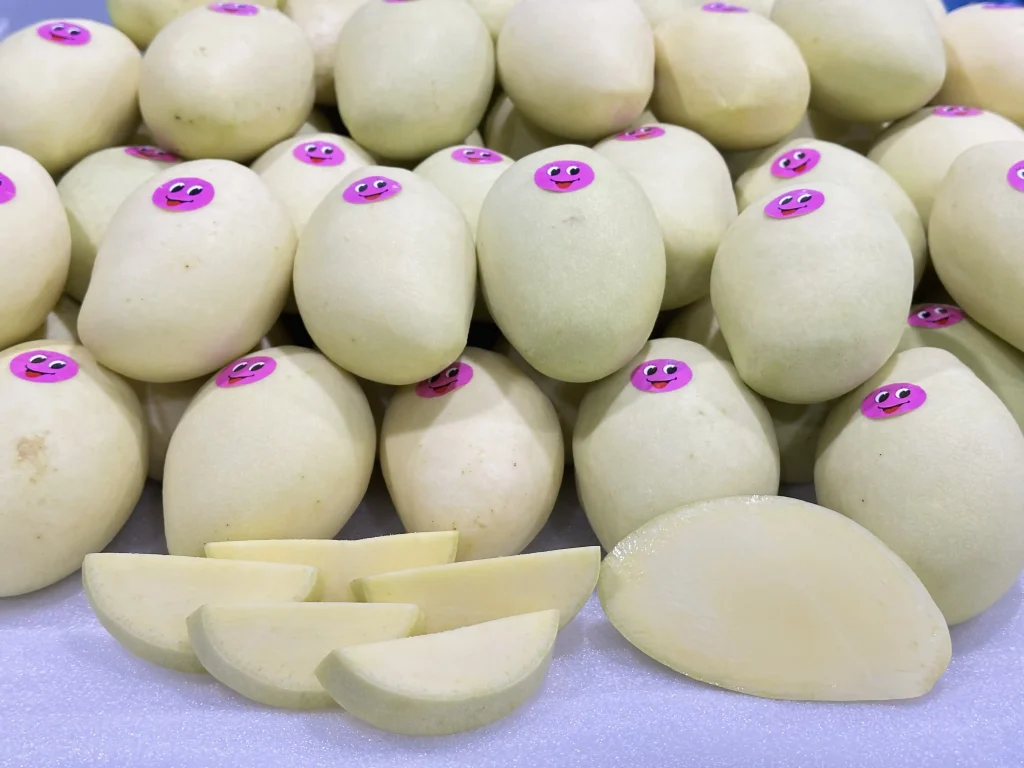
The 20-day shelf life makes Keo logistically compatible with sea freight transit times to markets in the Middle East, Europe, and East Asia, provided proper pre-cooling and cold chain management are maintained from packing house through port of export. This positions Keo as a strong candidate for cost-optimized sourcing strategies where air freight premiums are not justifiable. Keo Mango has the most significant seasonal gap of the five varieties, with complete unavailability from May through September, a stretch of five consecutive months. High-season availability runs from February through April and from October through December. Importers who rely on Keo as a primary line must plan inventory bridges through this gap, switching to R2E2, Elephant, or Chu during the unavailable months.
Key export specifications for Keo Mango:
Elephant Mango is the largest Vietnamese export mango variety by fruit size at 600 to 700 grams and above, but also carries the shortest confirmed shelf life of just 3 days and the lowest sugar content of 13 to 17 percent Brix, shipped by both air and sea freight at 4 to 8 degrees Celsius. Elephant Mango’s defining commercial characteristic is its visual impact: at 600 to 700 grams and above per fruit, it stands out in retail displays and appeals to markets where large-format fruit commands a premium on presentation. The variety packs in 5 and 10-kilogram box configurations, suited for both retail and foodservice channels.
Elephant Mango’s 3-day shelf life is the shortest of any variety in this group and represents the most significant logistical challenge for export. A 3-day post-harvest window requires a near-perfect cold chain from farm to packing house, through port, onto the vessel or aircraft, and into the buyer’s hands, with no tolerance for delays at any stage. This makes cold chain management capability a critical supplier selection criterion for Elephant Mango. The lower Brix range of 13 to 17 percent makes it less competitive in premium-sweetness markets, but may be preferred in markets where mild flavor profiles suit foodservice applications where mango is used as an ingredient rather than eaten fresh. Elephant Mango is available from January through June and again in December, with a complete supply gap in July and reduced but present availability from August through November.
Key export specifications for Elephant Mango:
Across the five Vietnamese export mango varieties, Elephant leads in size, Hoa Loc leads in sugar content, and R2E2 and Keo share the longest shelf life, with no single variety achieving the top ranking across all three attributes simultaneously. This absence of a dominant variety across all metrics reflects a portfolio of trade-offs that importers must navigate based on their specific market requirements, logistics infrastructure, and consumer preferences. The table below covers all six root export attributes for direct comparison.

The following table compares all five Vietnamese export mango varieties across size, sugar content, shelf life, box configuration, shipping method, and storage temperature. Reading this table alongside the seasonal availability calendar gives importers the full picture needed to build a structured sourcing strategy.
| Specification | Chu Mango | Hoa Loc Mango | R2E2 Mango | Keo Mango | Elephant Mango |
|---|---|---|---|---|---|
| Small size | 280 g and up | 400 g and up | 450 g and up | 300 g | 600 g and up |
| Large size | 300 g and up | 500 g and up | 550 g and up | 350 g | 700 g and up |
| Sugar content (Brix) | 15 to 19% | 19 to 21% | 15 to 19% | 15 to 19% | 13 to 17% |
| Shelf life | 7 days | Not specified | 20 days | 20 days | 3 days |
| Box weight | 4 or 5 kg | 4 or 5 kg | 4, 5, 7.5, or 10 kg | 4, 5, or 10 kg | 5 or 10 kg |
| Shipping method | Air only | Air only | Air only | Air and sea | Air and sea |
| Storage temperature | 10 to 13°C | 10 to 13°C | 10 to 13°C | 4 to 8°C | 4 to 8°C |
When ranked by size from largest to smallest: Elephant (600 to 700 grams and above), R2E2 (450 to 550 grams and above), Hoa Loc (400 to 500 grams and above), Keo (300 to 350 grams), and Chu (280 to 300 grams and above).
When ranked by sugar content from highest to lowest: Hoa Loc (19 to 21 percent) leads clearly, followed by Chu, R2E2, and Keo at an equal 15 to 19 percent range, with Elephant Mango at the bottom at 13 to 17 percent.
When ranked by shelf life from longest to shortest: R2E2 and Keo both reach 20 days, Chu follows at 7 days, and Elephant Mango holds the shortest confirmed rating at 3 days. Hoa Loc has no specified shelf life, which in practice signals that buyers should treat it as a fast-turnover product.
The pattern that emerges from this comparison is instructive. The variety with the highest sugar content (Hoa Loc) has an unspecified and likely shorter shelf life. The variety with the largest fruit size (Elephant) has the shortest confirmed shelf life at 3 days. The two varieties with the longest shelf life (R2E2 and Keo) occupy the middle of the sugar content range. This inverse relationship between premium eating quality and post-harvest longevity is a structural feature of fresh mango biology that every importer must account for when building a sourcing strategy.
Yes, Keo and Elephant Mangoes are the only two of the five Vietnamese export varieties specified for sea freight shipment. Chu, Hoa Loc, and R2E2 are rated for air freight only, limiting their practical reach to markets within shorter transit windows. The key technical differentiator is storage temperature: Keo and Elephant require 4 to 8 degrees Celsius, a range compatible with standard refrigerated container conditions used in ocean freight, while Chu, Hoa Loc, and R2E2 require 10 to 13 degrees Celsius, a range more typical of air freight cold rooms and express refrigerated logistics.
For importers, the practical implication is direct. Buyers sourcing for high-volume, cost-sensitive markets where air freight economics are not viable should focus Vietnamese mango procurement on Keo or Elephant. Buyers serving premium retail channels where sweetness and quality command higher margins can absorb the air freight premium and access Hoa Loc, Chu, or R2E2. Even for Keo and Elephant, rigorous cold chain management from packing house to vessel is non-negotiable. Elephant Mango’s 3-day shelf life demands an unbroken cold chain from harvest through the 12-hour processing window at Gobeimex’s Tien Giang facility, through pre-cooling, loading, and transit.
The five Vietnamese export mango varieties collectively provide sourcing opportunities across all 12 months of the year, though supply density and variety availability shift significantly across seasons. The table below maps the high season, low season, and unavailable months for each variety, giving importers a full-year procurement calendar.
| Month | Chu | Hoa Loc | R2E2 | Keo | Elephant |
|---|---|---|---|---|---|
| January | Low | Low | High | Not available | High |
| February | Low | Low | High | High | High |
| March | High | Low | High | High | High |
| April | High | High | High | High | High |
| May | High | High | High | Not available | High |
| June | High | High | High | Not available | High |
| July | Low | Low | Low | Not available | Not available |
| August | Low | Low | Not available | Not available | Low |
| September | Low | Not available | Low | Not available | Low |
| October | Low | Low | Low | High | Low |
| November | Low | Low | Low | High | Low |
| December | Low | Low | High | High | High |
The months with the broadest combined high-season availability run from January through June and in December, when R2E2, Elephant, and Keo overlap with Chu and Hoa Loc across multiple peak periods. These months represent the most favorable windows for large-volume procurement and promotional campaigns requiring consistent supply from a single origin.
The most constrained sourcing window falls between July and September. During this period, Keo Mango is completely unavailable from May through September, Elephant Mango has no supply in July, R2E2 has no supply in August, and Hoa Loc has no supply in September. Chu Mango remains available at low-season volumes throughout, making it a useful bridging variety. Importers seeking year-round product continuity from a single Vietnamese supplier should build sourcing contracts that rotate across at least three to four varieties throughout the year, using high-season peaks of each variety to cover the gaps left by others. Gobeimex’s multi-variety sourcing model across 230 and above hectares of growing areas supports exactly this kind of diversified, 52-week supply commitment.
The right Vietnamese mango variety for any importer depends on three intersecting factors: available logistics budget (air versus sea freight), required shelf life for the destination market’s distribution network, and the sweetness profile preferred by end consumers in that market. No single variety is universally optimal, and the decision framework shifts significantly depending on whether the target channel is premium retail, mass market supermarket, wholesale distribution, or foodservice. For European markets such as Germany, the Netherlands, and the United Kingdom, R2E2 Mango’s 20-day shelf life and air freight compatibility make it the most practical option for premium positioning, while Keo Mango provides a sea freight path for cost-optimized volume sourcing. For the UAE and Kuwait, where sweetness is a primary purchase driver, Hoa Loc’s 19 to 21 percent Brix aligns well with Gulf consumer preferences. For Japan’s demanding retail standards, R2E2’s consistent sizing and 20-day shelf life provide the reliability that Japanese importers require. For North American markets including Canada, R2E2 and Keo best balance extended shelf life with certified production standards meeting FDA requirements. All varieties supplied through Gobeimex carry GlobalGAP, FDA, ISO, GRASP, and Sedex certifications, meeting phytosanitary import requirements across these regions.
Vietnamese export mangoes compete with Thai varieties such as Nam Dok Mai and Mahachanok and with the Philippine Carabao mango, with Vietnam’s key advantages being variety diversity, competitive production costs, and year-round supply capacity. Thai mango currently holds stronger global brand recognition, particularly in Japan and the Middle East, while Philippine Carabao mango commands premium positioning in select Asian and Middle Eastern markets. Vietnam’s Mekong Delta growing region provides scale and variety breadth that neither Thailand nor the Philippines can fully replicate within a single origin. Gobeimex’s participation in Fruit Logistica in Berlin and Asia Fruit Logistica in Hong Kong reflects Vietnam’s growing presence in international fresh produce trade, with export volumes to Canada, the UAE, and EU markets increasing steadily.
Across the five Vietnamese export varieties, higher sugar content correlates broadly with shorter or unspecified shelf life, while lower-sugar varieties like R2E2 and Keo achieve the longest post-harvest stability at 20 days. Hoa Loc’s 19 to 21 percent Brix is the highest but comes with no confirmed shelf life figure, signaling a faster ripening trajectory in practice. Elephant Mango, despite its large size, carries the shortest confirmed shelf life at 3 days alongside the lowest Brix of 13 to 17 percent, showing that size alone does not predict storage stability. R2E2 and Keo both achieve a 20-day shelf life at a mid-range Brix of 15 to 19 percent, representing the best balance for long-distance export. For retail buyers, the implication is direct: select Hoa Loc for fast-moving premium lines and R2E2 or Keo for extended display windows.


