Subtotal $0.00

Export-grade milk fruit from Vietnam must meet five quality dimensions: international certification compliance, a harvest-to-pack window of no more than 12 hours, pesticide residue limits within destination-country MRL thresholds, physical grading standards covering size uniformity and skin integrity, and an unbroken cold chain at 4 to 6 degrees Celsius from farm gate to destination airport. Global importers and distributors evaluating Vietnamese suppliers must treat these standards as the foundation of every reliable procurement decision before any commercial negotiation begins.
Global market data confirms that demand for Vietnamese milk fruit is rising across four continents, driven by its creamy texture, high sugar content of 13 to 18 percent, and growing interest in tropical specialties among Asian diaspora communities and premium fruit retailers in Europe and the Middle East. The four main export varieties, Purple Loren, Green Loren, Jumbo Bo Hong, and Golden Hoang Kim, each carry unique seasonal windows and specifications that buyers must integrate into annual sourcing calendars to avoid supply disruptions.
Finding trusted suppliers who can deliver on quality, volume, and consistency is the critical third challenge for global buyers entering this category. The Vietnamese fresh produce export ecosystem includes both large certified exporters and smaller uncertified traders, making supplier due diligence essential. This article covers all three dimensions: the quality and certification standards that define export eligibility, the market data that reveals where and when demand is strongest, and the criteria and profiles that help buyers identify genuinely reliable milk fruit exporters.
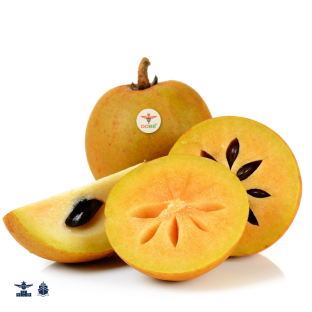
Milk fruit, known commercially as star apple (Chrysophyllum cainito), is a tropical fruit cultivated extensively across Vietnam’s Mekong Delta, where it has become one of the country’s most distinctive fresh export products. Its Vietnamese name, “vú sữa,” reflects the fruit’s signature characteristic: a sweet, milky juice combined with smooth, creamy flesh that distinguishes it clearly from other tropical fruits in the international marketplace. Understanding milk fruit’s sensory profile and commercial positioning across the four export varieties helps buyers assess its market potential accurately.
Vietnam exports four primary milk fruit varieties, each with distinct physical characteristics, sugar content ranges, and shelf life profiles that determine suitability for different target markets. The variety a buyer selects directly affects logistics complexity, pricing, and shelf appeal at the retail level.
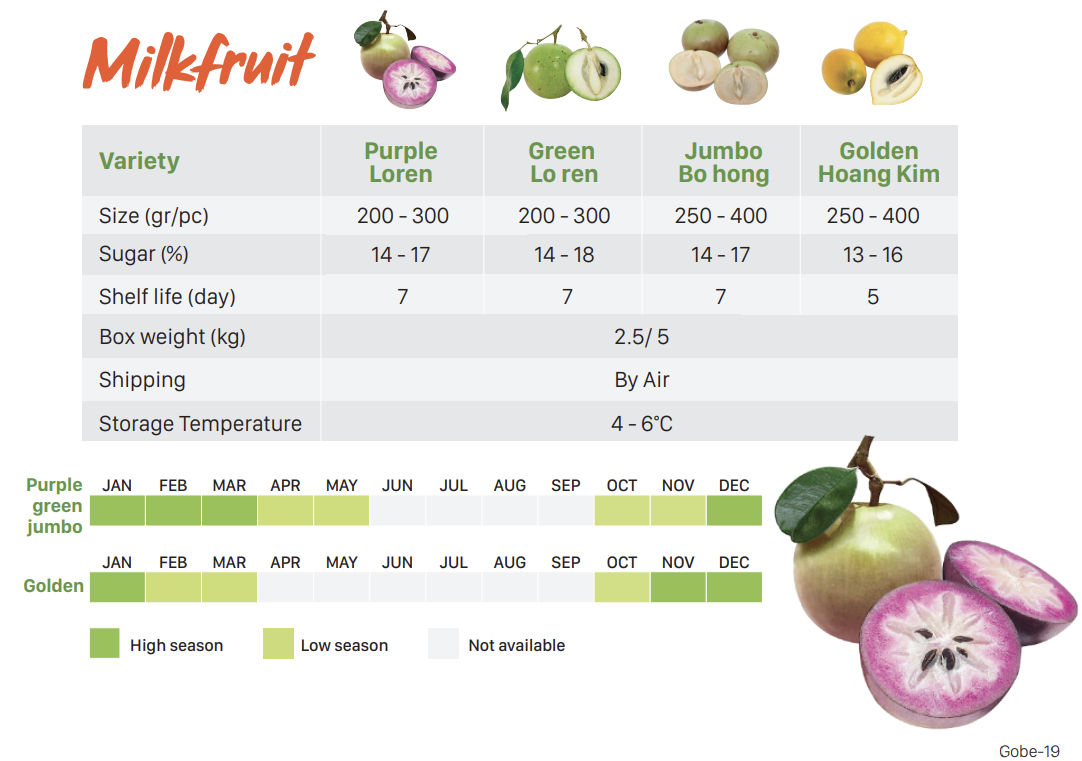
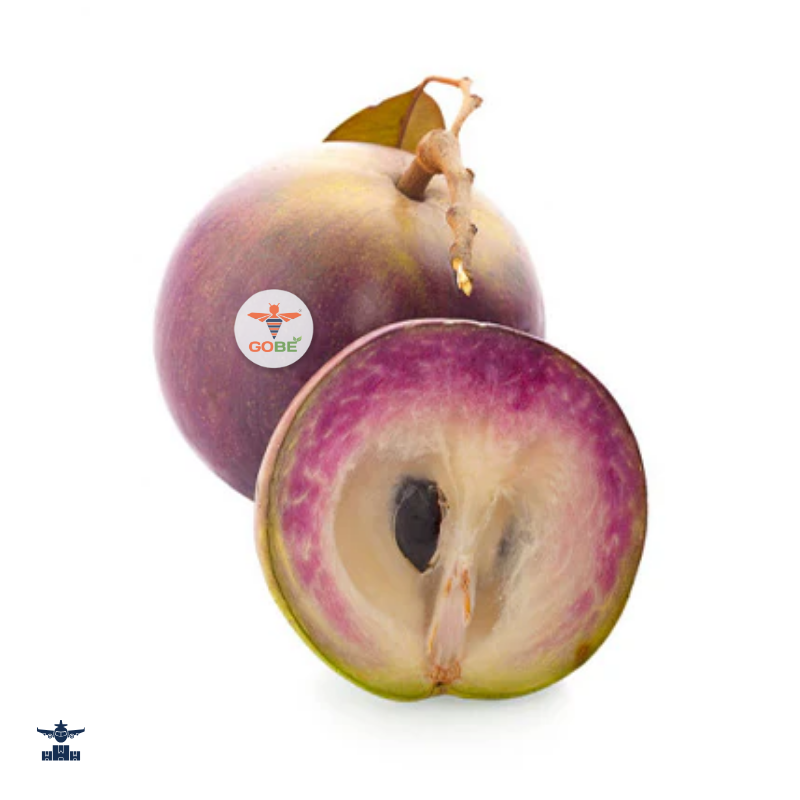
Purple Loren features deep purple skin when ripe, white creamy flesh, sugar content of 14 to 17 percent, and a shelf life of 7 days under cold chain conditions at 4 to 6 degrees Celsius. Individual fruit weight ranges from 200 to 300 grams, making it well-proportioned for premium retail and gift packaging formats. Purple Loren ships exclusively by air freight.
Green Loren shares the same weight range (200 to 300 grams) and shelf life (7 days) as Purple Loren but retains green skin at full ripeness, a characteristic that can initially confuse buyers accustomed to color-change ripeness indicators. Its sugar content reaches 14 to 18 percent, making it one of the sweetest varieties in the export portfolio, and it performs well in markets where lighter-colored tropical fruits are preferred aesthetically.
Jumbo Bo Hong is the large-format variety, with individual fruit weight of 250 to 400 grams and a 7-day shelf life under proper cold chain management. Sugar content ranges from 14 to 17 percent. Its larger size commands premium pricing in markets like Japan and Gulf Cooperation Council countries, where visual presentation drives retail purchasing decisions.
Golden Hoang Kim is the most commercially distinct variety because of its golden-yellow skin and a shorter shelf life of 5 days compared to the 7-day shelf life of the other three varieties. Sugar content ranges from 13 to 16 percent and fruit weight falls between 250 and 400 grams. The shorter shelf life demands tighter cold chain management and faster logistics execution from packing house to final destination, placing it in a higher-risk, higher-reward commercial category for experienced importers.
The table below summarizes the key specifications across all four export varieties; buyers use this side-by-side reference to assess procurement feasibility across shipping routes and shelf life requirements.
| Specification | Purple Loren | Green Loren | Jumbo Bo Hong | Golden Hoang Kim |
|---|---|---|---|---|
| Size (g/fruit) | 200–300 | 200–300 | 250–400 | 250–400 |
| Sugar content (%) | 14–17 | 14–18 | 14–17 | 13–16 |
| Shelf life (days) | 7 | 7 | 7 | 5 |
| Box weight (kg) | 2.5 / 5 | 2.5 / 5 | 2.5 / 5 | 2.5 / 5 |
| Shipping method | By air | By air | By air | By air |
| Storage temperature | 4–6°C | 4–6°C | 4–6°C | 4–6°C |
Milk fruit’s global export demand is growing because of three converging forces: a unique taste profile with no direct substitute among commonly available tropical fruits, strong appeal among the large Vietnamese and Southeast Asian diaspora communities in Canada, Australia, Germany, and the United States, and active assortment expansion by premium supermarket chains in Europe and the Middle East. These drivers together position milk fruit in a low-competition premium tropical niche where flavor differentiation and shelf appeal command meaningful margin premiums over commodity fruits. For importers, this translates to higher FOB values, loyal diaspora-driven repeat purchases, and expanding mainstream consumer awareness in key growth markets.
Export-grade milk fruit must satisfy five interconnected quality dimensions: international certification compliance, post-harvest handling with a harvest-to-pack window of no more than 12 hours, pesticide residue compliance within destination-country MRL limits, physical grading standards covering size uniformity and skin integrity, and an unbroken cold chain at 4 to 6 degrees Celsius from farm gate to destination airport. Each dimension carries direct consequences for market access, customs clearance, and shelf life performance at the buyer’s end.
Understanding how these standards interlock helps buyers assess not just whether a product meets minimum legal thresholds for import, but whether it will arrive in commercial-grade condition that protects their brand and satisfies end consumers.
Five certifications form the non-negotiable compliance foundation for exporting milk fruit to regulated markets: GlobalGAP, GRASP, ISO, FDA, and Sedex. Each certification addresses a different dimension of the supply chain and carries different weight depending on the destination market. Buyers who require access to EU supermarkets, North American retailers, or Gulf Cooperation Council distributors cannot bypass any of these certifications without risking customs rejection or being delisted from buyer approved supplier rosters.
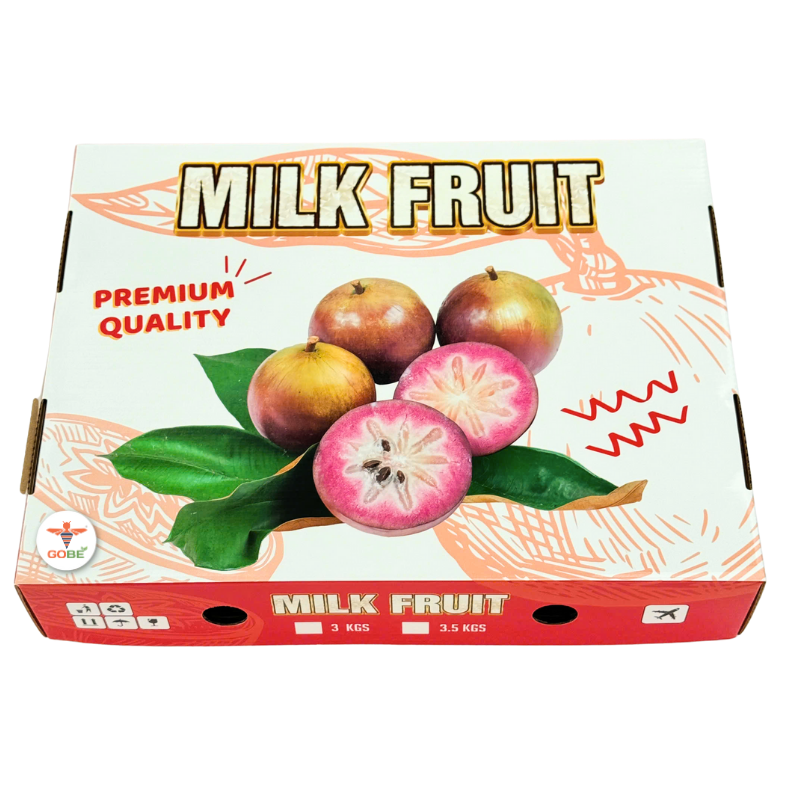
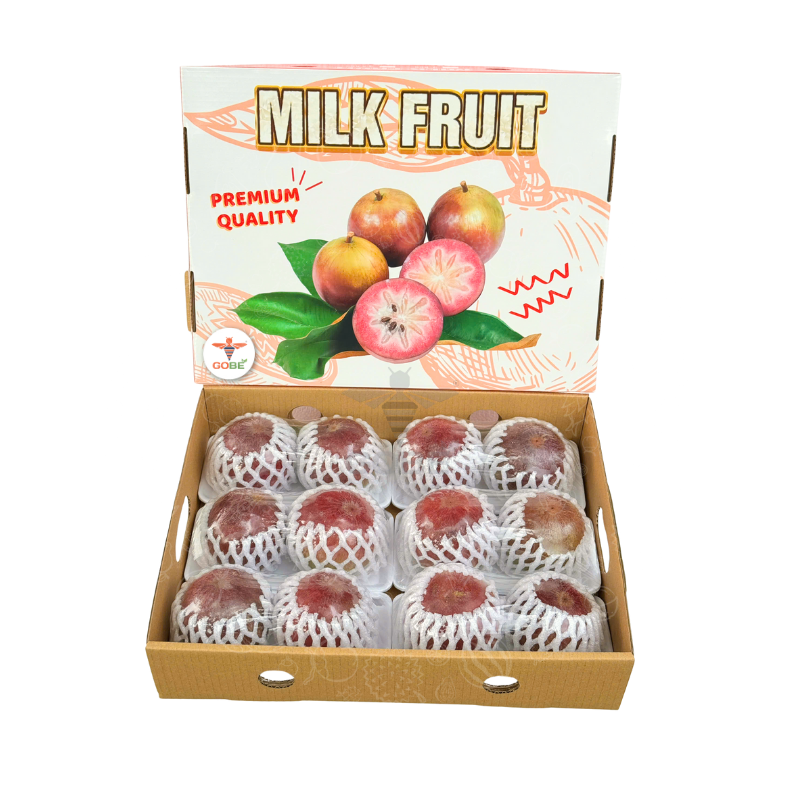
Export-grade milk fruit is packed in boxes of either 2.5 kg or 5 kg net weight, with individual fruit size ranging from 200 to 300 grams for Loren varieties and 250 to 400 grams for Jumbo Bo Hong and Golden Hoang Kim. All four varieties require air freight shipping due to shelf lives of 5 to 7 days, making sea freight commercially non-viable for any export destination beyond immediate neighboring countries. Meeting these packaging requirements is a precondition for customs clearance at every regulated destination market.
Packaging for export-grade milk fruit must meet the following requirements to protect product integrity and ensure compliance:
The cold chain requirement of 4 to 6 degrees Celsius must be maintained without interruption from the packing house through pre-cooling, airport handling, air cargo hold, and destination-country customs inspection. Any temperature excursion above this range accelerates softening and reduces the remaining shelf life available to the importer for distribution. Exporters who control their own refrigerated transport fleet from farm to airport offer a materially lower risk profile than those relying entirely on third-party cold chain providers.
Global market data on Vietnamese milk fruit exports shows consistent volume growth across four key regions: North America, Europe, the Middle East, and Asia, driven by diaspora community demand, fresh produce retail premiumization, and growing mainstream consumer awareness of exotic tropical fruits. Vietnam remains the dominant commercial source of export-grade milk fruit globally, with the Mekong Delta provinces of Tien Giang, Ben Tre, and Vinh Long accounting for the majority of cultivated area and commercial packing volume.
Understanding which markets are importing, what drives demand in each region, and how seasonal supply gaps create procurement risks helps buyers build smarter annual sourcing strategies.
The primary importing countries for Vietnamese milk fruit span four continents, with Canada, the UAE, the UK, Germany, the Netherlands, Japan, Kuwait, Russia, and the Maldives representing the most established volume-significant destination markets. Each region has distinct demand drivers that shape purchasing patterns and quality priorities.
Seasonal availability varies significantly across the four milk fruit varieties, creating supply gaps that buyers must plan around to maintain year-round product continuity. Purple Loren, Green Loren, and Jumbo Bo Hong share an identical seasonal pattern, while Golden Hoang Kim follows a more restricted calendar. Buyers who understand this seasonality before contracting can structure procurement agreements that avoid mid-year disruptions.
The table below presents the seasonal availability calendar for all four milk fruit varieties, distinguishing between high season, low season, and unavailable periods; this reference is essential for any buyer building a 12-month sourcing plan.
| Variety | High Season | Low Season | Unavailable |
|---|---|---|---|
| Purple Loren | Jan–Mar and Dec | Apr–May and Oct–Nov | Jun–Sep |
| Green Loren | Jan–Mar and Dec | Apr–May and Oct–Nov | Jun–Sep |
| Jumbo Bo Hong | Jan–Mar and Dec | Apr–May and Oct–Nov | Jun–Sep |
| Golden Hoang Kim | Jan and Nov–Dec | Feb–Mar and Oct | Apr–Sep |
For importers requiring year-round supply, June to September presents the most significant sourcing challenge, as all four varieties are unavailable during these months. Experienced exporters address this through two strategies: maintaining a diversified product portfolio that includes other Vietnamese tropical fruits with different seasonal windows such as longan, passion fruit, or papaya, and sourcing from multiple growing regions at different elevations or microclimates where harvest timing may vary from the Mekong Delta norm. Contracts with fixed monthly volumes across all 12 months are not commercially viable for milk fruit unless the supplier explicitly demonstrates how the June-to-September gap will be managed within a broader category arrangement.
Trusted milk fruit exporters are distinguishable from unreliable traders by three non-negotiable characteristics: full possession of internationally recognized certifications (GlobalGAP, GRASP, ISO, FDA, and Sedex), demonstrated control over the cold chain from farm to airport, and verifiable export history across multiple regulated markets with documented compliance records. The Vietnamese fresh produce export landscape includes both certified exporters who meet these criteria and a larger number of smaller traders who lack the infrastructure, documentation, and institutional knowledge to deliver consistent export-grade product.
Evaluating potential suppliers before committing to a commercial relationship requires a structured checklist approach rather than relying on self-reported claims or price alone.
Global buyers should evaluate milk fruit exporters across six criteria: international certification status, cold chain infrastructure ownership, year-round supply capability, export experience and market references, supply chain transparency, and documentation completeness. Each criterion addresses a distinct risk category that directly affects the buyer’s ability to import, sell, and profit from the product. Applying this checklist systematically filters out traders who cannot sustain commercial-grade performance across multiple shipment cycles.
Criteria that indicate a reliable exporter:
Red flags that indicate an unreliable supplier:
Gobeimex (Golden Bee Import Export Company Limited) qualifies as a reliable milk fruit supplier based on 12 years of export experience, 230-plus hectares of certified growing areas, five active international certifications, and a dual packing house model that delivers farm-to-pack processing within 12 hours of harvest. The company exports to more than 10 countries across North America, Europe, the Middle East, and Asia, maintaining supply continuity for 52 weeks per year. This operational foundation directly addresses the highest-risk points global buyers face when sourcing milk fruit.
Global buyers interested in establishing a milk fruit supply relationship with Gobeimex can contact the team directly:
Milk fruit occupies a strategically complementary position within Vietnam’s tropical fruit export portfolio compared to durian, longan, jackfruit, passion fruit, and papaya, with its primary differentiators being higher air freight dependency due to short shelf life, premium price positioning, and strong appeal in specific diaspora and premium retail segments. For importers looking to diversify their Vietnamese tropical fruit assortment, milk fruit adds meaningful category breadth without directly competing with the volume and logistics profile of sea-freight commodities like durian or longan. Each Vietnamese tropical fruit carries a distinct commercial viability profile that determines how it fits into an importer’s product strategy.
The table below compares five Vietnamese export fruits by shelf life, shipping method, sugar content range, and primary certification requirement, helping buyers assess which product combination best balances logistics cost, risk, and margin.
| Fruit | Shelf Life | Shipping | Sugar (%) | Key Certification |
|---|---|---|---|---|
| Milk Fruit | 5–7 days | Air | 13–18 | GlobalGAP, FDA |
| Longan | 7–14 days | Air/Sea | 18–22 | GlobalGAP |
| Durian | 30+ days (frozen) | Sea (IQF) | 25–35 | GlobalGAP, FDA |
| Passion Fruit | 14–21 days | Air/Sea | 12–18 | GlobalGAP |
| Papaya | 14–21 days | Sea | 10–15 | GlobalGAP |
Phytosanitary and import regulations for milk fruit vary by destination, with Japan, the EU, and the United States applying the most stringent inspection and documentation requirements. The EU enforces strict MRL limits aligned with Regulation (EC) No 396/2005, requiring COA documentation from an accredited laboratory for each shipment. Japan requires compliance with the Japan Positive List System for pesticide residues, which sets very low tolerance limits and requires pre-export inspection by authorized Vietnamese competent authorities. The United States requires FDA registration and FSVP compliance from both the exporter and the U.S. importer of record. The UAE requires standard phytosanitary certificates and halal-compatible production practices, with no specific additional regulatory barriers beyond general food safety compliance. All markets universally require a Phytosanitary Certificate issued by Vietnam’s Plant Protection Department, a Certificate of Origin, and a Certificate of Analysis covering key pesticide residues relevant to the destination market’s regulatory framework.
Milk fruit’s 5 to 7-day shelf life makes sea freight commercially non-viable for any destination beyond neighboring countries, creating a mandatory air freight dependency that directly increases landed cost for importers. Air freight for fresh produce from Ho Chi Minh City to major destination airports in Canada, the UAE, the UK, or Japan typically adds USD 2.50 to USD 5.00 per kilogram to the total landed cost, depending on routing, consolidation volumes, and seasonal rate fluctuations. This cost is offset by milk fruit’s premium market positioning and relatively high FOB value compared to sea-freight commodities.
Exporters optimize logistics costs through three strategies:
For Golden Hoang Kim, with its 5-day shelf life, departure timing is critical. Flights departing in the early morning from Ho Chi Minh City to the UAE or Japan typically arrive with 3 to 3.5 days of remaining shelf life at the destination, giving the importer a commercially viable distribution window only if customs clearance and cold storage handoff at the destination are completed within 12 to 24 hours of arrival.
Gobeimex — Elevating Vietnamese Produce, Connecting Global Markets.
📧 Info@gobeimex.com | 📞 +84 939 93 54 55 | 🌐 https://gobeimex.com