Subtotal $0.00

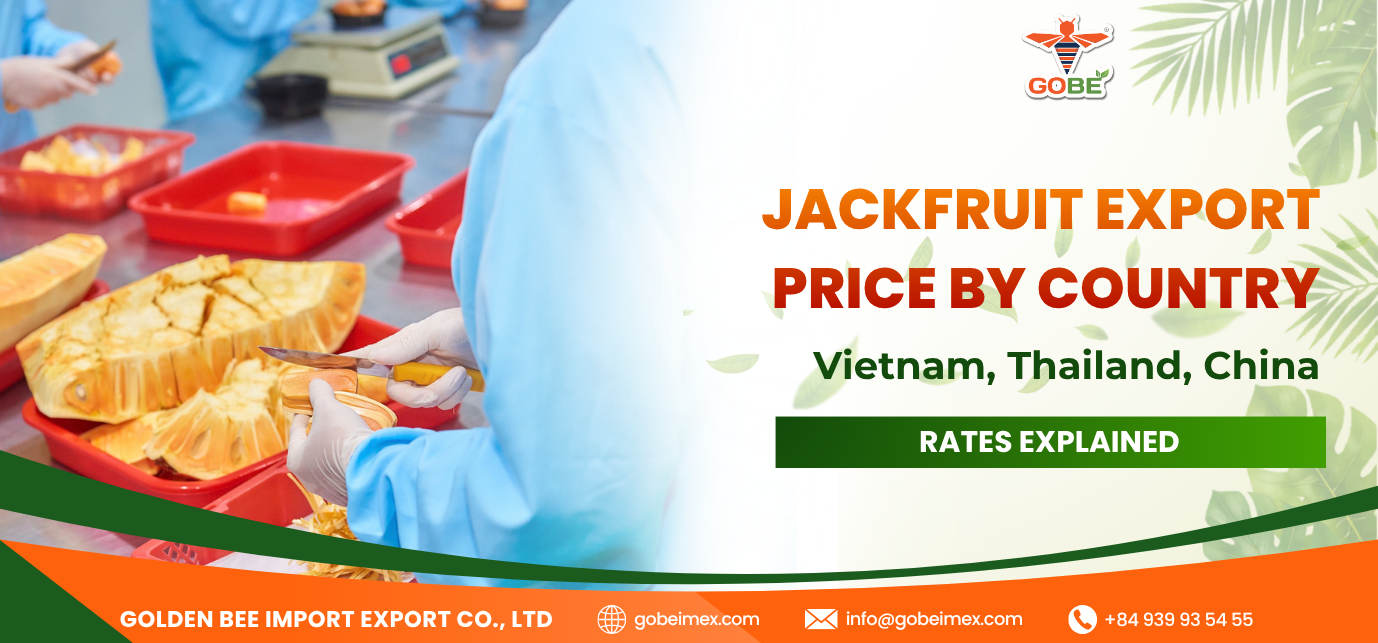
Jackfruit export price is not a single fixed number. It is a layered cost structure that varies by country of origin, product form, quality certification, and trade terms, with Vietnam, Thailand, and China each occupying a distinct position in the global market. Understanding what is included in a quoted export price, whether FOB, CIF, or EXW, is the first step before any meaningful comparison between sourcing destinations can begin.
Vietnam, Thailand, and China represent the three dominant jackfruit-exporting nations, but their price ranges diverge significantly. Vietnam currently offers FOB prices ranging from $0.80 to $2.50/kg depending on whether the product is fresh, frozen, or dried. Thailand positions itself in the $1.20 to $2.80/kg bracket with a stronger emphasis on processed forms. China, with most production consumed domestically, exports at $0.70 to $1.80/kg but with limited year-round availability for international buyers.
The differences in jackfruit export rates between these three countries are explained by a combination of growing conditions, labor costs, cold chain infrastructure, quality certification requirements, and trade agreement positioning. To make the right sourcing decision, importers need to understand not only the headline price but also what drives each number and how those drivers shift across seasons, markets, and product categories.
Jackfruit export price is the agreed monetary value per kilogram or per metric ton at which jackfruit leaves the country of origin under specific trade terms, covering raw material, processing, packaging, cold chain logistics, and certification costs embedded in the quoted figure. This section breaks down the three most common trade terms, the product forms that generate different price levels, and the cost components that explain why jackfruit export prices are never fixed.
Understanding these foundations matters because two exporters quoting different prices for “jackfruit” may be quoting under different trade terms, for different product grades, or with different certification levels included.
FOB, CIF, and EXW define the boundary of financial responsibility between seller and buyer, and each produces a different price figure for the same product. Importers who conflate these terms risk misreading cost comparisons between origins.

The three terms work as follows for jackfruit importers:
For the purpose of comparing jackfruit export prices across Vietnam, Thailand, and China in this article, all reference rates are expressed in FOB USD/kg unless otherwise noted, as this is the standard benchmark used in fresh produce international trade.
Fresh whole jackfruit, frozen jackfruit, dried jackfruit, and canned jackfruit each carry a different FOB price because of the processing investment, shelf life, and cold chain requirements involved. The more processing required, the higher the per-kilogram value and the less the price is affected by seasonal harvest fluctuations.
The table below summarizes how product form affects the jackfruit export price bracket across the three countries covered in this article. It provides a fast reference for importers comparing product forms before entering detailed sourcing discussions.
| Product Form | Processing Level | Cold Chain Required | Typical FOB Price Range (USD/kg) |
|---|---|---|---|
| Fresh whole jackfruit | Minimal: grading, washing, packing | Continuous refrigeration | $0.80 to $1.50 |
| Frozen jackfruit (IQF) | Medium: cutting, seeding, freezing | Frozen cold chain | $1.20 to $2.20 |
| Dried jackfruit | High: slicing, dehydrating, packaging | Ambient acceptable | $1.80 to $4.50 |
| Canned jackfruit | High: brining, canning, sterilization | Ambient acceptable | $1.50 to $3.80 |
Fresh whole jackfruit is the most price-sensitive product form because it requires an unbroken cold chain and carries the shortest shelf life of any form listed above.
Jackfruit export prices are not fixed because they are built from multiple cost components, each of which changes with market conditions, season, and buyer requirements. Importers who understand the component structure are better positioned to evaluate competing quotations accurately.
The core components that make up a jackfruit FOB export price include:
Understanding this structure means that when two exporters from the same country quote different prices for “jackfruit,” the difference may reflect different product grades, different certification levels, or different cold chain standards rather than simple price competition.
Vietnam, Thailand, and China export jackfruit at different FOB price ranges depending on product form, quality grade, and certification level. Vietnam offers strong competitive value for certified fresh and frozen product; Thailand leads in processed forms; China primarily supplies volume markets at lower price points with limited export availability.
The table below provides a starting reference point for the three countries before the detailed breakdown by section.
| Country | Fresh FOB (USD/kg) | Frozen FOB (USD/kg) | Dried FOB (USD/kg) | Primary Export Markets |
|---|---|---|---|---|
| Vietnam | $0.80 to $1.50 | $1.20 to $2.00 | $2.00 to $4.00 | China, UAE, Canada, EU, Japan |
| Thailand | $1.00 to $1.80 | $1.50 to $2.80 | $2.50 to $4.50 | EU, USA, Japan, Middle East |
| China (Hainan) | $0.70 to $1.30 | $1.00 to $1.80 | $1.80 to $3.50 | Southeast Asia, limited EU |
The sections below explain the specific dynamics behind each country’s pricing in greater detail.
Vietnam’s current jackfruit export price ranges from $0.80 to $1.50/kg FOB for fresh whole jackfruit, $1.20 to $2.00/kg for frozen IQF jackfruit, and $2.00 to $4.00/kg for dried jackfruit, with certified product (GlobalGAP, FDA) commanding prices at the upper end of each range. Vietnam’s pricing is shaped by several interconnected factors that importers should understand before engaging with exporters.

Growing regions and their price influence:
Vietnam’s primary jackfruit-growing provinces are Tien Giang, Dong Nai, and Binh Phuoc. Tien Giang, located in the heart of the Mekong Delta, is particularly significant because packing houses in this region, including Gobeimex’s main facility, move fruit from farm to packing completion within 12 hours of harvest. This speed directly protects product quality and reduces post-harvest loss, which in turn supports a more stable export price with fewer quality rejections at the destination port.
Certification and its price impact:
Vietnam’s exporters who hold GlobalGAP and FDA certifications can access premium markets such as Canada, the UAE, the United Kingdom, and Germany. Certified product commands a price premium of $0.15 to $0.30/kg above uncertified product from the same growing region, because certification eliminates border rejection risk and satisfies retailer and supermarket requirements directly.
Seasonal harvest calendar and price by month:
Vietnam has two main jackfruit harvest peaks: the primary season from March to June and a secondary season from September to November. During peak harvest, farm gate prices drop and FOB prices for fresh jackfruit move toward the lower end of the range at $0.80 to $1.00/kg. During the off-season, FOB prices for fresh product rise to $1.30 to $1.50/kg as supply tightens, while frozen jackfruit maintains more stable pricing across the calendar through cold storage inventory.
Export destinations and their price requirements:
Vietnam’s largest jackfruit export destination by volume is China, where large quantities of fresh and semi-processed jackfruit are traded at competitive prices. Value-added exports to the UAE, Canada, the European Union, and Japan require higher quality standards and certified product, which generates higher FOB prices per kilogram. Gobeimex supplies certified fresh and frozen jackfruit to buyers in Canada, the UAE, the UK, Germany, and the Netherlands, markets that consistently require GlobalGAP and FDA-compliant sourcing documentation.
For importers requesting FOB quotations from Vietnam, the standard reference unit is per metric ton (MT), with 1 MT equivalent to 1,000 kg. A container of frozen IQF jackfruit at $1.60/kg FOB Ho Chi Minh City translates to $1,600 per MT, and a 20-foot reefer container carries 18 to 22 MT of frozen product depending on packaging format.
Thailand’s current jackfruit export price ranges from $1.00 to $1.80/kg FOB for fresh jackfruit and $1.50 to $2.80/kg for frozen and processed forms, with Thailand’s export positioning driven by its strong brand recognition in the EU, USA, and Japanese markets for processed tropical produce. Thai FOB prices sit above Vietnamese reference prices for comparable product forms because of distinct varietal, labor, and processing dynamics.
Key jackfruit varieties and price positioning:
Thailand exports primarily the “Chompa” variety (also known as J33) and the “Golden Pillow” cultivar. These varieties are known for their thick, sweet flesh and low seed-to-flesh ratio, which makes them attractive for processed and fresh-cut applications. The premium positioning of these varieties in European and Japanese markets allows Thai exporters to command higher FOB prices per kilogram than their Vietnamese counterparts in some product categories.
Processing capacity and value-added exports:
Thailand has invested significantly in industrial-scale fruit processing infrastructure over the past two decades. A higher proportion of Thailand’s jackfruit exports leave the country in frozen, canned, or dried form rather than fresh. Frozen canned jackfruit in brine from Thailand is widely distributed through retail channels in the EU and North America at price points that reflect the processing and branding investment embedded in the FOB quote.
Export volume and trade relationships:
Thailand exports jackfruit to over 40 countries, with the European Union, the United States, Japan, and the Middle East representing its core destination markets. The volume and consistency of these trade relationships allows Thai exporters to maintain relatively stable price expectations even during seasonal fluctuations, because processed and frozen inventory buffers the impact of fresh harvest variability.
Quality grade and standard:
Thailand’s export industry is governed by a well-established quality control infrastructure at the national level, with the Department of Agriculture setting and enforcing phytosanitary and pesticide residue standards. Most Thai jackfruit exporters targeting the EU and USA hold HACCP and ISO certifications, and a growing number are pursuing GlobalGAP registration. These compliance costs are embedded in the FOB price.
China’s jackfruit export price ranges from $0.70 to $1.30/kg FOB for fresh product from Hainan Province, with limited availability for international buyers because the vast majority of China’s jackfruit production is consumed domestically. Understanding China’s position in the global jackfruit export market requires understanding the fundamental difference between a country that produces jackfruit and one that is a net exporter of it.
Domestic consumption vs. export availability:
China produces a significant volume of jackfruit annually, but domestic consumption, driven by rapid growth in fresh tropical fruit demand from China’s urban middle class, absorbs the overwhelming majority of production. This dynamic means jackfruit prices within China are heavily influenced by domestic retail demand, and the available surplus for export is often limited and inconsistent across seasons.
Hainan as the origin and its price implications:
Jackfruit grown in Hainan Province is harvested from March through October. The distance from Hainan to major international export ports, primarily Guangzhou or Tianjin, adds a logistics cost component to the FOB price that does not apply to Vietnamese exporters shipping from Ho Chi Minh City or Thai exporters shipping from Bangkok or Laem Chabang. This geography means that China’s headline FOB price advantage on a per-kilogram basis can be partially offset by longer inland logistics.
Product form and export focus:
China’s jackfruit exports are primarily in fresh and semi-processed form, directed toward neighboring Southeast Asian markets and, to a smaller degree, the Middle East. China does not have the same infrastructure for GlobalGAP or FDA-compliant jackfruit export at scale as Vietnam or Thailand, which limits its access to the premium markets of North America, the European Union, and Japan.
For importers sourcing from China, the price range of $0.70 to $1.30/kg FOB reflects volume-oriented trade rather than quality-premium positioning, and supply reliability across 52 weeks is lower than what established exporters in Vietnam or Thailand can provide.
Vietnam wins on price competitiveness for certified fresh and frozen jackfruit targeting Middle Eastern and North American markets; Thailand leads on processed and canned jackfruit for EU and Japanese premium retail; China offers the lowest headline prices but with significant constraints on export availability, certification coverage, and year-round supply reliability. The comparison below addresses which country suits which buyer profile, based on the four dimensions that matter most: FOB price, product form, quality certification, and export market alignment.
The table below summarizes the key differences across the three countries along the dimensions most relevant to an importer’s sourcing decision. It provides a single-reference view of how Vietnam, Thailand, and China compare on every dimension that affects total cost and supply reliability.
| Comparison Dimension | Vietnam | Thailand | China (Hainan) |
|---|---|---|---|
| Fresh FOB (USD/kg) | $0.80 to $1.50 | $1.00 to $1.80 | $0.70 to $1.30 |
| Frozen FOB (USD/kg) | $1.20 to $2.00 | $1.50 to $2.80 | $1.00 to $1.80 |
| Dried FOB (USD/kg) | $2.00 to $4.00 | $2.50 to $4.50 | $1.80 to $3.50 |
| Certifications available | GlobalGAP, FDA, ISO, GRASP, Sedex | HACCP, ISO, GlobalGAP (growing) | Limited international certification |
| Year-round supply (52 weeks) | Yes, fresh and frozen inventory | Yes, processed inventory | Limited due to domestic absorption |
| Primary export destinations | UAE, Canada, UK, Germany, Japan | EU, USA, Japan, Middle East | Southeast Asia, limited Middle East |
| Cold chain infrastructure | Strong, unbroken farm-to-port | Strong | Moderate |
| Typical minimum order volume | 1 x 20ft reefer container | 1 x 20ft reefer container | Negotiable, less consistent |
Which country is most price-competitive by product segment?
For fresh whole jackfruit targeting volume buyers in the Middle East and Southeast Asia, Vietnam offers the strongest combination of competitive FOB pricing and certification compliance. Exporters like Gobeimex, operating packing houses in Tien Giang with farm-to-pack cycles under 12 hours, can deliver fresh certified jackfruit to Dubai or Kuwait at price points that are difficult for Thai competitors to match without sacrificing margin.
For frozen IQF jackfruit targeting European supermarkets and North American retailers, Thailand has historically had stronger brand presence and more established trade lanes. Vietnamese frozen jackfruit certified under GlobalGAP and FDA is increasingly competitive in these markets, particularly for buyers looking to diversify their sourcing away from a single origin.
For dried and canned jackfruit targeting specialty health food and Asian grocery retail, Thailand leads in price positioning because of its deeper processing infrastructure and established retail relationships. Vietnamese dried jackfruit is competitive on price but is still building brand recognition in premium retail channels.
For buyers prioritizing the lowest possible headline price without a requirement for international certification, China’s Hainan-origin product may appear attractive on paper. Importers should factor in supply reliability constraints, limited certification coverage for regulated markets, and the additional documentation burden when importing from an origin with less established phytosanitary trade protocols with the destination country.
Premium vs. volume market alignment:
The most important strategic question for an importer is not “which country is cheapest?” but rather “which country’s price structure is most appropriate for my market’s requirements?” A European organic health retailer, a Middle Eastern supermarket chain, and a Southeast Asian food service distributor have fundamentally different sourcing requirements, and the optimal country of origin differs accordingly.
The differences in jackfruit export rates between Vietnam, Thailand, and China are explained by five core factors: growing conditions and input costs, labor cost differentials, cold chain infrastructure investment, quality certification requirements, and the volume-to-export ratio of each country’s domestic production. These factors combine differently in each country, which is why a simple price-per-kilogram comparison between origins often obscures more than it reveals for importers making informed sourcing decisions.
Yes, growing conditions and labor costs significantly affect jackfruit export price, because they determine the farm gate cost of raw material and the per-unit processing expense that forms the foundation of the FOB price before logistics and certification are added. These two inputs are the most consequential cost variables beneath the quoted FOB figure.
Climate and soil conditions by country:
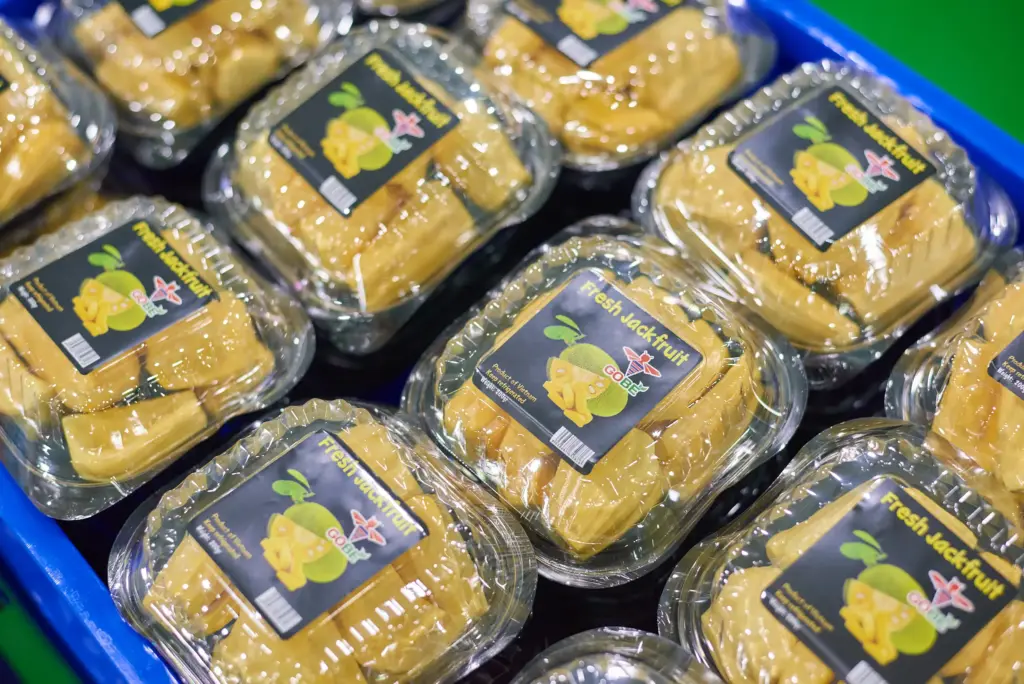
Vietnam’s Mekong Delta region, particularly Tien Giang Province, benefits from fertile alluvial soil, high humidity, and consistent rainfall patterns that support high-yield jackfruit cultivation with relatively low input costs per kilogram. The proximity of growing areas to packing facilities, a geographic advantage that Gobeimex has deliberately structured into its supply chain, minimizes post-harvest loss and reduces the transport cost component between farm and packing house.
Thailand’s central and eastern fruit-growing regions have similarly favorable tropical conditions, but land costs in Thailand are higher than in Vietnam’s Mekong Delta, which pushes the farm-gate price of raw material upward. Thailand’s agricultural labor costs are approximately 30 to 45% higher than Vietnam’s on a per-day equivalent basis, which directly influences the per-kilogram processing cost at the packing house level.
China’s Hainan Province experiences a tropical monsoon climate suitable for jackfruit cultivation, but the island’s geography creates higher inland logistics costs for moving product from growing areas to export ports on the mainland. Labor costs in Hainan’s agricultural sector have risen significantly over the past decade as the region has developed its tourism and service economy, reducing the labor cost advantage that once made Hainan-origin fruit more competitive on price.
Distance from growing area to export port:
The distance and infrastructure quality between growing areas and the port of export represents a cost component that is easy to overlook when comparing headline FOB prices. In Vietnam, the combination of growing areas in Tien Giang, approximately 70 km from Ho Chi Minh City port, and the use of dedicated refrigerated container trailers by exporters like Gobeimex means cold chain integrity is maintained with minimal cost overhead. Moving product from interior growing areas of Thailand to Laem Chabang port, or from Hainan to a mainland Chinese export hub, involves longer distances and higher refrigerated transport costs per kilogram.
Yes, quality certification drives higher jackfruit export prices in a measurable and consistent way, because certification is the mechanism by which exporters gain access to premium markets with higher FOB price expectations and stricter residue tolerance requirements. The price premium received in certified markets more than compensates for the annual certification cost embedded in the FOB quote.
The following breakdown illustrates the approximate cost contribution of each major international certification to the export price structure of jackfruit:
Certified vs. uncertified product: the real-world price differential:
In practical terms, the price differential between certified and uncertified jackfruit of equivalent quality grade is $0.20 to $0.50/kg on the FOB quote. A buyer comparing a $0.90/kg FOB price from an uncertified exporter with a $1.15/kg FOB price from a GlobalGAP and FDA-certified exporter is not comparing the same product risk profile. The certified product eliminates border rejection risk, satisfies retailer audit requirements, and carries documented traceability from farm to port, all of which have real financial value when considered against the cost of a rejected container at a destination port.
Gobeimex holds GlobalGAP, GRASP, ISO, FDA, and Sedex certifications across its jackfruit export operations. This certification portfolio is the reason Gobeimex supplies jackfruit to supermarket chains in Canada, the UAE, the UK, Germany, the Netherlands, and Japan, markets where certification is a non-negotiable minimum standard, not a premium feature.
Yes, jackfruit export price shifts meaningfully across all three dimensions: seasonal harvest cycles create price volatility for fresh product; trade agreements and import tariffs alter the effective landed cost at the destination market; and certification level creates a structural price differential that persists regardless of season or trade policy. These three variables represent a more advanced layer of price analysis for importers who have already understood the baseline FOB rates and are now optimizing their sourcing strategy for specific markets and commercial objectives.
RCEP, CPTPP, and bilateral FTAs between Vietnam and key import markets directly reduce the import tariff applied to jackfruit at the destination port, which lowers the effective CIF landed cost for importers and in some cases creates a meaningful landed price advantage for Vietnamese-origin jackfruit over Thai or Chinese origin in the same destination market. The tariff impact works as follows for three key destination markets:
Yes, organic-certified jackfruit commands a significantly higher export price than conventional jackfruit, with the premium ranging from 30 to 80% above the conventional FOB equivalent depending on the destination market and buyer segment. Organic jackfruit FOB prices from Vietnam and Thailand range from $1.50 to $3.50/kg for fresh certified organic product, compared to $0.80 to $1.80/kg for conventional certified product of equivalent grade.
The markets with the highest organic price absorption capacity are the European Union, particularly Germany and the Netherlands, North America covering Canada and the United States, and Japan. All three are markets where health-conscious consumer segments are willing to pay a retail price premium that sustains the higher FOB cost at origin. For importers targeting premium health food retail or organic grocery channels, organic-certified jackfruit from Vietnam or Thailand represents a micro-niche sourcing opportunity that conventional price tables do not capture. Gobeimex can discuss organic sourcing options and minimum volume requirements directly with interested importers through its dedicated export inquiry channel at Info@gobeimex.com.
Gobeimex — Elevating Vietnamese Produce, Connecting Global Markets.
Golden Bee Import Export Company Limited supplies certified fresh and frozen jackfruit from Vietnam to importers, distributors, and supermarkets across Canada, the UAE, the United Kingdom, Germany, the Netherlands, Japan, Kuwait, and beyond. With GlobalGAP, FDA, ISO, GRASP, and Sedex certifications, a 12-hour farm-to-pack cycle, and 52-week supply availability, Gobeimex provides the quality and reliability that premium markets require.
For FOB price quotations, product specifications, and sourcing inquiries, contact the Gobeimex export team at Info@gobeimex.com or visit gobeimex.com. WhatsApp inquiries: +84 939 93 54 55.