Subtotal $0.00

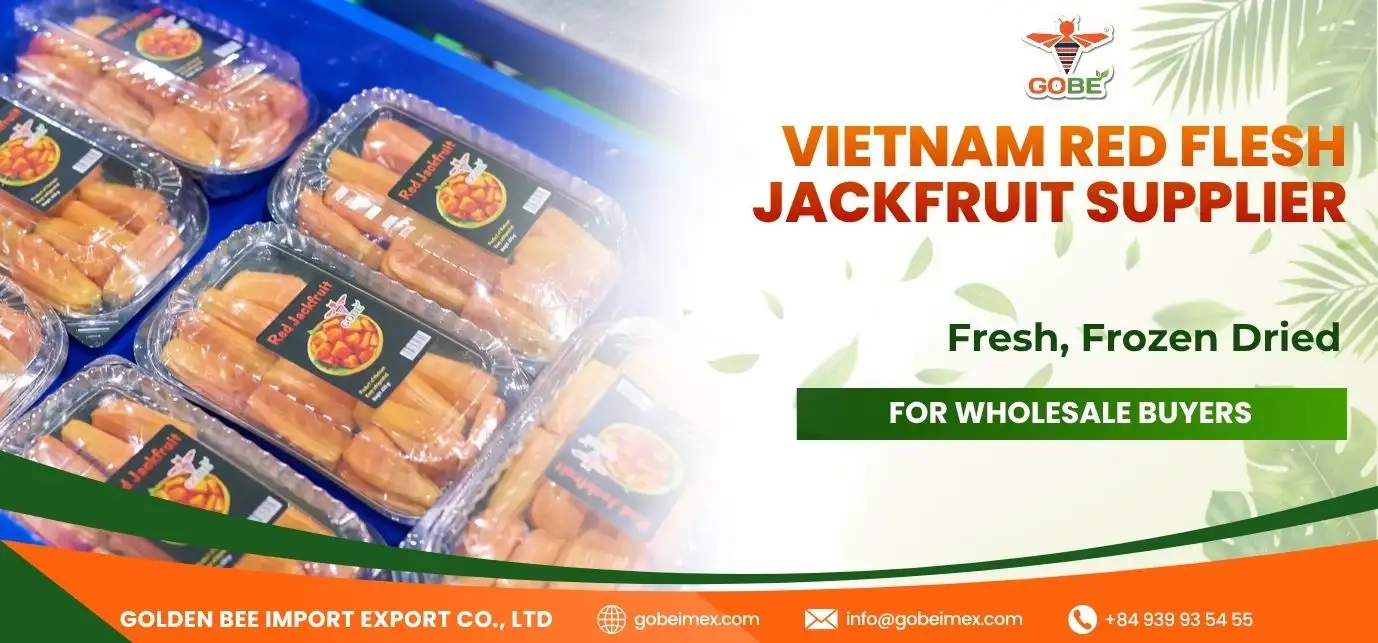
Vietnam is one of the world’s leading sources of red flesh jackfruit, offering wholesale buyers a reliable, year-round supply in fresh, frozen, and dried forms backed by internationally recognized certifications. As import demand for tropical specialty produce continues to climb across Europe, North America, and the Middle East, sourcing directly from a verified Vietnam supplier gives distributors and food manufacturers a decisive competitive edge in both quality and cost.
The three product forms available from Vietnam red flesh jackfruit suppliers — fresh whole fruit, IQF frozen segments, and dried jackfruit — each serve distinct commercial applications, from supermarket fresh produce aisles to industrial food manufacturing lines. Understanding the specifications, shelf life, and packaging options for each form is the critical first step before placing a wholesale order.
Beyond product availability, wholesale buyers evaluating a Vietnam jackfruit supplier need to verify certifications, confirm minimum order quantities, review standard trade terms, and request samples before committing to a long-term supply agreement. The sections below address each of these requirements in the sequence that a professional importer or distributor would naturally follow during the sourcing process.
Related posts:
Vietnam red flesh jackfruit is a premium tropical variety distinguished by its deep orange-to-red pigmented flesh, sweeter aromatic profile, and firmer pod texture compared to common yellow or white flesh jackfruit — making it increasingly sought after by wholesale buyers targeting specialty and health-oriented retail channels.
To fully appreciate why Vietnam commands the attention of global importers, it helps to understand both the intrinsic qualities of the fruit itself and the structural advantages Vietnam holds as a producing country.
Red flesh jackfruit is identified primarily by its carotenoid-rich flesh, which ranges from deep golden-orange to a distinctly reddish hue depending on variety and maturity stage. This pigmentation is not cosmetic — it reflects a higher concentration of beta-carotene and lycopene compared to standard yellow-flesh cultivars, attributes that increasingly attract health food retailers and functional food brands in the EU and North American markets.
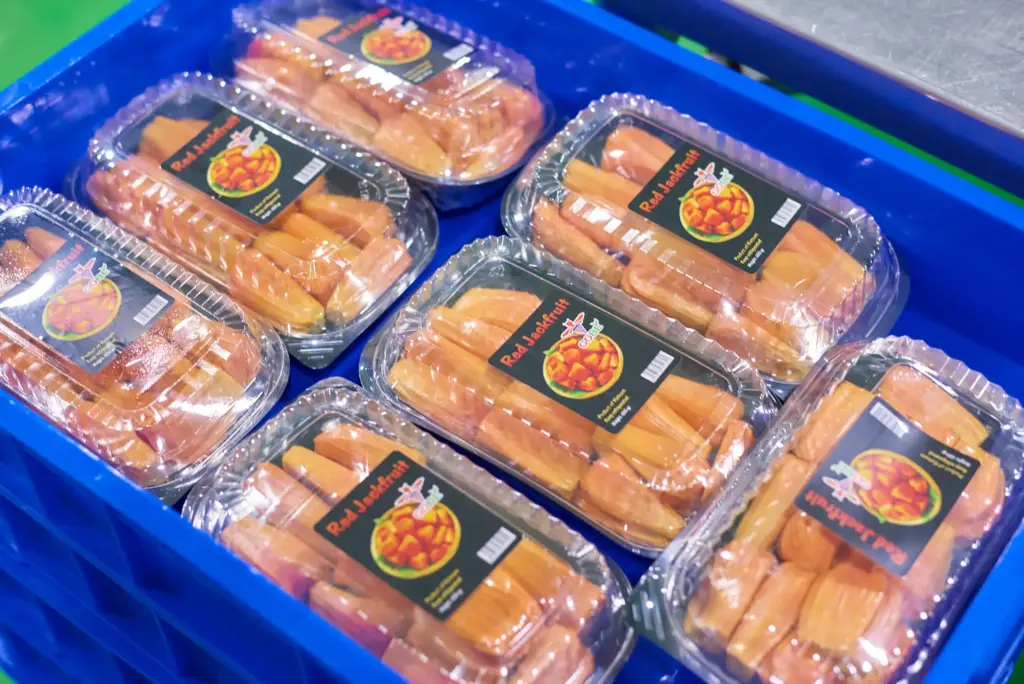
Texturally, red flesh jackfruit pods are notably firmer and more fibrous than yellow-flesh varieties, which translates directly into better performance in cooked and processed applications. When ripened, the flesh delivers a pronounced tropical sweetness with subtle floral notes. When harvested young and unripe, the same firm, meat-like texture makes it an ideal ingredient for plant-based food manufacturing. This dual-use versatility — fresh ripened fruit for consumer retail and young fruit for food processing — gives red flesh jackfruit a broader commercial footprint than single-use tropical commodities.
The Brix reading of export-grade ripe red flesh jackfruit typically falls between 20 and 28 degrees, indicating natural sugar content that meets the flavor benchmarks required by premium fresh produce buyers in Japan, Germany, the Netherlands, and the UAE. Flesh-to-seed ratio is another key commercial metric: top-grade export fruit yields a pod-to-total-fruit ratio exceeding 30%, a threshold that directly affects the landed cost per kilogram of usable product for buyers.
Vietnam’s position as a preferred sourcing origin for wholesale jackfruit buyers is the result of several compounding advantages that are difficult for competitor origins to replicate simultaneously.
First, the Mekong Delta provinces of Tien Giang and Dong Thap — the heartland of Vietnam’s jackfruit cultivation — offer ideal tropical growing conditions: consistent high humidity, alluvial soil with excellent water retention, temperatures averaging 26 to 30 degrees Celsius year-round, and abundant rainfall distributed across multiple growing cycles. These conditions naturally accelerate fruit development and intensify the carotenoid pigmentation characteristic of red flesh varieties.
Second, Vietnam’s jackfruit sector has matured into a large-scale, professionally managed industry. Cultivation areas have expanded significantly over the past decade, and a growing proportion of farms have achieved GlobalGAP certification, enabling direct access to regulated markets in the EU, the UK, Japan, and the United States. This institutional maturity differentiates Vietnam from other tropical origins where supply chains remain fragmented and certification coverage is limited.
Third, Vietnam’s geographic position and established cold-chain logistics infrastructure allow reefer container shipments to reach major destination ports efficiently. Tien Giang’s packing facilities are strategically located within the growing region, and Ho Chi Minh City’s port infrastructure provides multiple weekly vessel departures to Europe, the Middle East, and Asia-Pacific. This logistics density reduces lead time variability, a critical consideration for supermarket buyers operating on tight replenishment windows.
Vietnam is consistently ranked among the top three jackfruit exporting nations globally, competing primarily with India, Bangladesh, and Thailand. However, Vietnam’s specific advantage in the wholesale export segment lies in its ability to supply certified, traceable, export-grade product at commercial volumes across all three product forms — fresh, frozen, and dried — simultaneously. This multi-form supply capability makes Vietnam a single-origin, multi-SKU source for buyers who want to consolidate their jackfruit procurement under one supplier relationship.
Key destination markets for Vietnamese jackfruit exports include Canada, the United States, Germany, the Netherlands, the United Kingdom, the UAE, Kuwait, Japan, and emerging Southeast Asian import markets. This geographic spread confirms that Vietnam’s quality standards are already accepted and validated across the most demanding regulatory environments in global food trade.
GOBE IMEX, trading as Golden Bee Vietnam (GoBe), is one of Vietnam’s established exporters operating in this space, with over 12 years of industry experience, more than 230 hectares of growing areas combining company-owned and GlobalGAP-certified partner farms, and a confirmed capacity to supply 52 weeks per year. The company’s main packing house is located in Tien Giang, positioned to move fruit from farm to pack within 12 hours of harvest, and a secondary facility in Ho Chi Minh City consolidates product from multiple growing regions to support a diversified product portfolio.
Yes — Vietnam red flesh jackfruit is available in all three commercial forms (fresh, frozen, and dried) for wholesale buyers, with each form supported by export-compliant packaging, international food safety certifications, and the ability to customize specifications to individual market or customer requirements.
This availability across multiple product forms is a significant practical advantage for importers and distributors who serve more than one sales channel or need to manage seasonal fresh supply gaps with frozen inventory. Below is an overview of each form and its primary commercial application, followed by detailed specifications in the sub-sections.
Fresh red flesh jackfruit targets supermarket chains, fresh produce importers, and specialty retailers in markets with direct access to reefer container logistics. Frozen IQF red flesh jackfruit serves food manufacturers, restaurant supply chains, meal kit companies, and ingredient distributors who need consistent supply with extended shelf life. Dried jackfruit — whether soft-dried, chewy, or crispy — addresses the snack food segment, health food retail, and ingredient requirements for baked goods, trail mix blends, and specialty confectionery.
All three forms can be supplied in retail-ready packaging, food service bulk format, or private label configurations depending on buyer requirements and destination market specifications.
Export-grade fresh red flesh jackfruit from Vietnam typically weighs between 5 and 25 kilograms per fruit, with a Brix level of 20 to 28 degrees for ripe commercial grade, and is processed and packed within 12 hours of harvest to preserve peak sensory quality and maximize shelf life at destination.
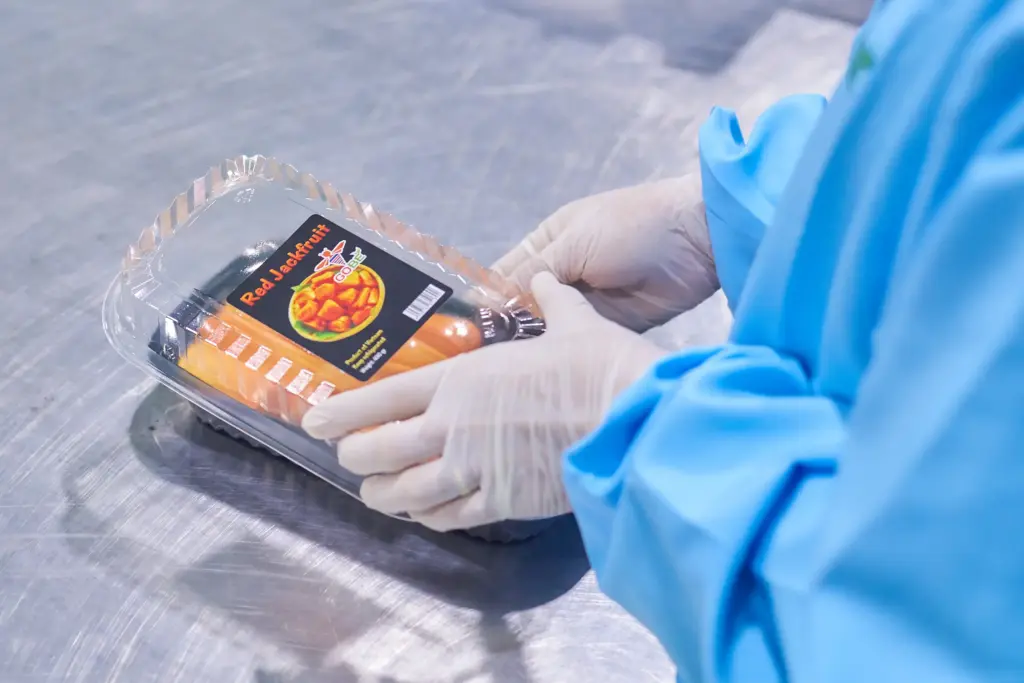
The post-harvest handling sequence for fresh export fruit follows a strict timeline. After harvest, fruit is transported immediately to the packing house — in the case of GOBE IMEX, this occurs within the same day given the Tien Giang packing facility’s proximity to growing areas. At the packing house, fruit undergoes washing and surface sanitization, visual grading for color uniformity and absence of physical defects, size sorting according to buyer specifications, and pre-cooling before packing into export cartons or crates.
Key technical specifications for wholesale buyers to confirm when ordering fresh red flesh jackfruit include:
Harvest timing in Vietnam’s Mekong Delta allows for commercial volumes from approximately March through November, with peak availability between May and August. Through a network of farms across different micro-zones and altitudes, suppliers like GOBE IMEX maintain supply continuity across 52 weeks by rotating harvest sources strategically. Fresh red flesh jackfruit is best suited for supermarket chains in the EU (Germany, Netherlands, UK), specialty Asian grocery channels in North America, and premium fresh produce importers in the UAE and Japan, all of which have established reefer shipping lanes from Ho Chi Minh City port.
Frozen IQF red flesh jackfruit and dried red flesh jackfruit from Vietnam serve fundamentally different buyer segments, with frozen optimized for food manufacturers requiring consistent raw material and dried targeting snack, health food, and ingredient distribution channels.
Frozen IQF Red Flesh Jackfruit: Key Specifications
IQF (Individual Quick Freezing) is the industry-standard freezing method applied to export-grade jackfruit segments from Vietnam. In this process, individual fruit pods are separated, cleaned, and passed through a cryogenic or mechanical blast freezing tunnel at temperatures between -35 and -40 degrees Celsius, ensuring that each piece freezes individually rather than bonding into a solid block. This method preserves cell structure, natural red pigmentation, pod texture, and flavor compounds far more effectively than conventional block freezing.
Standard export specifications for IQF frozen red flesh jackfruit include:
Dried Red Flesh Jackfruit: Key Specifications
Dried jackfruit is available in three processing styles: soft-dried (chewy texture, 18 to 22% moisture), medium-dried (snack-style, 12 to 15% moisture), and crispy-dried (low-moisture, chip-style, under 5% moisture). Red flesh dried jackfruit commands attention in premium snack segments due to its natural color differentiation from standard yellow-dried jackfruit products.
Standard dried specifications include:
Frozen vs. Dried: A Quick Comparison for Wholesale Buyers
The table below summarizes the key commercial trade-offs between frozen and dried red flesh jackfruit to help wholesale buyers determine which form best matches their distribution model and end-use customer requirements.
| Criteria | IQF Frozen | Dried |
|---|---|---|
| Shelf Life | 18 to 24 months at -18°C | 9 to 18 months at ambient |
| Shipping Cost | Higher (reefer required) | Lower (ambient container) |
| MOQ Flexibility | Medium (full pallet or container) | High (smaller orders feasible) |
| Primary End Use | Food manufacturing, food service | Snack retail, ingredient supply |
| Processing After Import | Minimal (ready to use) | None (shelf-stable) |
| Color Retention | Excellent (IQF preserves pigment) | Good (depends on drying method) |
Food manufacturers, restaurant supply chains, and meal kit operators benefit most from frozen IQF supply for its consistency and minimal downstream processing requirements. Snack brands, health food distributors, and ingredient resellers typically favor dried jackfruit for its ambient storage economics and longer retail shelf life.
A reliable Vietnam red flesh jackfruit supplier should hold at minimum five internationally recognized certifications: GlobalGAP, GRASP, ISO, FDA registration, and Sedex membership, each addressing a distinct compliance dimension that wholesale buyers and their retail or regulatory partners will scrutinize before approving a new supplier.
Certifications are not optional extras in the fresh and processed produce export business — they are the foundational proof points that a supplier’s quality claims can be independently verified. For buyers whose products will enter supermarket chains in Germany, the Netherlands, Canada, or Japan, supplier certification status is a non-negotiable prerequisite. Below is a breakdown of what each certification means in practice for wholesale buyers evaluating a Vietnam jackfruit supplier.
GlobalGAP certification is the minimum entry requirement for fresh produce exported to mainstream retail channels in the European Union and the United Kingdom, covering agricultural practices, pest management, post-harvest handling, traceability, and worker safety throughout the growing and packing operation.
Specifically for jackfruit buyers targeting EU supermarkets, GlobalGAP certification confirms that:
GRASP (GlobalGAP Risk Assessment on Social Practice) is the complementary social compliance module that many EU retailers, particularly in Germany, France, and the Netherlands, now require in addition to the agricultural standard itself. GRASP certification covers working conditions, labor rights, fair treatment of workers, and community impact assessments at farm level.
GOBE IMEX holds both GlobalGAP and GRASP certifications across its supply base, covering company-owned farms (30+ hectares) and partner-operated growing areas (200+ hectares), providing buyers with end-to-end traceability from the specific farm plot through to the export packing house.
ISO certification, FDA registration, and Sedex membership together cover the quality management, food safety compliance, and supply chain ethics dimensions that wholesale buyers in North America, the Middle East, and Asia require beyond the farm-level agricultural standards.
ISO certification (typically ISO 22000 or FSSC 22000 for food safety management systems) confirms that the supplier’s packing and processing operations are governed by a documented, auditable quality management system with defined control points, corrective action procedures, and continuous improvement processes. For buyers placing large repeat orders, ISO certification is evidence that the operational consistency required to maintain spec compliance across multiple shipments is systematically managed rather than relying on individual operators.
FDA registration is the mandatory compliance requirement for any food product exported to the United States, confirming that the facility has registered with the U.S. Food and Drug Administration and complies with the Food Safety Modernization Act (FSMA) requirements for preventive controls, supplier verification, and foreign supplier verification programs (FSVP). Without FDA registration, a Vietnam jackfruit supplier cannot legally ship to the U.S. market.
Sedex (Supplier Ethical Data Exchange) membership enables buyers to access the supplier’s audit data on ethical trading practices, including labor rights, health and safety, business ethics, and environmental management, through the shared Sedex platform. This is particularly valuable for buyers who are themselves required to conduct supply chain due diligence under emerging EU corporate sustainability reporting requirements.
To verify a supplier’s certification status before signing a contract, buyers should request the current certification certificates with issue and expiry dates, the name of the accredited certification body, and where applicable, the GlobalGAP Number (GGN) which can be independently verified through the GlobalGAP database. GOBE IMEX provides documentation for all five certifications upon request as part of its standard supplier qualification package.
Wholesale buyers source red flesh jackfruit from Vietnam through a structured B2B procurement process covering inquiry and sample request, quotation, contract confirmation, production scheduling, quality control inspection, and shipment, with standard trade terms varying by buyer location, product form, and order volume.
Understanding the full procurement workflow in advance allows buyers to plan lead times accurately, allocate internal resources for supplier qualification, and avoid common sourcing delays that arise from incomplete specification alignment early in the negotiation process.
The typical procurement sequence for wholesale red flesh jackfruit from Vietnam follows seven stages, beginning with initial inquiry and ending with documentation release for customs clearance at the destination port.

The stages are:
Minimum order quantities, pricing structure, and applicable Incoterms differ across the three product forms due to the different production economics, cold chain requirements, and shipment unit constraints involved.
For fresh red flesh jackfruit, the practical minimum order is typically one full reefer container (approximately 18 to 22 metric tons net weight depending on fruit size and packaging). Smaller trial orders via air freight are possible for initial sample evaluation but carry significantly higher freight costs per kilogram. Pricing is quoted FOB Ho Chi Minh City as the standard Incoterm, with CIF or CFR quotations available for buyers who prefer cost and freight included to destination port.
For IQF frozen red flesh jackfruit, MOQ is generally one full reefer container (20-foot or 40-foot depending on volume), with the option for LCL (less-than-container-load) shipments for buyers in the trial phase subject to additional handling charges. Pricing is typically quoted FOB or CIF, with price per metric ton varying based on product grade (young green vs. ripe), cut style (whole pod, halved, diced), and packaging format.
For dried red flesh jackfruit, MOQ is more flexible due to ambient temperature shipping, with some suppliers accepting pallet-level orders as entry orders. Dried product is quoted FOB or CIF and can be shipped in standard (non-refrigerated) containers, which significantly reduces freight cost compared to fresh and frozen.
Common payment terms in Vietnamese fresh produce export include:
Lead time from confirmed purchase order to cargo-ready date is typically 7 to 14 days for fresh jackfruit (aligned with harvest schedule), 14 to 21 days for frozen IQF production runs, and 14 to 28 days for dried production depending on order volume and current production schedule.
Wholesale buyers can specify custom packaging configurations including retail-ready consumer packs with private label printing, food service bulk formats, and export master cartons with buyer-specific labeling, barcodes, and nutritional information panels compliant with destination market labeling regulations (EU Regulation 1169/2011, FDA labeling requirements, etc.).
GOBE IMEX offers flexible packaging solutions across all three product forms. Buyers are encouraged to submit packaging specifications at the inquiry stage to allow the supplier to confirm feasibility, lead time for packaging material procurement, and any associated cost adjustments before issuing a final quotation.
To request a quotation, product samples, or detailed specifications for red flesh jackfruit in any of the three available forms, wholesale buyers can contact GOBE IMEX / Golden Bee Vietnam directly at Info@gobeimex.com or via phone and WhatsApp at +84 939 93 54 55. The full product catalog is also available for download at gobeimex.com.
Red flesh jackfruit outperforms yellow flesh jackfruit on premium positioning and food manufacturing versatility, while yellow flesh maintains a commercial advantage in high-volume mass market fresh sales and established dried snack segments.
For wholesale buyers making a sourcing decision between the two varieties, understanding the commercial differentiation helps align product selection with target sales channel and end-consumer profile.
Red flesh jackfruit is increasingly preferred by plant-based food manufacturers for its firmer pod texture, natural color intensity, and superior structural integrity after cooking, making it a more effective meat-analogue base ingredient than yellow flesh varieties, particularly for pulled-style protein applications.
When young green red flesh jackfruit is cooked and shredded, the fibrous pod structure closely replicates the texture of pulled chicken or pulled pork, a characteristic that has driven significant commercial interest from plant-based meal kit brands, vegan ready meal producers, and foodservice operators in the EU and North American markets. The natural reddish-orange pigmentation of the cooked flesh additionally provides visual differentiation from competitors using standard yellow jackfruit, supporting premium retail positioning. Specific applications include pulled jackfruit burger patties, jackfruit tacos, Asian-style curry with jackfruit, vegan jerky, and ready meal components. The plant-based food sector in the EU and US continues to expand at significant pace, and IQF frozen young green red flesh jackfruit from Vietnam is positioned as a clean-label, naturally preserved ingredient that requires no artificial additives or binders to perform in these applications.
IQF (Individual Quick Freezing) is the standard freezing method applied to export-grade red flesh jackfruit from Vietnam, using blast freezing at -35 to -40 degrees Celsius to freeze each individual pod separately, preserving cell integrity, red pigmentation, and natural flavor compounds more effectively than conventional block freezing methods.
The key advantage of IQF over block freezing for jackfruit specifically is that individual pods remain separated after freezing, allowing buyers to use precise quantities without thawing an entire block, and preserving the pod’s fibrous texture that is essential for plant-based meat applications. For wholesale buyers receiving IQF frozen red flesh jackfruit, quality evaluation at receipt should include checking the core temperature of the product (must be at or below -18°C), assessing the degree of clumping between individual pieces (excessive clumping indicates temperature break during transit), and inspecting the natural red color of the flesh after a controlled partial thaw of a representative sample. The cold chain requirement from GOBE IMEX’s Tien Giang packing house to the destination port is maintained through refrigerated trailer transport to Ho Chi Minh City port and -18°C reefer containers for the ocean freight leg, ensuring unbroken temperature control from production to the buyer’s receiving dock.