Subtotal $0.00


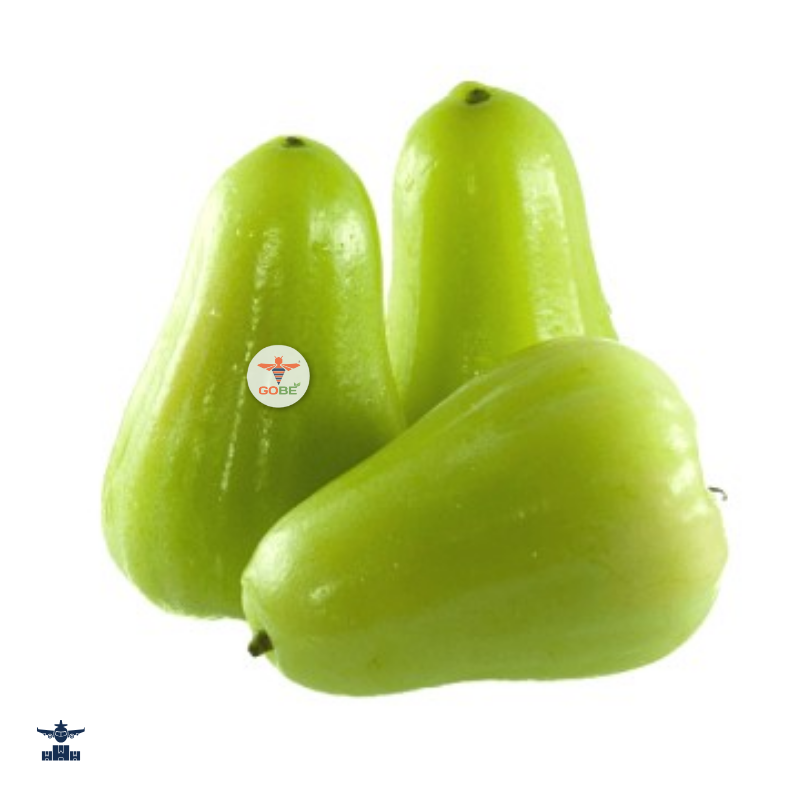
Wax Apple (Syzygium samarangense) is a tropical fruit native to Southeast Asia, identified by its bell-shaped body, glossy skin, and crisp seedless flesh with approximately 90% water content. Vietnam’s Mekong Delta is the primary export origin, where certified growing areas and packing houses convert harvested fruit to export-ready cartons within 12 hours, giving importers access to year-round supply at export-grade quality.
The flavor of Wax Apple is the first evaluation criterion for importers assessing retail acceptance. The fruit delivers a light, crisp bite with mildly sweet juice, no astringency, and a clean floral aftertaste. This profile positions Wax Apple as a strong candidate for health-conscious retail segments, fresh-cut programs, and premium supermarket shelves across Europe, North America, and the Middle East.
Trade names represent the most critical knowledge gap in Wax Apple import operations. The fruit is sold internationally as Java Apple, Rose Apple, Bell Fruit, Love Apple, Jambu Air, and Water Apple, and confusing these names in customs declarations, phytosanitary certificates, or product labels carries direct compliance risk at port of entry.
Wax Apple is the tropical fresh fruit of the species Syzygium samarangense, belonging to the Myrtaceae family, characterized by a bell shape, smooth wax-like skin, hollow interior, and seedless flesh, with two commercially available varieties differentiated by skin color, sugar content, and target market. This botanical identity is the foundation for every downstream document in the import process.
Specifically, this definition anchors the species name required on phytosanitary certificates, the physical attributes that determine packaging specifications, and the growing regions that determine supply reliability.
The name “Wax Apple” refers to the fruit’s naturally smooth, shiny skin surface, which resembles a wax coating without any post-harvest treatment applied. This visual characteristic makes Wax Apple immediately recognizable at point of sale and highly effective in fresh produce retail displays.
Wax Apple is cultivated across Vietnam, Thailand, Taiwan, Malaysia, and Indonesia. Among these origins, Vietnam has established itself as the primary export source, particularly from the Mekong Delta, where climate conditions, soil quality, and proximity to packing infrastructure produce export-grade fruit. The main packing house in Tien Giang Province processes fruit within 12 hours of harvest to lock in peak freshness before airfreight departure.
Two varieties are commercially available:
Both varieties share identical cold-chain requirements, shelf life parameters, and packaging specifications, meaning importers face no additional logistical differentiation between the two. Variety selection is market-driven rather than logistics-driven.
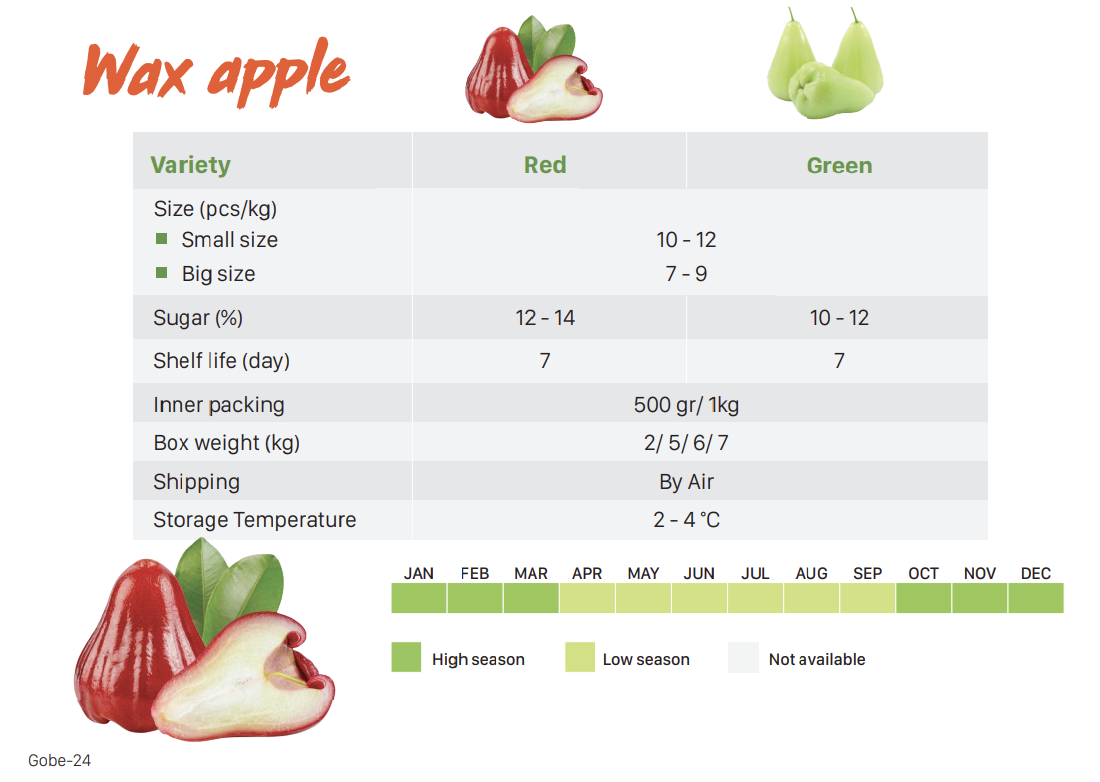
Wax Apple exports from Vietnam follow standardized specifications covering size grading, inner packing, carton weight, and cold-chain temperature, all of which importers must confirm in purchase orders and shipping instructions before the first shipment is booked. The table below summarizes all key product specifications for both commercially available varieties.
This specification table allows importers to align packaging requests, retail format requirements, and logistics planning against confirmed supply parameters from Vietnamese exporters.
| Specification | Red Wax Apple | Green Wax Apple |
|---|---|---|
| Small size (pcs/kg) | 10–12 | 10–12 |
| Big size (pcs/kg) | 7–9 | 7–9 |
| Sugar content (Brix) | 12–14% | 10–12% |
| Shelf life (days) | 7 | 7 |
| Inner packing | 500g / 1kg | 500g / 1kg |
| Export carton options (kg) | 2 / 5 / 6 / 7 | 2 / 5 / 6 / 7 |
| Transport mode | By air | By air |
| Storage temperature | 2–4°C | 2–4°C |
Wax Apple tastes crisp, mildly sweet, and highly refreshing, with approximately 90% water content and a light floral aftertaste, placing it closer to a hydrating snack fruit than a sugar-forward tropical variety. For importers evaluating retail market fit, this flavor profile is both a key selling point and a positioning asset that informs which channels the product enters.
The eating experience begins with a firm, audible crunch that exceeds the crispness of standard apple varieties, followed immediately by clean, cool juice with no astringency, bitterness, or sour edge. The aftertaste is faint and floral, attributed to trace volatile compounds in the flesh. This neutral-leaning flavor makes Wax Apple broadly acceptable across consumer demographics, including children, elderly consumers, and individuals managing caloric intake.
For importers mapping the product to specific channels, the flavor profile supports three commercial positioning strategies. First, high water content and low caloric density align with the growing hydrating snack segment in health-focused retail. Second, the absence of a dominant acidic note makes Wax Apple acceptable in markets where tart flavors have limited consumer acceptance. Third, the seedless interior and thin edible skin allow consumption without preparation, making it suitable for fresh-cut programs in supermarkets and airline catering contexts.
Red Wax Apple is noticeably sweeter at 12–14% Brix, while Green Wax Apple offers a milder, more neutral flavor at 10–12% Brix with a slightly firmer texture. This distinction directly informs variety selection based on destination market taste preferences.
The comparison across key sensory and commercial attributes is summarized in the table below, which importers can use to match variety selection to buyer segment requirements.
| Attribute | Red Wax Apple | Green Wax Apple |
|---|---|---|
| Sugar content (Brix) | 12–14% | 10–12% |
| Skin color | Deep red to crimson | Pale green to light yellow-green |
| Texture | Crisp, slightly softer | Firmer, slightly denser |
| Flavor intensity | Noticeably sweet | Mild, light, neutral |
| Shelf life at 2–4°C | 7 days | 7 days |
| Primary target markets | Europe, North America, international supermarkets | Asia, Middle East, specialty ethnic retail |
Both varieties share identical shelf life and cold-chain requirements, so importers supplying multiple market segments can source both simultaneously without adding operational complexity. For European supermarkets and North American retailers, Red Wax Apple’s visual appeal and higher Brix reading provide stronger at-shelf persuasion. For ethnic grocery networks serving Southeast Asian diaspora communities or fresh markets in the Middle East, Green Wax Apple’s milder profile aligns with regional consumption norms.
The key facts importers need about Wax Apple cover four areas: nutritional composition, seasonal supply calendar, shelf life parameters, and cold-chain requirements, each of which directly influences purchasing decisions, logistics planning, and retail marketing strategy. The two most commercially significant categories are nutritional profile and supply seasonality.
These facts determine how the product is positioned at retail and how sourcing timelines are structured across the calendar year.
Wax Apple contains 10–14% Brix sugar, approximately 90% water, minimal caloric density, and no large seed mass, making it one of the most hydration-forward fresh fruits available for retail positioning. These characteristics serve importers as both a compliance requirement and a commercial marketing asset.
Key nutritional attributes relevant to import documentation and retail labeling:
Importers supplying retailers in the United Kingdom, Germany, the Netherlands, or Canada can use these attributes to build category narratives around health and wellness. The no-seeds, no-peeling characteristic reduces preparation friction for end consumers, a factor valued in premium supermarket fresh produce programs.
Wax Apple from Vietnam follows a dual-peak seasonal pattern, with high season from January through March and October through December, and a lower-volume period from April through September. This calendar is the foundation for annual import planning, promotional scheduling, and logistics booking.
The table below outlines the monthly availability pattern, allowing importers to align purchase orders, promotional campaigns, and airfreight bookings with actual supply conditions from Vietnam.
| Month | Season | Sourcing Implication |
|---|---|---|
| January | High season | Peak volume, competitive pricing, optimal for large orders |
| February | High season | Peak volume, schedule promotional campaigns |
| March | High season | Final high-season window, begin transitional planning |
| April | Low season | Volume reduces, coordinate with exporter for allocation |
| May | Low season | Advance booking recommended |
| June | Low season | Limited volume, higher unit cost |
| July | Low season | Maintain supply through pre-arranged contracts |
| August | Low season | Continue allocation-based sourcing |
| September | Low season | Pre-high-season positioning, confirm Q4 volumes |
| October | High season | Second peak begins, volume and pricing improve |
| November | High season | Stable high-volume supply, Q4 retail campaigns |
| December | High season | Year-end peak demand aligns with supply availability |
No month represents a complete supply gap. Through Vietnam’s multi-farm sourcing network, Wax Apple is available for 52 consecutive weeks annually. Importers planning high-volume campaigns or promotional activations in Q2 and Q3 should confirm allocations with their Vietnamese export partner at least six to eight weeks in advance to secure sufficient volume during the low-season window.
Wax Apple is sold internationally under at least six recognized trade names, including Java Apple, Rose Apple, Bell Fruit, Love Apple, Jambu Air, and Water Apple, with each name reflecting a different regional language, historical trade route, or local naming convention. Understanding these name variations is a compliance and risk management requirement, not a linguistic exercise.
These names appear across import declarations, phytosanitary certificates, supermarket labels, customs tariff codes, and buyer purchase orders. Using an incorrect or ambiguous name in any of these documents can trigger delays at port of entry, requests for supplementary documentation, or shipment rejection.
Yes. Java Apple and Wax Apple are the same fruit. Both names refer to the identical botanical species Syzygium samarangense, and the two terms are used interchangeably in international trade documentation, botanical literature, and agricultural export records.
The name “Java Apple” originates from the island of Java in Indonesia, one of the historical distribution points of Syzygium samarangense along Asian maritime trade routes. As European traders documented tropical fruits through these routes, “Java Apple” entered botanical and commercial literature as the reference name used in academic and formal trade contexts across Europe and North America. “Wax Apple” is more common in retail labeling and consumer-facing marketing, particularly in North American and Asian supermarket environments.
The practical implication for importers is to standardize the name used across all contracts and documents. If purchase orders reference “Wax Apple” and the supplier’s phytosanitary certificate uses “Java Apple,” confirm with the relevant authority in the destination market that both names are accepted as equivalent references to Syzygium samarangense before shipment. This eliminates documentation discrepancies at customs inspection.
No. Rose Apple (Syzygium jambos) and Wax Apple (Syzygium samarangense) are botanically distinct species with different physical characteristics, flavor compounds, and phytosanitary classifications. Confusing these two species in trade documentation is the most consequential naming error in fresh tropical fruit import operations.
The key differences between the two species that importers must recognize are presented in the comparison table below, which maps each attribute across both species for documentation and sourcing clarity.
| Feature | Wax Apple (Syzygium samarangense) | Rose Apple (Syzygium jambos) |
|---|---|---|
| Shape | Bell-shaped, wider at base | Oval to pear-shaped, more rounded |
| Size | Larger, 5–8 cm length typical | Smaller, 3–5 cm typical |
| Skin color | Red or green, variety-dependent | Pale yellow to whitish-green |
| Aroma | Light, faintly floral | Strongly rose-like fragrance |
| Flesh | Crisp, very watery, hollow interior | Firmer, drier, less hollow |
| Seed | No large seed, seedless eating | Contains 1–4 seeds |
| Sugar content | 10–14% Brix | Lower, more muted sweetness |
The complication arises because several markets, including the United Kingdom, Australia, and parts of the Middle East, have historically used the name “Rose Apple” to refer to what is botanically Syzygium samarangense. The only reliable method of avoiding this ambiguity is to specify the Latin binomial (Syzygium samarangense) in all commercial contracts, purchase specifications, and phytosanitary certificate requests. Importers sourcing for markets where “Rose Apple” is in common consumer use should also verify with local regulatory authorities whether the trade name requires disambiguation on product labeling.
Importers source Wax Apple from Vietnam most effectively by working with a certified exporter in the Mekong Delta region, where growing areas, packing houses, and cold-chain logistics are operationally integrated, enabling a farm-to-airfreight timeline of approximately 12 hours from harvest to pack. This speed is the defining competitive advantage of Vietnamese Wax Apple supply against other regional origins.
Vietnam’s Mekong Delta supplies Wax Apple continuously for 52 weeks per year through a combination of exporter-owned farmland and certified partner growing areas. The two operational requirements that determine sourcing success are packaging and cold-chain compliance, and the certification status of the exporting partner.
Wax Apple imports from Vietnam follow standardized packaging of 500g or 1kg inner packs with export carton options of 2, 5, 6, or 7 kg, shipped exclusively by airfreight at a controlled temperature of 2 to 4°C throughout the cold chain. These parameters define the operational framework every importer must confirm before placing an order.
Key packaging and cold-chain specifications:
Importers should coordinate flight schedules and customs clearance timelines with their Vietnamese export partner at least 48 to 72 hours before shipment to ensure the 7-day shelf life window leaves sufficient days for in-country distribution after arrival.
A trusted Wax Apple exporter from Vietnam should hold five internationally recognized certifications: GlobalGAP, GRASP, ISO, FDA, and Sedex, each addressing a different compliance dimension across target markets in Europe, North America, and the Middle East. Importers should request copies of all valid certifications before signing long-term supply contracts.
The certification requirements by market context:
Certification validity periods vary, and an expired certificate at time of shipment can create market-specific import complications, particularly for shipments entering EU or Canadian ports where certificate verification is systematic.
For importers evaluating Wax Apple supply from Vietnam, Golden Bee Import Export Company Limited (Gobeimex) holds all five certifications listed above and supplies Wax Apple year-round from its Mekong Delta growing areas and packing house in Tien Giang Province. To request product specifications, a seasonal availability schedule, or a current certification package, contact the Gobeimex export team at Info@gobeimex.com or visit gobeimex.com.