Subtotal $0.00

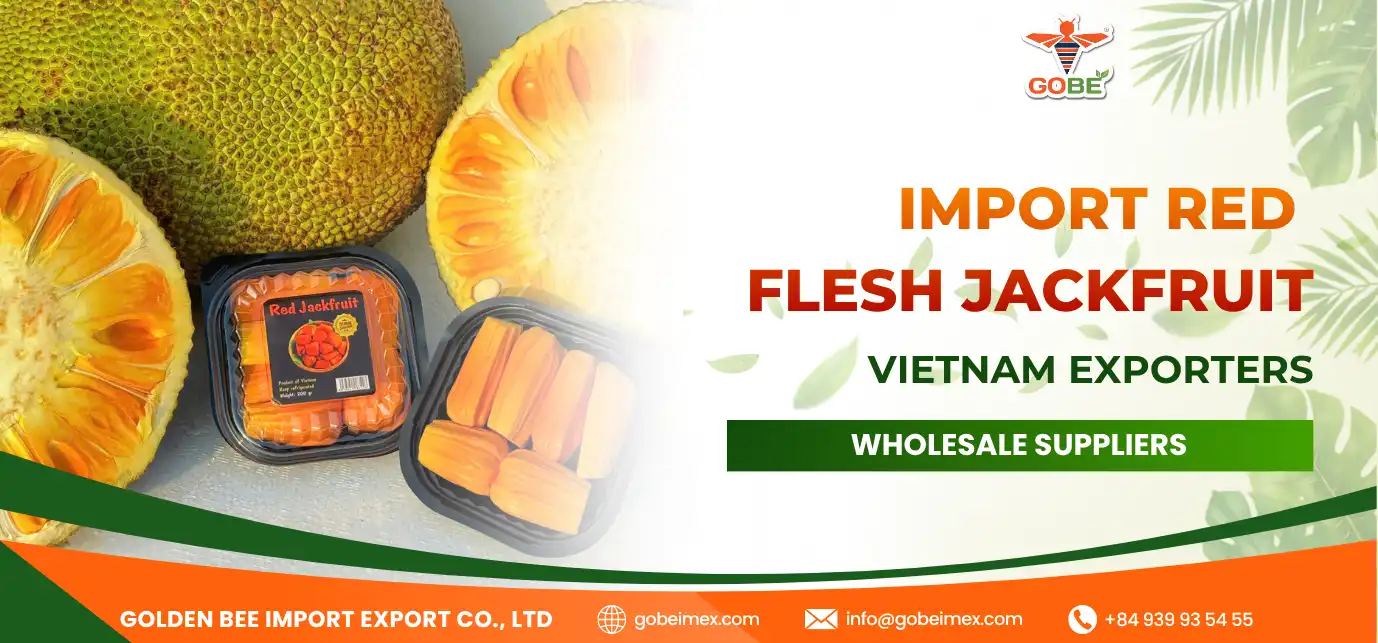
Red flesh jackfruit from Vietnam is one of the most sought-after tropical commodities in global B2B fresh produce trade, offering importers a rare combination of distinctive flavor, striking appearance, and year-round availability backed by internationally certified supply chains. Vietnam’s Mekong Delta growing region, combined with farm-to-pack processing within 12 hours of harvest, gives Vietnamese exporters a measurable freshness advantage over competing origins.
For importers sourcing red flesh jackfruit at wholesale scale, the key decision factors are supplier certification, product form availability, cold chain integrity, and documentation compliance. Vietnam’s top exporters hold GlobalGAP, FDA, ISO, Sedex, and GRASP certifications, supply to markets across North America, Europe, the Middle East, and Asia, and offer flexible packaging from full container loads to trial LCL shipments.
Beyond supplier selection, understanding the import process from MOQ to phytosanitary documentation is essential for smooth market entry. This guide covers every layer of the import decision: what red flesh jackfruit is and why Vietnam leads global supply, which product forms are available for wholesale buyers, how to identify and evaluate reliable Vietnamese exporters, and how to structure your import order from logistics to compliance.
Red flesh jackfruit is a rare jackfruit variety distinguished by its deep red-to-orange flesh, richer sweetness, and more aromatic profile compared to the standard yellow-fleshed jackfruit varieties that dominate conventional export markets. Vietnam has emerged as the primary sourcing origin for this variety, driven by the country’s tropical climate, concentrated growing regions, and the ability to supply continuously across 52 weeks of the year.
Specifically, understanding what makes this variety distinct and why Vietnam holds a competitive sourcing advantage helps importers assess whether this product fits their portfolio requirements.
Red flesh jackfruit differs from conventional jackfruit primarily in flesh color, flavor intensity, and market positioning. Where standard jackfruit produces pale yellow to golden arils, the red flesh variety produces deep orange-red pods that signal a significantly higher concentration of carotenoids and natural sugars.
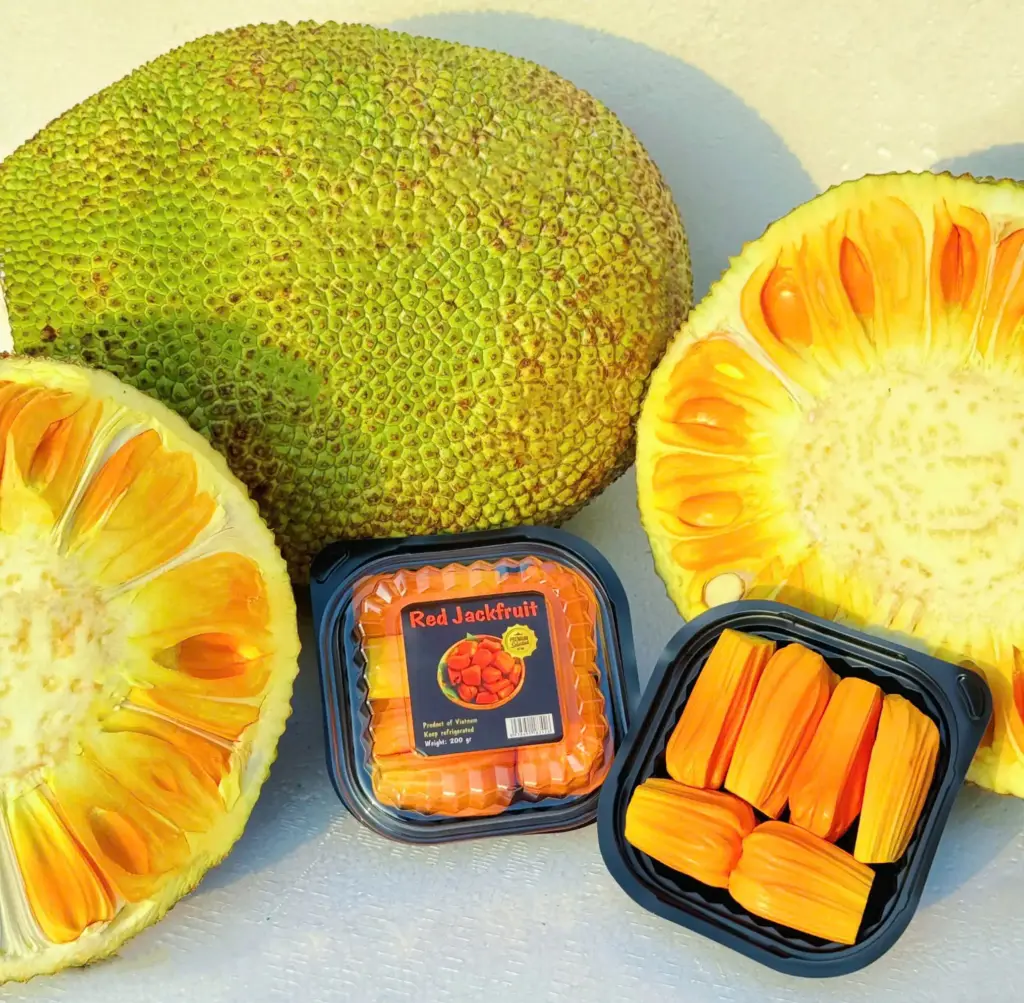
To illustrate the distinction, the key differentiating attributes of red flesh jackfruit include:
More importantly, the visual differentiation of red flesh jackfruit makes it highly marketable in retail environments where exotic fruit displays drive impulse purchasing. This positions the variety firmly in the premium tropical fruit segment that European, Middle Eastern, and North American importers are actively expanding.
Vietnam leads global supply of red flesh jackfruit due to its tropical growing conditions, established agricultural infrastructure, and the geographic concentration of production in the Mekong Delta, Tay Ninh, and Dong Nai provinces. These regions produce consistent volumes across the full calendar year, removing the seasonal supply gaps that affect competing origins.
The sourcing advantages of Vietnam as an origin for red flesh jackfruit importers include:
According to data from Vietnam’s Ministry of Agriculture and Rural Development, jackfruit ranks among Vietnam’s top fresh fruit export commodities, with shipment volumes to key markets including the EU, Middle East, and North America increasing year-on-year as international awareness of Vietnamese tropical varieties grows.
Three primary product forms of red flesh jackfruit are available for wholesale import from Vietnam: fresh whole fruit, fresh-cut ready-to-eat portions, and IQF or vacuum-packed frozen product. Each form addresses different import market requirements, logistics constraints, and end-use channels, giving wholesale buyers flexibility to match product specification to their distribution model.
Below, each product form is examined in detail to help importers determine which option aligns with their market requirements and supply chain capabilities.
Yes, fresh whole red flesh jackfruit is available for export from Vietnam on a year-round basis, supported by multi-region sourcing across growing areas with staggered harvest calendars that prevent supply gaps across the 52-week trading year.
More precisely, the year-round availability of fresh whole red flesh jackfruit for import is underpinned by the following supply chain characteristics:
For importers requiring consistent weekly shipments of fresh whole red flesh jackfruit, working with exporters who operate packing facilities in the Mekong Delta growing region is critical to minimize the time between harvest and container loading.
Wholesale buyers can source red flesh jackfruit from Vietnam in three processed or frozen formats: fresh-cut refrigerated portions, IQF individually quick-frozen arils, and vacuum-packed frozen segments. Each format extends shelf life significantly beyond fresh whole fruit and opens different end-use channels for the importing buyer.
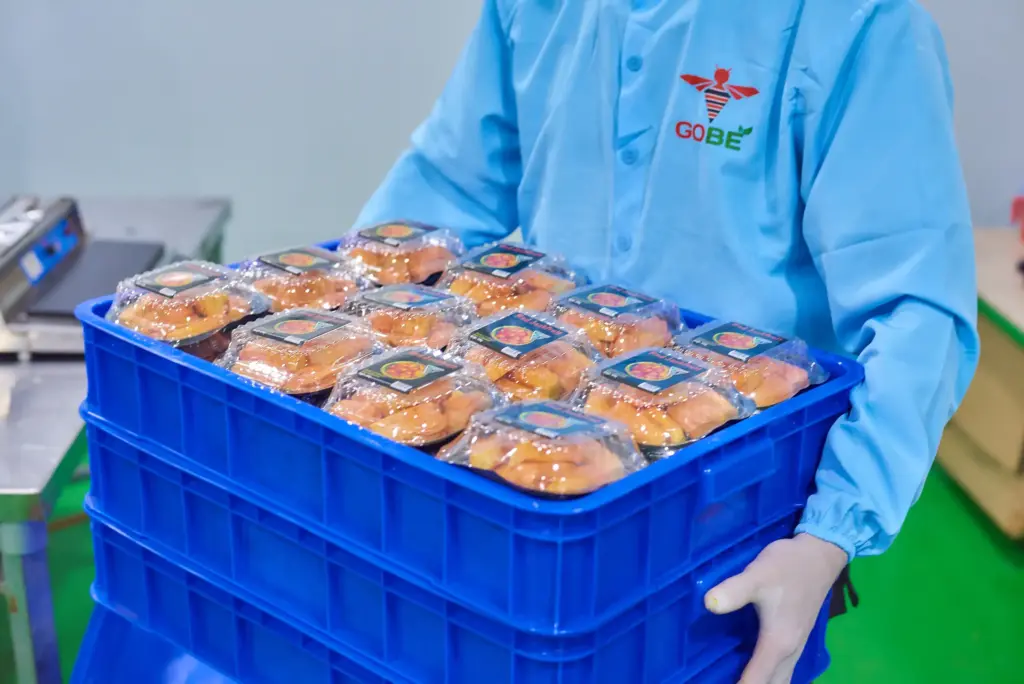
Additionally, the processed and frozen formats of red flesh jackfruit available for wholesale import include:
Fresh-cut refrigerated portions:
IQF frozen red flesh jackfruit arils:
Vacuum-packed frozen segments:
Notably, frozen formats are increasingly preferred by first-time importers of red flesh jackfruit because they reduce the time pressure of fresh product distribution and allow buyers to build market demand before committing to high-frequency fresh shipment schedules.
Reliable red flesh jackfruit exporters from Vietnam are identified by their international certification portfolio (GlobalGAP, FDA, ISO, Sedex, GRASP), their control over growing area traceability, the location of their packing houses within key production regions, and their verified export history to multiple international markets. Vietnam has a developing but increasingly professional community of fresh fruit exporters capable of meeting the compliance requirements of EU, US, Middle East, and Asian import markets.
To better understand what separates trustworthy suppliers from commodity brokers with no direct supply chain control, the following sections examine certification requirements and quality maintenance processes in detail.
One concrete example of a credible Vietnamese red flesh jackfruit exporter is GOBE IMEX (Golden Bee Vietnam), a company operating a primary packing house in Tien Giang Province in the Mekong Delta growing heartland. GOBE IMEX manages more than 30 hectares of company-owned farmland and partners with growers across 200 or more GlobalGAP-certified hectares. The company processes fruit within 12 hours of harvest, maintains an unbroken cold chain from farm through port, and supplies confirmed buyers in Canada, the UAE, the UK, Germany, the Netherlands, Japan, Kuwait, and other markets across four continents.
A reliable red flesh jackfruit exporter from Vietnam should hold at minimum GlobalGAP and ISO certifications as a baseline, with FDA registration for US market shipments, and Sedex and GRASP accreditation for importers whose retail customers require ethical supply chain documentation.
Specifically, the role of each certification in the context of importing red flesh jackfruit from Vietnam is as follows:
| Certification | Issuing Body | What It Confirms for Importers |
|---|---|---|
| GlobalGAP | FoodPLUS GmbH | Good agricultural practices, pesticide residue control, and safe production methods across the growing area |
| GRASP | GlobalGAP | Social and labor practice standards, required by European retailers for responsible sourcing compliance |
| ISO (9001 or 22000) | ISO / Certification body | Quality management system and food safety management system standards in packing operations |
| FDA Registration | US Food and Drug Administration | Compliance with US food safety import requirements, mandatory for shipments entering the United States |
| Sedex | Supplier Ethical Data Exchange | Ethical business conduct and responsible supply chain management, required by major UK and European supermarket buyers |
The table above outlines the five key certifications that importers should verify when qualifying a Vietnamese red flesh jackfruit supplier, with each certification addressing a different layer of compliance risk.
Furthermore, importers should request copies of valid certificates during supplier qualification, verify certificate numbers against issuing body databases where possible, and confirm that the certified scope covers the specific product (fresh jackfruit or processed jackfruit) and the specific packing facility that will handle their orders. Traceability documentation, including farm records, packing house batch records, and pre-shipment inspection reports, should be available on request from any supplier claiming export-grade compliance.
Vietnam’s leading red flesh jackfruit exporters maintain quality from farm to port through an integrated four-stage control process: GAP-compliant cultivation with regular field inspection, in-orchard quality checks at harvest, packing house processing within 12 hours of picking, and unbroken refrigerated cold chain from packing house to port of export.
To illustrate how this quality maintenance chain functions in practice:
Stage 1: GAP-Compliant Cultivation
Certified growing areas follow GlobalGAP protocols for pesticide application, irrigation management, and harvest maturity determination. Agricultural engineers conduct regular field visits to monitor crop development and enforce residue controls within internationally permitted limits. Fruit intended for export is tracked from individual farm blocks to enable full traceability back to source.
Stage 2: Harvest and In-Orchard QC
Fruit is harvested at the optimal maturity stage for export, assessed by visual indicators (skin color, firmness) and Brix measurements where applicable. Quality control personnel reject fruit showing surface damage, pest marks, or premature ripening. Only export-grade fruit proceeds to the packing house.
Stage 3: Farm-to-Pack Within 12 Hours
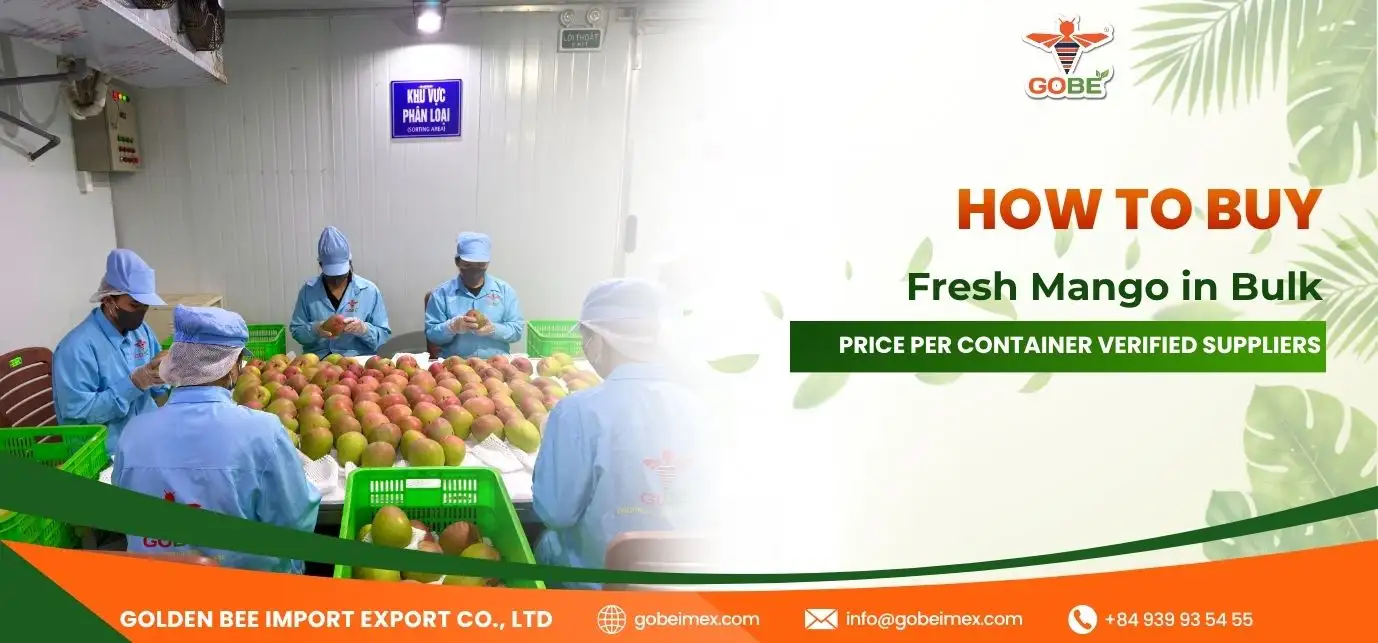
The 12-hour window between harvest and packing house processing is a critical differentiator of Vietnamese exporters operating in the Mekong Delta. GOBE IMEX’s Tien Giang packing facility, for example, is located directly within the growing region, eliminating the extended transport times that affect exporters consolidating fruit from distant farms. Processing within 12 hours locks in peak freshness, prevents field heat buildup, and extends post-harvest shelf life measurably.
Stage 4: Cold Chain from Packing House to Port
Following processing and packing, product moves immediately into refrigerated cold storage. Refrigerated container trailers transport product from packing house to port under continuous temperature monitoring. Container stuffing is conducted under controlled temperature conditions to prevent thermal shock. Exporters with their own refrigerated transport fleet, such as GOBE IMEX, maintain temperature control at every handover point rather than relying on third-party cold chain operators who may not maintain equivalent standards.
Importing red flesh jackfruit from Vietnam involves four practical components: establishing minimum order quantities with your supplier, selecting the appropriate packaging specification for your market, assembling the required export and import documentation, and selecting an Incoterm structure that matches your logistics capability and risk appetite. Each component is addressed in the following sections.
The standard minimum order quantity for red flesh jackfruit import from Vietnam is one full container load (FCL), either a 20-foot or 40-foot refrigerated container, with LCL (Less than Container Load) options available from some exporters for trial or sample orders. MOQ flexibility varies by supplier and depends on production season and existing container scheduling.

More precisely, the MOQ and packaging structure for wholesale red flesh jackfruit imports from Vietnam typically includes:
Full Container Load (FCL):
Less than Container Load (LCL):
Packaging specifications:
Importers with specific retail customer requirements, such as pre-printed retail-ready packaging or specific box weight declarations, should communicate these specifications to the exporter during the initial sourcing inquiry to confirm feasibility before placing a confirmed order.
Importing red flesh jackfruit from Vietnam requires a standard set of export documents plus market-specific phytosanitary and food safety compliance certificates. The complete documentation package varies by destination market but follows a consistent core structure.
The table below outlines the standard documentation set and market-specific additions required for red flesh jackfruit imports from Vietnam:
| Document | Purpose | Required For |
|---|---|---|
| Phytosanitary Certificate | Confirms fruit is free from pests and diseases, issued by Vietnam’s Plant Protection Department | All import markets |
| Certificate of Origin (C/O) | Confirms Vietnamese origin, enables preferential tariff rates under applicable trade agreements | All import markets, tariff benefits vary by agreement |
| Commercial Invoice | Declares product description, quantity, unit price, and total value | All import markets |
| Packing List | Details carton count, net weight, gross weight, and container loading | All import markets |
| Bill of Lading (B/L) or Airway Bill | Transport document and title transfer | All import markets |
| Health Certificate / Food Safety Certificate | Confirms product meets food safety standards of exporting country | EU, Middle East, some Asian markets |
| FDA Prior Notice | Electronic notification to US FDA before shipment arrives | United States |
| Fumigation Certificate | Confirms wooden pallet or packaging materials meet ISPM 15 standard | Most markets, including EU and US |
The table above details the documentation framework that importers should confirm with their Vietnamese exporter before the first shipment. Gaps in documentation compliance are among the most common causes of import delays and customs holds.
Additionally, Incoterm selection significantly affects importer responsibility and cost structure:
For importers placing their first order from a Vietnamese red flesh jackfruit supplier, CIF or FOB are the most practical Incoterm choices. EXW is typically used only by importers with well-established local logistics partners in Vietnam.
Vietnamese red flesh jackfruit outperforms competing origins on farm-to-pack processing speed, certification breadth, and year-round supply consistency, while global import demand is accelerating across the Middle East, Europe, and North America as exotic tropical fruit categories expand in mainstream retail. This supplementary section provides importers with competitive context and market trend intelligence to support longer-term sourcing strategy decisions.
Vietnam outperforms Thailand on year-round supply consistency and certification availability, while Indonesia offers lower base pricing but with less standardized export certification and longer lead times in many sourcing corridors. For importers requiring GlobalGAP-certified product with verified cold chain and 12-market export track records, Vietnam currently offers the most complete compliance profile among the three origins.
Key comparison points include:
The Middle East, Europe, and North America are the three highest-growth import markets for red flesh jackfruit, driven by diaspora community demand, expanding exotic fruit retail categories, and plant-based diet trends that position jackfruit as a premium whole-food ingredient.
Market-specific demand drivers include:
For importers currently evaluating market entry into the red flesh jackfruit category, the Middle East offers the fastest commercial pathway due to shorter logistics lead times from Vietnam, established import infrastructure, and consistent community-driven demand. European market entry offers greater long-term volume potential but requires full Sedex and GRASP documentation from the sourcing supplier. North America represents the highest-growth ceiling, particularly for frozen and processed red flesh jackfruit formats suited to food manufacturing and foodservice applications.
Importers interested in sourcing red flesh jackfruit from a certified Vietnamese exporter can contact GOBE IMEX (Golden Bee Vietnam) directly via the company’s website at gobeimex.com or by phone and WhatsApp at +84 939 93 54 55 to discuss product specifications, availability, and trial order arrangements.