Subtotal $0.00


There are 5 types of export-ready young coconut recognized in international trade: Whole, Half Green, Diamond, Easy Open, and Polish. Each type is defined by its cut style and coconut variety, engineered to meet the specific demands of importers, distributors, and supermarket chains across North America, Europe, the Middle East, and Asia. Understanding these five types is the first step any serious buyer must take before placing an international order.
Shelf life and technical specs differ significantly across these five types and directly drive logistics decisions. Whole and Half Green coconuts carry a 20-day shelf life, Diamond and Easy Open extend to 50 days, and Polish lasts only 10 days. Sugar content ranges from 6.0% to 9.0% depending on variety, determining which type suits sea freight versus air freight and which aligns with your target market’s flavor profile.
For B2B buyers building a sourcing strategy, this guide breaks down every technical attribute needed, covering size, count per carton, shipping method compatibility, and cold chain requirements, so you can match the right coconut type to the right market, transit time, and retail or HoReCa application.
There are 5 types of export-ready young coconut: Whole, Half Green, Diamond, Easy Open, and Polish, each defined by a specific cut style and coconut variety suited to distinct international markets and shipping conditions. This section covers how each type is classified, how they compare at a glance, and what sets each apart for sourcing decisions.
Classification in the export trade is based not only on the coconut variety but primarily on the cut style applied during processing. Each importing market has its own preferences for presentation, portioning, and retail readiness. The table below summarizes the 5 types at a glance before each is explored in detail.
The following table describes all 5 export-ready young coconut types, showing the variety associated with each cut style and its primary market application. Buyers use this table to quickly align product type with target channel before reviewing full specs.
| Type | Cut Style | Variety | Primary Market Application |
|---|---|---|---|
| Whole | Full fruit, trimmed | Xiêm | HoReCa, bulk import |
| Half Green | Partially trimmed | Xiêm | Retail, foodservice |
| Diamond | Geometric precision cut | Milky | Premium retail, gift packaging |
| Easy Open | Pre-scored opening | Lai | Consumer-ready retail |
| Polish | Fully peeled, smooth | Lai | Air-freight markets, premium grocery |
Each variety name reflects the cultivar grown in Vietnam’s Mekong Delta region, where Gobeimex sources and processes all five types at its packing house in Tien Giang within 12 hours of harvest.
Whole, Diamond, and Polish coconuts differ in processed weight, target market, and preferred shipping method, with Whole the heaviest at 1.2 to 1.6 kg per fruit, Diamond mid-range at 0.8 to 1.2 kg, and Polish the lightest at 0.4 to 0.6 kg. These three types represent the widest range of cut styles in the export lineup, and each serves a different buyer profile.
Whole coconut uses the Xiêm variety, retaining more of the outer husk and delivering the heaviest fruit weight per unit. It is preferred by HoReCa buyers and bulk importers in markets such as the UAE, Canada, and Europe where staff prepare the coconut before service. Diamond cut uses the Milky variety and features a geometric precision cut that makes it visually distinctive in retail settings, positioning it well for premium grocery chains and gift-oriented packaging. Polish coconut uses the Lai variety and undergoes the most intensive processing, removing nearly all external material to produce a smooth, white, highly presentable product suited to premium grocery and airline catering.
From a logistics standpoint, Diamond and Polish are better suited to air freight because their reduced weight and compact profile lower freight cost per unit. Polish, with its 10-day shelf life, travels exclusively by air. Whole and Half Green coconuts can travel by both air and sea, though sea freight is best reserved for routes where transit does not exceed the 20-day shelf life window.
Yes, Easy Open coconut is meaningfully different because it features a pre-scored opening that allows consumers to access the water without any cutting tool, making it the most consumer-ready format in the export lineup. This distinction gives it a specific retail advantage over all other types.
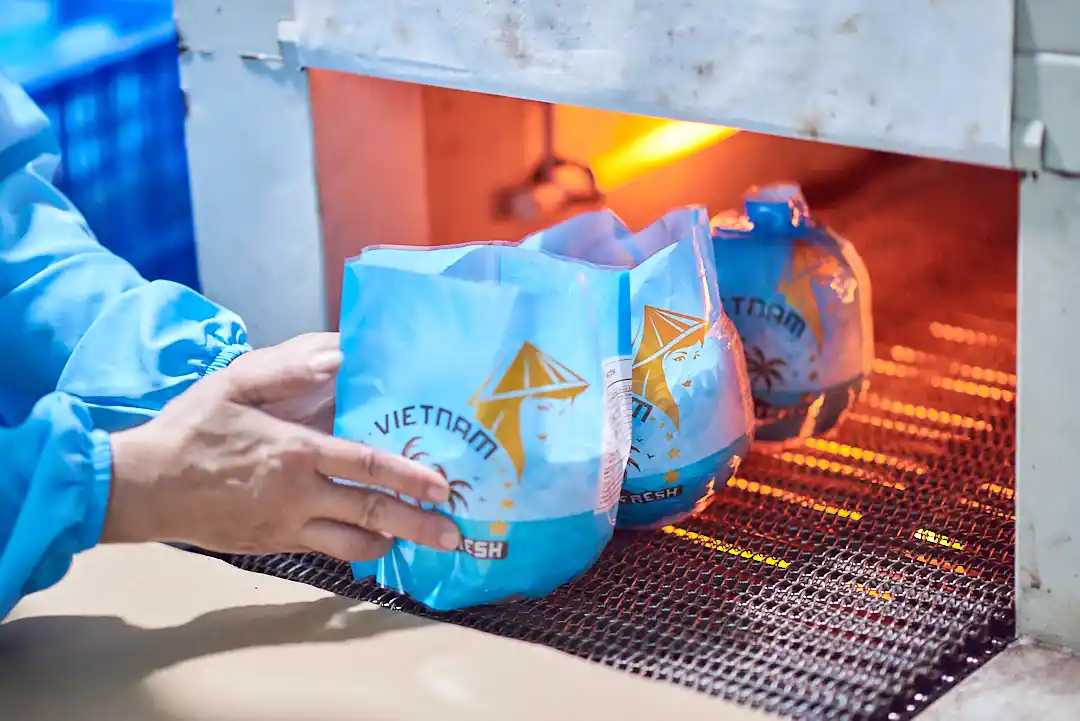
Easy Open uses the Lai variety, the same cultivar as Polish coconut, but the processing approach is distinct. Instead of full peeling, the coconut is trimmed and fitted with a pre-cut or scored cap that the end consumer removes without tools. This design targets retail shelf placement in markets where convenience drives purchase decisions, including Japan, South Korea, and modern trade channels in Southeast Asia and the Middle East.
Compared to Half Green, which shares a similar size range (0.9 to 1.3 kg versus Easy Open at 0.8 to 1.2 kg), the critical differences lie in cut style, variety, and shelf life. Half Green uses the Xiêm variety with partial outer husk retained and carries a 20-day shelf life. Easy Open extends to 50 days because of the Lai variety’s physical characteristics and the precision sealing applied after the scoring process. Both types support 9 or 12 pieces per carton and travel by air and sea.
The 5 young coconut types carry distinct technical specifications across size, sugar content, shelf life, count per carton, shipping method, and storage temperature, with shelf life the most critical variable for logistics planning, ranging from 10 days for Polish to 50 days for Diamond and Easy Open. This section provides a complete spec comparison followed by focused analysis of shelf life and sugar content.

The table below presents complete specifications for all 5 types side by side. Buyers use this table as a single-reference comparison to evaluate all key attributes before confirming an order.
| Specification | Whole | Half Green | Diamond | Easy Open | Polish |
|---|---|---|---|---|---|
| Size (kg/fruit) | 1.2 to 1.6 | 0.9 to 1.3 | 0.8 to 1.2 | 0.8 to 1.2 | 0.4 to 0.6 |
| Variety | Xiêm | Xiêm | Milky | Lai | Lai |
| Sugar Content (%) | 7.0 to 8.8 | 7.0 to 8.8 | 7.0 to 9.0 | 6.0 to 8.0 | 6.0 to 8.0 |
| Shelf Life (days) | 20 | 20 | 50 | 50 | 10 |
| Count (pieces/carton) | 9 or 12 | 9 or 12 | 9 or 12 | 9 or 12 | 9, 12, or 14 |
| Shipping Method | By air and sea | By air and sea | By air and sea | By air and sea | By air only |
| Storage Temperature | 2 to 5°C | 2 to 5°C | 2 to 5°C | 2 to 5°C | 2 to 5°C |
The most operationally significant contrast is the shelf life gap between the 50-day types (Diamond and Easy Open) and the 10-day Polish, which drives the choice between sea freight and air freight for most long-haul markets.
Diamond and Easy Open coconuts have the longest shelf life among all five types, reaching 50 days under continuous cold storage at 2 to 5°C, making them the only types fully suitable for long-haul sea freight routes. Buyers on routes where transit exceeds 20 days must select one of these two types.
Buyers targeting markets such as Canada from Vietnam by sea (approximately 25 to 35 days depending on routing) should prioritize Diamond or Easy Open. Whole and Half Green coconuts, with 20-day shelf life, accommodate shorter sea freight routes to the Middle East or parts of Southeast Asia but present risk on North American or Northern European lanes unless air freight is used. Polish coconut, with only 10 days of shelf life, is exclusively shipped by air and suits nearby markets or premium segments that absorb higher freight costs.
An important operational note: all five types share the same storage temperature requirement of 2 to 5°C. A single temperature-controlled environment can accommodate mixed-type shipments when required, simplifying cold chain infrastructure planning for buyers managing multiple SKUs across different shipping lanes.
Sugar content varies by variety, with Diamond (Milky variety) reaching the widest range of 7.0 to 9.0%, Whole and Half Green (Xiêm variety) at 7.0 to 8.8%, and Easy Open and Polish (Lai variety) at 6.0 to 8.0%. This variation carries direct commercial implications for market positioning.
Diamond coconuts from the Milky variety deliver the broadest sweetness profile and the highest potential Brix reading, positioning them well for premium retail markets in Europe and North America where sweetness is a key consumer preference signal. Whole and Half Green from the Xiêm variety offer a consistently high and reliable sugar range, suitable for HoReCa buyers who serve the coconut directly to customers. Easy Open and Polish from the Lai variety deliver a lighter, more refreshing sweetness profile that aligns with consumer preferences in Japan, Southeast Asia, and health-focused retail in Australia and the Middle East.
For brand-positioning purposes, buyers entering premium grocery channels should note that Diamond’s 7.0 to 9.0% sugar range offers the flexibility to select lots at the higher end of the spectrum. Buyers serving refreshment-oriented markets may find the Lai variety’s 6.0 to 8.0% range better calibrated to their customer base.
The right type of young coconut for export depends on three key decision criteria: shipping method and transit time, the target import market and its consumer preferences, and the end-use application, whether HoReCa, retail, or food processing. This section maps those three criteria onto each of the five types to help buyers move from general interest to a specific sourcing decision.
Air freight is the only viable option for Polish coconuts given their 10-day shelf life, while Diamond and Easy Open are the strongest candidates for sea freight on long-haul routes due to their 50-day shelf life. The following breakdown maps each type to its recommended freight mode.
The storage temperature of 2 to 5°C is consistent across all types, which simplifies cold chain planning for buyers managing multiple SKUs across different shipping lanes.
Standard packaging for Whole, Half Green, Diamond, and Easy Open coconuts is 9 or 12 pieces per carton, while Polish coconuts offer three count options: 9, 12, or 14 pieces per carton, providing greater flexibility for retail pack configurations. This broader range for Polish reflects its positioning in premium retail environments where uniform portion count per display unit matters to category managers.
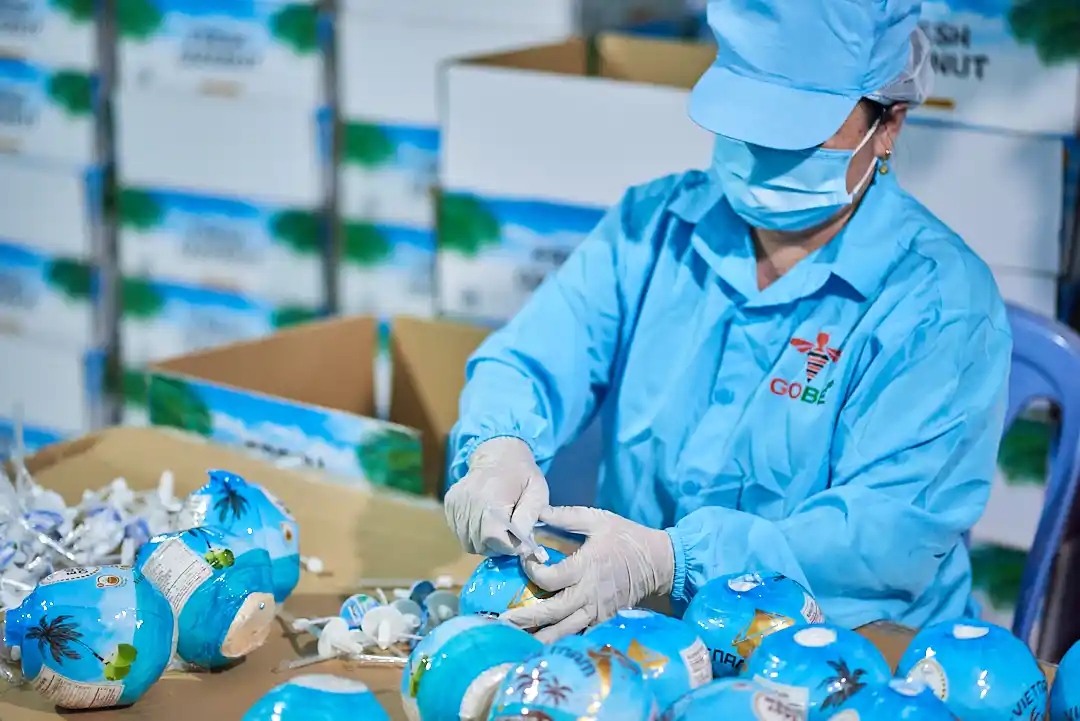
Buyers sourcing for European supermarkets, where 9 or 12 count is preferred for single-serve or twin-pack shelf placement, will find this range easy to integrate. For buyers in the Middle East or North America, where club-store or bulk-retail formats may require higher piece counts, the 14-piece option for Polish adds useful flexibility.
Gobeimex supports packing customization to meet the individual specifications of each importing market. EU buyers requiring EUDR-compliant documentation and specific label formats, Middle Eastern importers with Halal certification needs, and North American buyers requiring FDA-registered facility documentation can all be accommodated through Gobeimex’s packing house in Tien Giang, which processes coconuts within 12 hours of harvest. An unbroken cold chain from the farm gate through refrigerated container transport to the port of export ensures product integrity is maintained from the moment of harvest through to arrival at the buyer’s facility.
Young coconut from Vietnam is available for export 52 weeks per year, with a high season running from June through November and a low season covering January through May and December, but no months are classified as unavailable. This continuous availability is a commercially significant advantage for buyers who require consistent supply throughout the year.
High season brings higher volumes, more competitive pricing, and peak sugar content consistency. Low season still delivers reliable supply, though buyers may observe minor variability in individual fruit size. The following two subsections examine how this seasonal pattern affects sourcing decisions and what cold chain and compliance requirements apply year-round.
Yes, the high season from June through November delivers higher volume, more stable sugar content, and more competitive pricing, while the low season covering January through May and December may bring minor size variability and slightly higher unit costs due to reduced production volume.
For buyers planning annual procurement schedules, the high season is the optimal window to lock in competitive contract pricing and build buffer stock. During the low season, advance ordering and long-term supply agreements with a reliable exporter help neutralize price fluctuation risk. Gobeimex supplies young coconut 52 weeks per year from its network of company-owned and partner farms spanning over 230 hectares across Vietnam’s Mekong Delta.
All 5 young coconut types require continuous cold storage at 2 to 5°C from packing house to destination port, with no interruption permitted at any point in the supply chain. Buyers must confirm that their freight forwarder and in-market cold storage partner maintain this temperature range throughout.
Gobeimex maintains an in-house fleet of refrigerated container trailers to ensure an uninterrupted cold chain from its Tien Giang packing house to the port of export. For import compliance, Gobeimex holds GlobalGAP, GRASP, ISO, FDA, and Sedex certifications, covering the requirements of Canada, the UAE, EU markets including Germany and the Netherlands, Japan, and Kuwait. Buyers should request a Certificate of Origin and Phytosanitary Certificate with every shipment to facilitate smooth customs clearance at the destination port.
Buyers should be aware of three practical constraints when sourcing export-ready young coconut: shelf life limits on specific freight modes, seasonal volume variation, and the need for unbroken cold chain infrastructure throughout the supply journey. These are not barriers to procurement but factors that require planning.
No, Polish coconut is not suitable for all markets because its 10-day shelf life restricts it to air freight, making it commercially viable only for markets with strong air cargo infrastructure and premium price tolerance. Buyers targeting value-sensitive or sea-freight-dependent markets should consider Easy Open or Diamond instead.
Polish coconut commands a higher unit price because of the intensive processing involved and the exclusive reliance on air freight for delivery. For markets in Japan, Singapore, or Gulf cities with established premium grocery channels, these costs are absorbed within the retail margin. For buyers sourcing for mid-market retail in Canada or Eastern Europe, where price competitiveness is a stronger purchase driver, Diamond or Easy Open at 50-day shelf life via sea freight represents a more commercially sustainable choice.
Low season does not interrupt supply but can create minor variability in size consistency and slightly higher per-unit costs, which matters for large-volume buyers with strict size grading requirements for retail category management.
Buyers managing large annual contracts should specify size tolerance ranges in their purchase agreements and discuss low-season sourcing protocols directly with their export partner. Gobeimex’s combination of 30+ hectares of company-owned farmland and 200+ hectares of partner-operated growing areas across the Mekong Delta provides sufficient source diversity to maintain volume continuity and size consistency through the low season.
📄 Download full product catalog: Catalog-Gobe.pdf
📩 Contact: Info@gobeimex.com | +84 939 93 54 55 | gobeimex.com


