Subtotal $0.00


GOBE IMEX exports two main types of jackfruit for the global market: Yellow Jackfruit and Red Jackfruit, each processed into multiple cutting formats to match the needs of importers, supermarkets, and food service buyers worldwide. Both varieties are grown across Vietnam’s Mekong Delta growing regions and packed under strict GlobalGAP-certified conditions before entering the export cold chain. Understanding these two types, along with their sugar content, size range, and seasonal availability, helps buyers select the right product for their target market.
Beyond variety, export jackfruit is offered in four cutting and packing formats: whole fruit, half or quarter cuts, peeled with seeds, and peeled without seeds. Each format is sized differently to suit specific retail channels, from bulk wholesale distribution to ready-to-eat retail packs, and each carries its own box weight specification for efficient container loading.
Preservation and shipping method depend directly on the cutting format chosen. Whole and half-cut jackfruit can travel by air or by sea thanks to a longer shelf life, while peeled jackfruit, which has a shorter shelf life and requires colder storage, is shipped exclusively by air to preserve freshness from Vietnam to the destination port.
Yellow and Red jackfruit also differ in sweetness level and seasonal availability, which directly affects sourcing strategy for importers planning year-round supply contracts. Below, we break down every specification GOBE IMEX buyers need, from variety and cutting format to shelf life, shipping method, and seasonal calendar, so you can build a sourcing plan with confidence.
There are 2 main types of jackfruit available for export at GOBE IMEX: Yellow Jackfruit and Red Jackfruit, classified by flesh color, sugar content, and seasonal growing pattern. Both varieties are cultivated within GOBE IMEX’s 230-plus hectares of GlobalGAP-certified growing areas in Vietnam’s Mekong Delta.
To understand which variety fits your market demand, it helps to look closely at each type individually before comparing them directly.
Yellow Jackfruit is a tropical fruit variety grown in Vietnam’s Mekong Delta, known for its golden-yellow flesh and sugar content of 20 to 22 percent. It is the more widely recognized jackfruit type in international retail, valued for its firm bulbs and balanced sweetness.
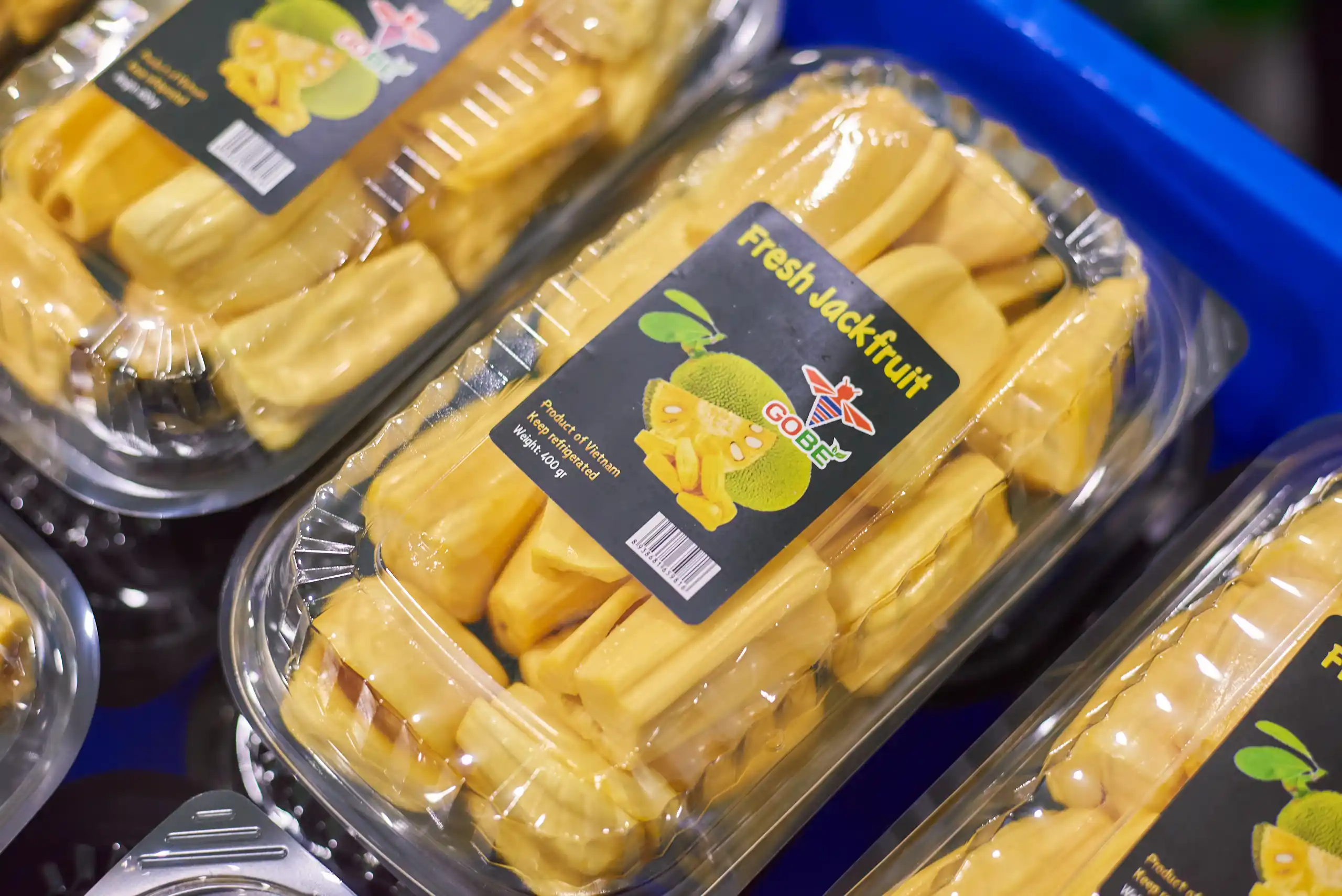
Specifically, Yellow Jackfruit ripens with a bright yellow to golden hue and a moderately firm texture that holds its shape well during transport and processing. This variety is available across all four cutting formats that GOBE IMEX offers, whole fruit, half or quarter cuts, and peeled formats, making it suitable for both bulk distribution and ready-to-eat retail packaging. Its seasonal peak falls in May, June, November, and December, giving buyers a predictable window for planning larger import volumes.
Red Jackfruit is a premium tropical variety grown in the same Mekong Delta region, distinguished by its deeper orange-red flesh color and slightly higher sugar content of 20 to 23 percent. It commands strong demand in markets seeking a visually distinctive, sweeter product.
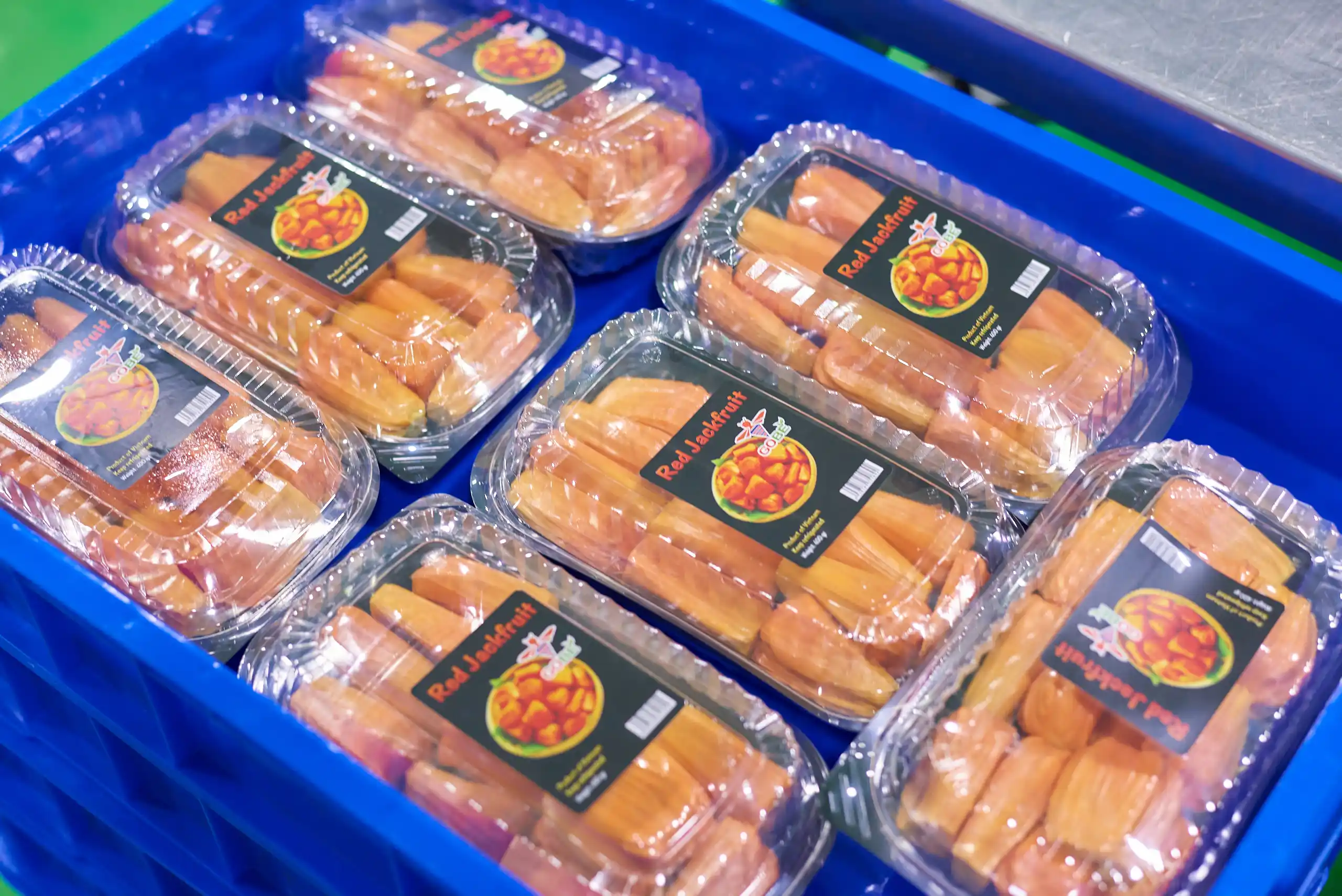
To illustrate, the deeper color and richer sweetness of Red Jackfruit make it especially popular for premium retail shelves and dessert-oriented food service channels. Compared to Yellow Jackfruit, Red Jackfruit has a longer high-season window, with peak availability in January, May, June, July, November, and December, giving importers more flexibility for continuous sourcing throughout the year. Both varieties are processed at GOBE IMEX’s Tien Giang packing house within roughly 12 hours of harvest, locking in freshness before cold-chain transport begins.
Export jackfruit from GOBE IMEX comes in 4 main cutting and packing formats: Whole Fruit, Half or Quarter cuts, Peeled with Seeds, and Peeled without Seeds, each sized to match a different distribution channel and shelf-life requirement.
Below, we outline the exact sizing and box weight for each format so buyers can calculate container loading and retail portioning accurately. In general, wholesale distributors and supermarkets that plan to portion the fruit in-store tend to order whole fruit or half or quarter cuts, since these formats keep more of the natural rind intact and travel well over longer distances. Retail chains and food service buyers who need ready-to-sell portions, on the other hand, typically choose peeled formats, which reduce in-store labor and food waste while offering a consistent, convenient serving size for end consumers. Choosing the right format from the start also affects freight cost, since heavier whole-fruit shipments require different container planning than smaller, lighter peeled cartons.
Whole fruit and half or quarter-cut jackfruit are offered in two size ranges each, with box weights calculated per fruit or per carton depending on the cut. These larger formats suit wholesale distributors and supermarkets that portion the fruit in-store.
Specifically, the size and packing structure for these two formats break down as follows:
Both formats maintain a 14-day shelf life and are stored at 10 to 15 degrees Celsius, which allows more flexible handling during long-distance transport compared to peeled products.
Peeled jackfruit is offered in two formats, with seeds and without seeds, each packed in smaller consumer-ready portions of 150 to 400 grams per pack. This format targets retail-ready and food service channels that require convenience and portion control.

To break this down further, the peeled formats are specified as follows:
The table below summarizes all four cutting formats side by side, including sugar content, size range, shelf life, box weight, shipping method, and storage temperature, giving buyers a single reference point for sourcing decisions.
| Specification | Yellow – Whole Fruit | Yellow – Half/Quarter | Red – Peeled with Seeds | Red – Peeled without Seeds |
| Sugar (%) | 20–22 | 20–22 | 20–23 | 20–23 |
| Cutting | Whole fruit | Half/Quarter | Peeled with seeds | Peeled without seeds |
| Small Size | 7–9 kg | 1–3 kg | 200 g | 150 g |
| Big Size | 9 kg and up | 4–6 kg | 400 g | 300 g |
| Shelf Life (days) | 14 | 14 | 14 | 7 |
| Box Weight (kg) | Per fruit | 5–6 | 3.6/8 | 2.7/6 |
| Shipping | By air & sea | By air & sea | By air | By air |
| Storage Temperature | 10–15°C | 10–15°C | 2–4°C | 2–4°C |
Export jackfruit is preserved through an unbroken cold chain and shipped either by air or by sea, depending on the cutting format and its corresponding shelf life. GOBE IMEX manages this process end to end, using its own refrigerated container trailers from the Tien Giang packing house to the port of export.
Because shelf life and storage temperature vary significantly between whole, half-cut, and peeled formats, shipping method must be matched carefully to each product type. Maintaining a continuous cold chain from farm to port is what allows GOBE IMEX to preserve peak freshness across every format, since even a short break in temperature control can shorten the effective shelf life of peeled products in particular. This is why the company’s packing house location, close to the growing region in Tien Giang, plays a direct role in shipping strategy, allowing fruit to move from harvest to refrigerated storage within roughly 12 hours.
Whole fruit, half or quarter cuts, and peeled jackfruit with seeds all hold a 14-day shelf life, while peeled jackfruit without seeds has a shorter shelf life of 7 days. This difference comes down to how much the flesh is exposed once the fruit is cut and deseeded.
In comparison, whole and half-cut jackfruit retain their natural rind or partial rind, which slows oxidation and moisture loss, supporting the full 14-day window at 10 to 15 degrees Celsius. Peeled jackfruit with seeds still benefits from the seed structure holding the bulb intact, also reaching 14 days when stored at a colder 2 to 4 degrees Celsius. Peeled jackfruit without seeds, however, has the most exposed flesh surface of all four formats, which shortens its shelf life to 7 days even under the same 2 to 4 degree cold storage. Buyers ordering this format should plan for faster inventory turnover once the product clears customs.
Yes, jackfruit can be exported by air or by sea, but the shipping method depends entirely on the cutting format. Whole fruit and half or quarter cuts are flexible enough to travel by either air or sea freight, while both peeled formats are shipped by air only.
The reasoning behind this split comes from shelf life and temperature sensitivity:
This is why importers seeking cost-efficient bulk volume typically choose whole or half-cut jackfruit by sea, while buyers targeting premium retail freshness opt for peeled formats by air despite the higher freight cost per kilogram.
Yellow Jackfruit and Red Jackfruit differ mainly in sugar content, flesh color, and seasonal availability window, with Red Jackfruit offering a slightly sweeter profile and a longer high-season period. Both varieties share the same packing standards and cold-chain handling at GOBE IMEX.
To help buyers choose between the two, the sections below compare sugar content and seasonal supply directly.
Red Jackfruit has a slightly higher sugar content at 20 to 23 percent, compared to Yellow Jackfruit’s 20 to 22 percent. This one to two percentage point difference is enough to give Red Jackfruit a noticeably sweeter taste profile favored in premium and dessert-focused markets.
However, Yellow Jackfruit remains highly competitive on flavor consistency and firmness, which makes it a reliable choice for buyers who prioritize texture stability over maximum sweetness, particularly for retail formats that require the fruit to hold its shape through longer transit and shelf display.
Red Jackfruit has a longer high-season window than Yellow Jackfruit, with peak supply across six months compared to Yellow Jackfruit’s four months. This gives importers sourcing Red Jackfruit more consistent access to peak-quality fruit throughout the year.
The table below sets out the monthly high and low season pattern for both varieties, giving buyers a practical reference for planning shipment schedules around peak supply.
| Variety | Jan | Feb | Mar | Apr | May | Jun | Jul | Aug | Sep | Oct | Nov | Dec |
| Yellow | Low | Low | Low | Low | High | High | Low | Low | Low | Low | High | High |
| Red | High | Low | Low | Low | High | High | High | Low | Low | Low | High | High |
As the table shows, Yellow Jackfruit peaks only in May, June, November, and December, while Red Jackfruit adds January and July to its high-season calendar. Consequently, buyers who need year-round consistency, or who are placing large orders outside the May to June and November to December windows, often lean toward Red Jackfruit or plan supplementary sourcing to bridge Yellow Jackfruit’s low-season gaps.
According to the Food and Agriculture Organization of the United Nations (2024), global jackfruit exports reached USD 3.7 billion in 2023, with Vietnam alone holding a 25 percent share of the global jackfruit market, underscoring the importance of matching variety and season correctly when sourcing from Vietnamese exporters.
Export jackfruit alternates between high-season and low-season periods throughout the year, and matching purchase orders to these windows directly affects fruit quality, pricing, and availability. Understanding this high and low season pattern helps importers avoid supply gaps.
The following sections detail the specific monthly pattern for Yellow Jackfruit and introduce the exporter behind GOBE IMEX’s year-round supply capability.
Yellow Jackfruit reaches high season in May, June, November, and December, while the remaining eight months of the year fall into low season. This four-month peak window is when fruit quality, size consistency, and volume availability are strongest.
During the low-season months, from January through April and July through October, Yellow Jackfruit is still available but typically in smaller volumes. Buyers planning large-scale orders are advised to concentrate purchasing around the two high-season windows in late spring and late in the calendar year, while placing smaller supplementary orders during low-season months if continuous supply is required.
GOBE IMEX, trading as Golden Bee Vietnam, is a GlobalGAP-certified exporter of jackfruit and other tropical fruits from Vietnam, led by Founder and Managing Director Scarlett Huynh. The company operates more than 230 hectares of certified growing area and holds five international certifications.
Specifically, GOBE IMEX combines 30-plus hectares of company-owned farmland with over 200 hectares of partner-operated growing areas, all monitored under GlobalGAP standards. Its main packing house in Tien Giang processes fruit within roughly 12 hours of harvest, while a second facility in Ho Chi Minh City diversifies sourcing. GOBE IMEX holds GlobalGAP, GRASP, ISO, FDA, and Sedex certifications, and supplies importers across Canada, the UAE, the UK, Germany, the Netherlands, Russia, Japan, and Kuwait for 52 weeks a year. Under Scarlett Huynh’s leadership, the company has represented Vietnamese fresh produce at Fruit Logistica in Berlin, Asia Fruit Logistica in Hong Kong, and Fruit Attraction in Madrid.


