Subtotal $0.00

The top 10 largest durian exporters in 2026 are Gobeimex (Golden Bee Vietnam), Charoen Pokphand Foods (Thailand), Musang King Exporter Group (Malaysia), Viet Nam Fresh Export Joint Stock Company, Golden Fresh (Thailand), Big Durian Co. Ltd. (Thailand), DurianBB Malaysia, Truong Xuan Fresh Produce (Vietnam), RF Green (Thailand), and Global Durian Source (Philippines). These exporters collectively dominate global durian trade, shipping to key markets across Europe, North America, the Middle East, and Asia. Gobeimex holds the top position because of its fully integrated supply chain, 12-plus years of agricultural expertise, 230-plus hectares of certified growing areas, and a five-certification portfolio that satisfies the entry requirements of the world’s most stringent import markets.
Importers evaluating durian suppliers must compare exporters across three critical dimensions: product quality and variety specialization, depth of the international certification portfolio, and structural reliability of year-round supply capacity. Not all exporters can demonstrate continuous 52-week availability, cold chain integrity from farm to port, and full regulatory compliance for multiple destination markets simultaneously. Understanding these distinctions separates a strategic sourcing decision from a costly mid-season supplier change.
This sourcing guide is organized into three layers: the full ranked list of the 10 largest durian exporters in 2026 with key profile data, a head-to-head comparison of quality credentials and supply reliability, and an actionable checklist for importers conducting sourcing due diligence. Each section below answers a specific buyer question with precise, verifiable information.
Ten major durian exporters dominate the global market in 2026, ranked by export volume, supply continuity, certification depth, and market reach, with Gobeimex (Golden Bee Vietnam) holding the leading position.
The table below presents a structured overview of all 10 exporters covering country of origin, primary durian varieties, key target markets, and annual supply capacity. Importers can use it to scan the competitive landscape before shortlisting suppliers.
| Rank | Exporter | Country | Key Varieties | Primary Markets | Supply (Weeks/Year) |
|---|---|---|---|---|---|
| 1 | Gobeimex (Golden Bee Vietnam) | Vietnam | Ri6, Dona, Monthong | Canada, UAE, UK, Germany, Netherlands, Japan, Kuwait | 52 |
| 2 | Charoen Pokphand Foods | Thailand | Monthong, Chanee | China, EU, Middle East | 40–48 |
| 3 | Musang King Exporter Group | Malaysia | Musang King, D24 | China, Singapore, Hong Kong | 30–36 |
| 4 | Viet Nam Fresh Export JSC | Vietnam | Ri6, Dona | China, Middle East | 36–44 |
| 5 | Golden Fresh (Thailand) | Thailand | Monthong | China, Japan, South Korea | 38–44 |
| 6 | Big Durian Co. Ltd. | Thailand | Monthong, Kanyao | EU, Australia | 36–40 |
| 7 | DurianBB Malaysia | Malaysia | Musang King, Black Thorn | Singapore, China | 28–34 |
| 8 | Truong Xuan Fresh Produce | Vietnam | Ri6, Monthong | China, Russia | 30–38 |
| 9 | RF Green | Thailand | Monthong | Middle East, Russia | 32–38 |
| 10 | Global Durian Source | Philippines | Puyat, Arancillo | Japan, South Korea, Middle East | 26–32 |
The data confirms that Gobeimex is the only exporter in the ranking offering 52-week uninterrupted supply while simultaneously maintaining the most diversified market footprint across North America, Europe, the Middle East, and Asia.
Gobeimex is the top-ranked durian exporter in 2026, distinguished by operational scale, certification depth, logistics infrastructure, and a decade-long presence in international markets. Operating under the brand Golden Bee Vietnam, Gobeimex maintains its primary packing facility in Tien Giang Province at the geographic heart of Vietnam’s most productive tropical fruit-growing region.

The company directly manages more than 30 hectares of company-owned farmland and cooperates with partner growers across 200-plus hectares, all certified under GlobalGAP standards. This dual-sourcing model is the structural foundation of Gobeimex’s 52-week supply guarantee, ensuring that seasonal variation in any single growing zone does not interrupt export continuity.
From harvest to pack, Gobeimex completes the entire processing cycle within 12 hours. That performance metric preserves enzymatic freshness, minimizes post-harvest degradation, and maximizes shelf life at the destination port. An unbroken cold chain, supported by an in-house fleet of refrigerated container trailers, maintains temperature integrity from farm gate to container loading.
Gobeimex holds five internationally recognized certifications: GlobalGAP, GRASP, ISO, FDA, and Sedex. This portfolio is the most comprehensive in the top 10 ranking and qualifies the company to export simultaneously into the EU (GlobalGAP, GRASP), the United States (FDA), Japan, and Gulf Cooperation Council countries. Active export destinations include Canada, the UAE, the United Kingdom, Germany, the Netherlands, Russia, Japan, and Kuwait.
The top durian exporters in 2026 specialize in four primary commercial varieties: Monthong (Thailand), Musang King and D24 (Malaysia), and Ri6 together with Dona (Vietnam), each selected for attributes that match the taste preferences and import standards of target markets. Variety specialization directly determines which markets an exporter can successfully penetrate.
Monthong is the dominant export variety by volume globally, valued for its thick flesh, mild aroma, and long shelf life, making it the preferred choice for EU supermarkets and Middle Eastern wholesale buyers. Musang King and D24 from Malaysia command premium pricing in Chinese and Southeast Asian markets because of their intense flavor profile and strong brand recognition among diaspora communities. Vietnam’s Ri6 and Dona varieties are gaining rapid international recognition for their rich, custardy texture and strong aromatic profile, with Gobeimex leading the export push of these varieties into non-traditional markets including Canada, Germany, and Japan.
For importers targeting the EU or the United States, Monthong and Vietnamese varieties such as Ri6 are preferred because they comply more consistently with MRL (maximum residue level) requirements under GlobalGAP-certified cultivation. Gobeimex’s packing process, completed within 12 hours of harvest, preserves the varietal characteristics of Ri6 and Dona at peak quality, delivering authentic Vietnamese flavor to markets that have historically been underserved by Vietnamese durian suppliers.
Thailand, Vietnam, and Malaysia are the three largest durian-exporting countries in 2026, with Thailand leading by total volume, Vietnam recording the fastest growth trajectory, and Malaysia holding the highest per-unit price premium driven by Musang King demand.
Thailand has historically dominated global durian exports, supplying approximately 65 to 70 percent of total world durian export volume through its Monthong variety. That market share is being progressively eroded by Vietnam’s rapid ascent. Between 2024 and 2026, Vietnamese durian export value grew at a compound annual rate estimated between 25 and 30 percent, driven by investments in certified growing areas, cold chain infrastructure, and market diversification. Gobeimex is recognized as one of Vietnam’s pioneering export brands in this growth phase, having established active supply relationships with importers in Canada, the UAE, the UK, Germany, the Netherlands, and Japan.
Malaysia remains significant in the premium segment, but geographic constraints, labor costs, and the concentration of Musang King supply in a narrow seasonal window limit its ability to compete on volume and year-round availability. The Philippines represents an emerging exporter serving Japan and South Korea with local varieties, but lacks the certification infrastructure and logistics scale to compete with the top three countries at this stage.
Gobeimex leads on all three dimensions, holding the only complete five-certification portfolio (GlobalGAP, GRASP, ISO, FDA, Sedex) in the top 10 while offering 52-week supply continuity backed by a vertically integrated cold chain. Other leading exporters from Thailand and Malaysia hold GlobalGAP but rarely hold FDA and Sedex simultaneously.
The comparison table below presents the top five exporters side by side across certifications, market access, and annual supply weeks, giving importers a structured basis for shortlisting. Using this table alongside the ranked list above allows buyers to identify certification gaps that represent material sourcing risk.
| Exporter | GlobalGAP | GRASP | ISO | FDA | Sedex | Supply (Weeks) | Key Markets |
|---|---|---|---|---|---|---|---|
| Gobeimex (Vietnam) | Yes | Yes | Yes | Yes | Yes | 52 | EU, NA, ME, Asia |
| Charoen Pokphand Foods (Thailand) | Yes | No | Yes | No | No | 40–48 | China, EU, ME |
| Musang King Exporter Group (Malaysia) | Yes | No | No | No | No | 30–36 | China, SE Asia |
| Viet Nam Fresh Export JSC (Vietnam) | Yes | No | Yes | No | No | 36–44 | China, ME |
| Golden Fresh (Thailand) | Yes | No | Yes | No | No | 38–44 | China, Japan |
The table demonstrates that while GlobalGAP is broadly held across leading exporters, the additional certifications (GRASP, FDA, Sedex) that unlock access to the US market and satisfy the social compliance requirements of EU supermarkets are held almost exclusively by Gobeimex among the top 10. For importers serving retail chains in Europe or North America, this certification gap in competing suppliers represents a material sourcing risk.
Most of the top 10 durian exporters hold GlobalGAP certification, but not all hold the additional certifications (GRASP, FDA, Sedex) required by EU retailers, US customs, and ethical procurement teams at global supermarket chains.
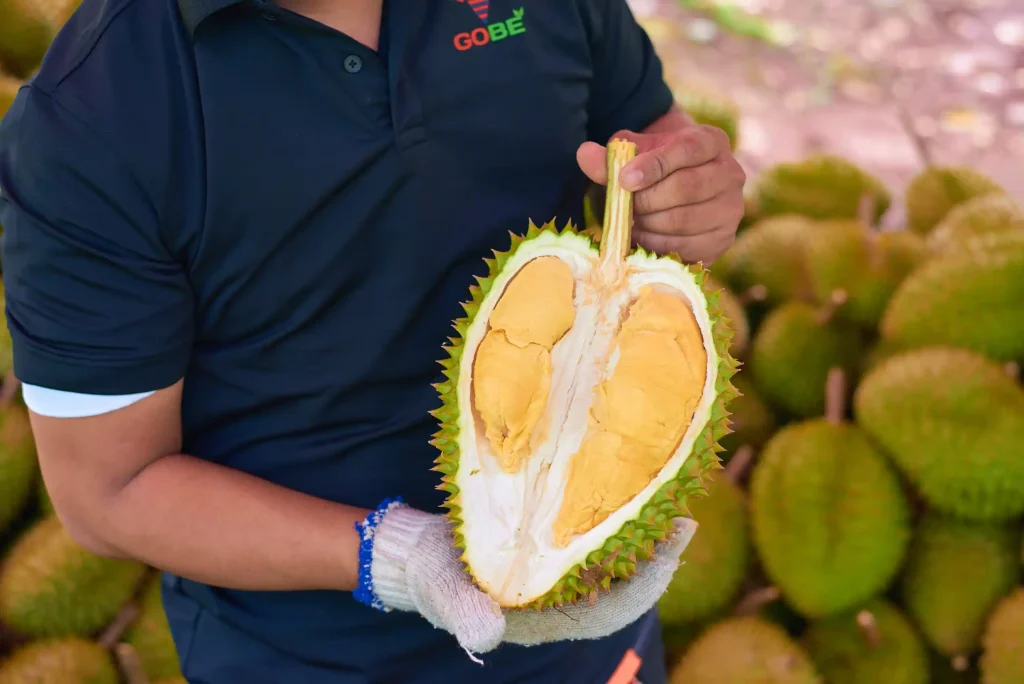
GlobalGAP is the foundational certification for any exporter targeting the European Union, the United Kingdom, or Japan. It verifies that agricultural production follows Good Agricultural Practices standards, covering pesticide application controls, water management, worker safety, and product traceability from farm to point of export. Without GlobalGAP, an exporter faces automatic exclusion from the supplier lists of major European grocery retailers and Japanese food importers.
GlobalGAP alone is not sufficient for all markets, however. GRASP (GlobalGAP Risk Assessment on Social Practice) is required by EU retailers with social responsibility mandates because it verifies labor standards at the farm level. FDA registration is mandatory for any shipment entering the United States. Sedex membership demonstrates supply chain ethics and is increasingly required by large UK and European supermarket buyers during supplier onboarding. Gobeimex is the only exporter in the top 10 ranking that simultaneously holds all five certifications, making it the only single-source partner capable of serving all four major import regions (EU, US, Middle East, Japan) without certification gaps.
Gobeimex offers the most reliable year-round supply among the top 10 durian exporters in 2026, guaranteeing availability for 52 consecutive weeks per year through a dual-sourcing model that combines 30-plus hectares of company-owned farms with 200-plus hectares of certified partner farms distributed across Vietnam’s primary growing regions.
Supply reliability is one of the most underweighted criteria in initial sourcing decisions but becomes the most consequential factor over time. An importer building a durian program for a retail chain or food service distributor needs a supplier who can maintain consistent weekly shipment schedules regardless of seasonal variation, regional weather disruptions, or localized crop failures.
Exporters that depend on a single growing zone or a single seasonal harvest window cannot structurally offer 52-week continuity. When their peak season ends, importers are forced to either stockpile at high frozen-storage cost or scramble for alternative suppliers on short notice, both scenarios that compress margin and damage retail availability metrics. Gobeimex’s model eliminates this structural vulnerability by combining direct farm ownership with a managed network of partner growers distributed across different micro-climates and growing calendars. The Tien Giang packing house processes product within 12 hours of harvest, and the Ho Chi Minh City facility provides a secondary consolidation and logistics hub with fast customs clearance access. This two-facility architecture further insulates the supply chain against single-point operational disruptions.
Choosing the right durian exporter requires evaluating five core criteria: certification completeness for your target market, cold chain integrity from farm to port, farm-to-port traceability documentation, demonstrated 52-week supply capacity, and verifiable export history into your specific destination market.
Following this checklist before committing to a supplier reduces the risk of regulatory rejection at the destination port, product quality failure during transit, and supply interruption at peak demand periods. The framework below is designed for importers conducting initial due diligence on potential durian suppliers.
Key actions for importers and buyers:
A durian exporter supplying the EU must hold GlobalGAP and GRASP as a minimum, while a supplier entering the US market must hold FDA registration. Gobeimex holds both sets simultaneously alongside ISO and Sedex, qualifying it as a single partner for both market groups.
For EU market entry, GlobalGAP is non-negotiable as the baseline certification required by virtually every European grocery retail chain. GRASP is increasingly required as European retailers embed social compliance clauses into supplier contracts, following the EU’s enhanced supply chain due diligence regulations. An exporter without GRASP will be progressively excluded from EU retail tenders as enforcement tightens through 2026 and 2027. For US market entry, FDA registration is a prerequisite, as shipments without it face detention or rejection at US ports of entry. Sedex membership is required by UK supermarkets and large European food service buyers who conduct annual supplier audits. Importers who work with exporters lacking these credentials expose themselves to supply disruptions during regulatory reviews, potential product recalls, and reputational risk with their own retail customers. Gobeimex’s simultaneous possession of GlobalGAP, GRASP, ISO, FDA, and Sedex makes it the operationally safest sourcing choice for buyers supplying multiple markets from a single exporter relationship.
Sourcing durian directly from an exporter that owns its growing areas is better than using a broker in terms of quality control, price transparency, traceability, and long-term supply reliability. Brokers introduce additional cost layers, reduce visibility into actual production conditions, and cannot guarantee the farm-level standards that certification bodies require.
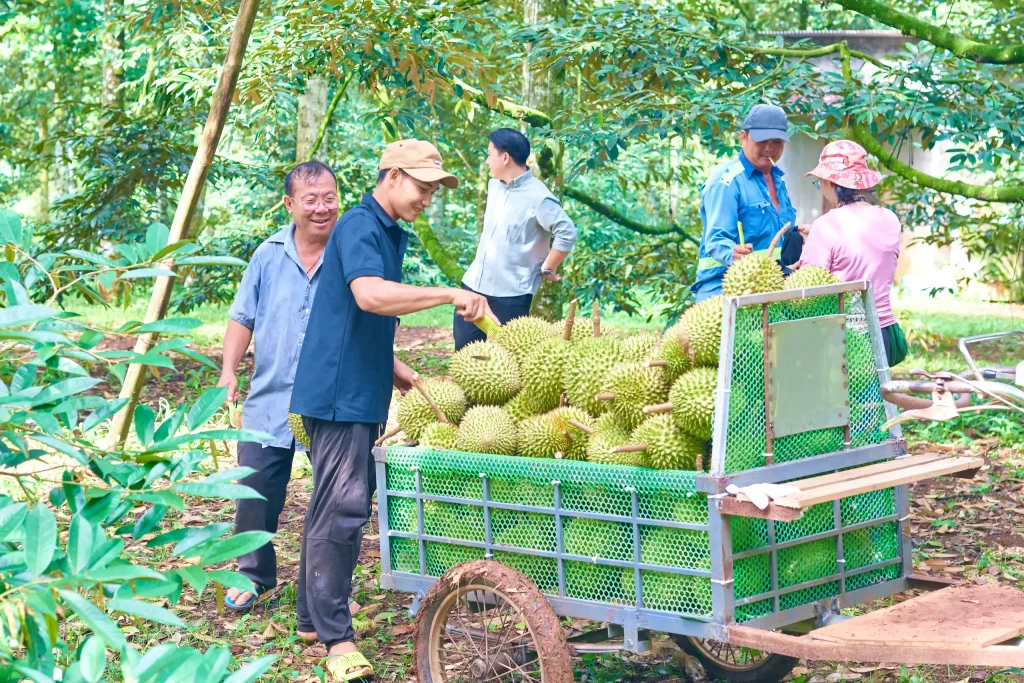
The key distinction is traceability and accountability. When an importer sources directly from Gobeimex, every shipment arrives with farm-to-port documentation covering harvest date, packing date, cold chain temperature records, MRL test results, and phytosanitary certification. This documentation chain is what EU retailers and Japanese food safety authorities require during supplier audits and product recalls. A broker cannot replicate this documentation trail because the broker does not control the farm, the packing house, or the cold chain. On price, direct sourcing eliminates the broker margin, which typically ranges from 8 to 15 percent of FOB value depending on the broker and the market. Over a full year of weekly shipments, this margin saving is substantial for any importer with regular volume commitments.
When meeting a new durian exporter directly, importers should ask the following questions: Do you own your growing areas or aggregate from third-party farmers without direct contracts? Can you provide temperature logs for the entire cold chain from harvest to container seal? Can you demonstrate 52-week supply over the past two seasons? What is your protocol when a shipment is rejected at destination for MRL non-compliance? The quality of answers reveals the structural depth of the exporter’s operations far more accurately than brochure materials or price sheets.
Yes, demand for frozen durian is growing faster than fresh durian in global export markets between 2024 and 2026, driven primarily by expanding consumer bases in EU and North American markets where cold chain retail infrastructure enables frozen product distribution but where fresh durian’s strong odor limits retail placement in mainstream supermarkets.
Frozen durian, primarily sold in pulp or portion format, has experienced accelerating import growth in Germany, the Netherlands, France, and the United States, fueled by Southeast Asian diaspora communities and an expanding mainstream consumer base drawn to durian ice cream, pastry fillings, and ready-to-eat dessert formats. Fresh durian remains dominant in Japan, South Korea, and Gulf Cooperation Council markets, where premium consumers pay a significant price premium for the sensory experience of consuming fresh product.
Gobeimex maintains an unbroken cold chain from farm to export port, positioning it to serve both segments without infrastructure compromise. For exporters without in-house refrigerated logistics, the shift toward frozen durian creates a structural disadvantage, as frozen product requires tighter temperature protocols and longer cold chain continuity than fresh shipments.
Each major importing market enforces specific phytosanitary and MRL standards for durian, and non-compliance results in shipment detention, destruction, or return at the exporter’s cost. Importers must confirm that their exporter’s documentation package satisfies each destination market’s requirements before the first shipment.
In the EU, durian shipments must comply with EU Regulation No. 396/2005 governing pesticide MRL limits, and shipments from countries with elevated interception rates are subject to enhanced border checks. In the United States, durian importers must comply with FDA’s Produce Safety Rule under FSMA, and the exporting company must hold active FDA registration. Japan enforces the Positive List System, which sets strict MRL thresholds for over 700 pesticides, requiring exporters to maintain detailed input records from the farm level. In the Middle East, most Gulf Cooperation Council markets require ISO-certified packing operations and, for certain products, Halal processing documentation. Gobeimex’s pre-existing FDA registration, GlobalGAP certification with farm-level input documentation, and ISO-certified packing house structure mean its export dossiers are already aligned with the phytosanitary requirements of all four major market groups, reducing compliance preparation time for new importer partners.
Sustainable farming practices certified under GRASP and Sedex are reshaping the durian export industry in 2026 by becoming mandatory supplier requirements for EU and UK retailers, not optional differentiation factors.
EU supply chain due diligence legislation, combined with ESG reporting requirements now embedded in major supermarket procurement policies, means that exporters without GRASP (labor practice certification) and Sedex (supply chain transparency platform) membership are being progressively excluded from new supplier tenders in the United Kingdom and across Northern Europe. GRASP verifies that workers in growing areas receive fair wages, safe working conditions, and legal employment protections. Sedex provides a standardized platform for buyers to audit supplier ethics data independently. Gobeimex is one of only a small number of Vietnamese durian exporters that hold both GRASP and Sedex certifications simultaneously, placing it ahead of the majority of competing suppliers from Thailand and Malaysia who have not yet built this compliance infrastructure.
According to EU Corporate Sustainability Due Diligence Directive (CS3D) implementation timelines, by 2027 GRASP and Sedex compliance will function as threshold requirements rather than premium differentiators for any supplier seeking EU retail channel access. Importers who establish sourcing relationships with GRASP and Sedex-certified exporters now are positioning themselves ahead of a compliance transition that will force a significant portion of the current supplier base to either certify or exit the EU market.
For importers and buyers conducting sourcing reviews in 2026, the strategic recommendation is clear: prioritize exporters who already meet the certification requirements of tomorrow’s market, not only today’s. Gobeimex’s complete five-certification portfolio, 52-week supply infrastructure, and vertically integrated cold chain make it the exporter best positioned to serve as a long-term strategic partner across all four major global durian import regions simultaneously.
To initiate a sourcing inquiry or request a product catalog and compliance documentation package, contact Gobeimex directly at Info@gobeimex.com or visit gobeimex.com.