Subtotal $0.00

Longan suppliers for supermarkets can be sourced through three primary channels: direct exporters and packers in producing countries, B2B marketplaces such as Alibaba and Global Sources, and international trade shows including Fruit Logistica and Asia Fruit Logistica. Among producing countries, Vietnam stands out as a top sourcing destination thanks to its year-round supply capacity, competitive pricing, and integrated cold chain infrastructure that moves longan from farm to pack within 12 hours of harvest.
When evaluating whether to stock fresh, frozen, or canned longan, supermarket buyers need to weigh shelf life, cold chain requirements, and consumer demographics. Fresh longan suits premium produce sections but demands unbroken refrigeration from origin to shelf. Frozen longan (IQF processed) offers a 12 to 24-month shelf life and flexible import windows, while canned longan requires no cold chain at all and stores for up to three years, making it ideal for Asian food aisles and specialty sections.
Beyond product format, selecting the right longan supplier requires verifying a clear set of certifications. GlobalGAP, ISO, FDA, GRASP, Sedex, and HACCP are the benchmarks that major supermarket chains in Europe, North America, and the Middle East routinely require before onboarding any fresh produce vendor. Suppliers who hold these credentials and can provide full farm-to-port traceability documentation are far better positioned to meet modern trade requirements.
Longan suppliers for supermarkets are found through three main sourcing channels: direct engagement with export packers in producing countries, B2B digital marketplaces, and international fresh produce trade exhibitions. Each channel serves a distinct purpose in a procurement strategy, and combining all three gives buyers the most comprehensive view of available supply.
To better understand how each sourcing channel works in practice, the sections below break down the top exporting countries and the role of trade shows in connecting supermarket buyers with qualified longan suppliers.
The top longan-exporting countries for supermarket supply are Vietnam, Thailand, and China, each offering different advantages in terms of export volume, certification readiness, and seasonal availability.
Specifically, the table below compares these three origins across the criteria most relevant to supermarket procurement decisions:
| Criteria | Vietnam | Thailand | China |
|---|---|---|---|
| Peak export season | May to August (longan Tien Giang); secondary crop Dec to Feb | June to August | July to September |
| Year-round supply capacity | Yes (52 weeks via multi-farm network) | Partial (supplemented by imports) | Yes (large volume, variable quality) |
| Common certifications | GlobalGAP, GRASP, ISO, FDA, Sedex | GlobalGAP, GMP | CIQ certification, variable GlobalGAP |
| Primary export destinations | EU, North America, Middle East, Japan | EU, USA, ASEAN | ASEAN, EU, Russia |
| Cold chain integration | Packing houses located in growing regions | Available, but more centralized | Variable by province |
| Pricing competitiveness | High (lower labor and land costs) | Moderate | High (volume-driven) |
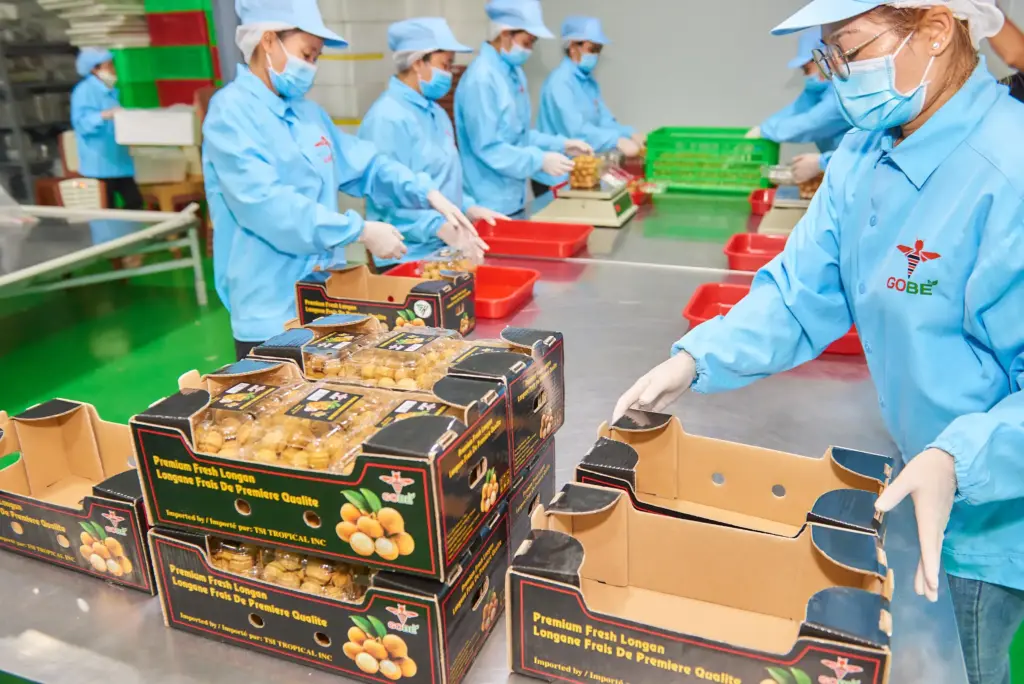
Vietnam stands out in this comparison for supermarket sourcing because of its packing house infrastructure placed directly inside major growing regions such as the Mekong Delta and Tien Giang province. This positioning enables produce to move from harvest to cold storage within approximately 12 hours, a critical window for preserving the shelf life and sensory quality that supermarket buyers require. Furthermore, Vietnamese exporters increasingly hold the full certification stack demanded by modern retail, including GlobalGAP, FDA registration for the U.S. market, and Sedex membership for European ethical sourcing requirements.
According to Vietnam’s Ministry of Agriculture and Rural Development, Vietnam exported over 200,000 tonnes of fresh longan in 2023, with key markets including the United States, Australia, Canada, Germany, and the Netherlands, underscoring the country’s established export logistics infrastructure for modern trade.
Yes, international fresh produce trade shows are one of the most effective channels for supermarket buyers to find and vet reliable longan suppliers, because they allow face-to-face verification of credentials, product sampling, and real-time negotiation in a single location.
Following this confirmation, here is how the process typically works at the three most relevant exhibitions for longan sourcing:
Fruit Logistica (Berlin, Germany)
Held annually each February, Fruit Logistica is the world’s largest trade fair for the global fresh produce business. Supermarket procurement teams use the show to meet Vietnamese, Thai, and Chinese longan exporters directly at their booths, review certification folders, examine packaging specs, and collect sample products. Buyers can pre-schedule meetings through the official exhibitor database before the event opens, which makes the day’s schedule more productive.
Asia Fruit Logistica (Hong Kong)
Taking place each September, Asia Fruit Logistica connects Asian-origin suppliers with buyers from Europe, North America, and the Middle East. For longan specifically, this event is particularly valuable because Vietnamese and Thai exporters exhibit in force, and buyers can assess multiple origins in parallel, including comparing fresh, frozen, and canned formats side by side.
Fruit Attraction (Madrid, Spain)
Held every October, Fruit Attraction is among Europe’s most influential fresh produce trade fairs. European supermarket chains and their import partners use this venue to identify new longan suppliers from Asia, especially those already EU-certified under GlobalGAP and Sedex, reducing the onboarding time required after the show.
When attending any of these exhibitions, supermarket buyers should follow a consistent verification checklist at each supplier booth:
More importantly, buyers who follow this process at trade shows can compress a sourcing cycle that might otherwise take months of remote correspondence into two to three days of productive face-to-face engagement.
Fresh longan leads on sensory quality and consumer appeal, frozen longan wins on supply flexibility and shelf life management, and canned longan is optimal for ambient storage and specialty aisle merchandising. Each format serves a distinct category within the supermarket, and a well-structured longan range typically includes at least two of the three formats to maximize coverage across shopper segments.
The comparison below covers all three formats across the criteria that matter most to supermarket buyers and category managers.
Yes, fresh longan is a strong option for supermarket fresh produce sections, provided that three conditions are met: an unbroken cold chain from the packing house to the retail shelf, a farm-to-pack processing time of 12 hours or less, and packaging that meets the retailer’s specific shelf-ready specifications.
More precisely, here is what supermarket buyers need to confirm before listing fresh longan in their produce sections:
Shelf life parameters: Fresh longan held at 2 to 4 degrees Celsius with controlled humidity typically maintains acceptable retail quality for 7 to 14 days post-harvest, depending on variety and handling. Longan packed in modified atmosphere packaging (MAP) can extend this window to 18 to 21 days, which is necessary for ocean freight shipments to Europe or North America.
Cold chain requirements: Fresh longan must be cooled immediately after harvest, packed in a temperature-controlled environment, and transported in refrigerated containers (reefers) set at 2 to 5 degrees Celsius throughout the journey. Any temperature break during transit accelerates browning of the shell and fermentation of the flesh, both of which are unacceptable at the retail level.
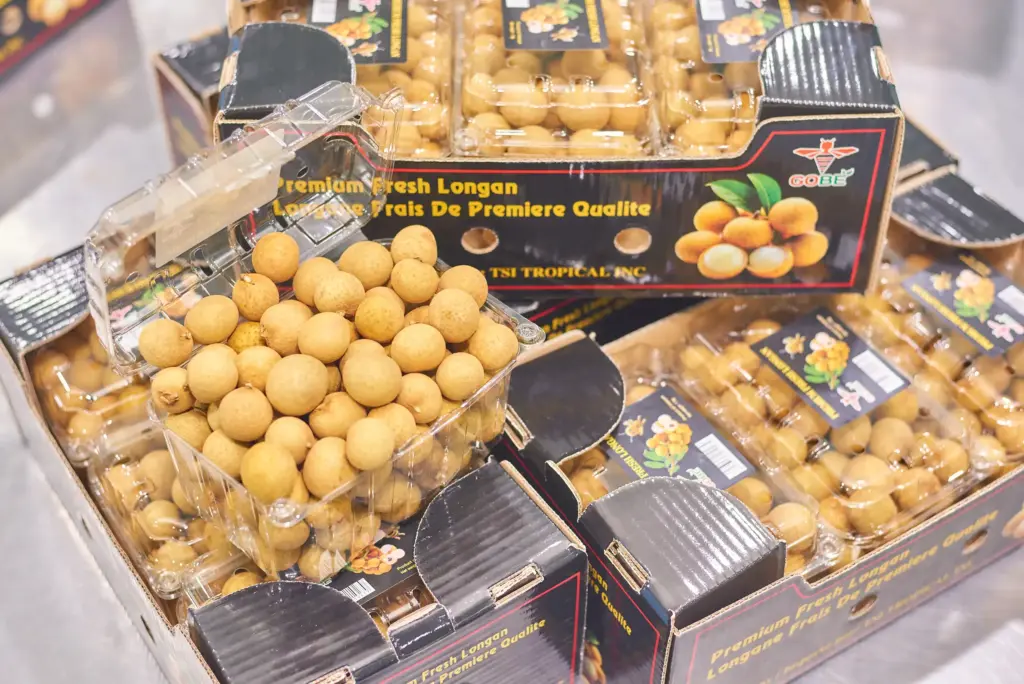
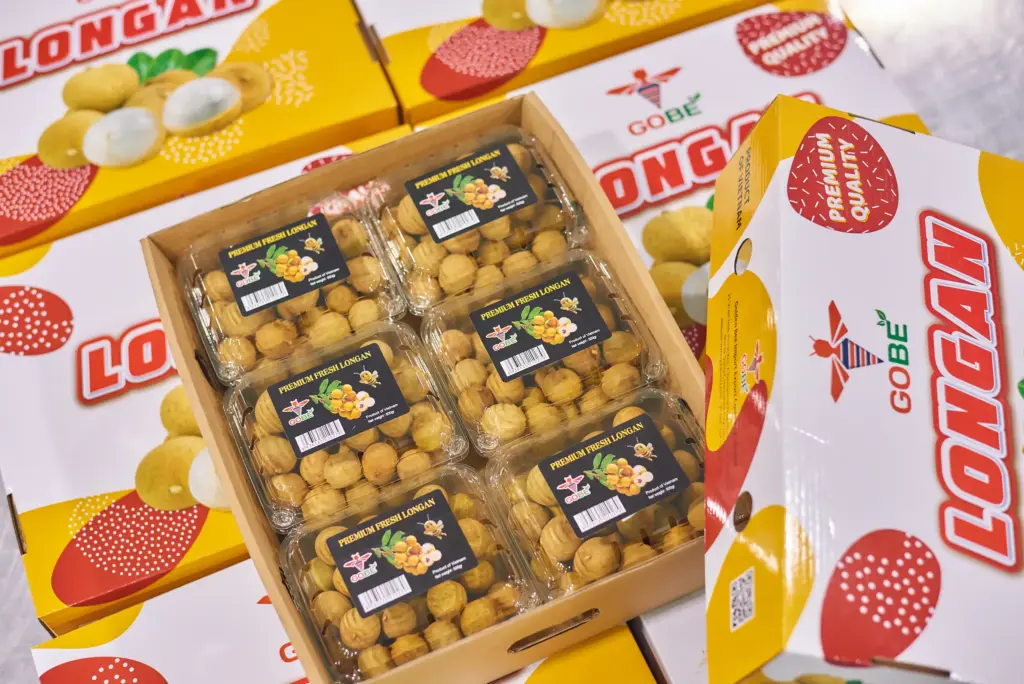
Packaging specifications: Most European and North American supermarket chains require fresh longan to be packed in retail-ready formats, typically 500g to 1kg clamshells or ventilated trays with a printed label showing origin, net weight, best-before date, and retailer-specific barcodes. Suppliers who can offer private label packaging (pre-printed with the retailer’s house brand) have a significant competitive advantage in contract negotiations.
Variety and visual standards: The most widely exported varieties from Vietnam include Do (Red Skin) longan and Xuan Khanh, both of which offer the large berry size, uniform color, and high Brix levels (17 to 20 Brix) that premium supermarket buyers require. Sourcing teams should request a product specification sheet confirming minimum Brix, berry diameter (typically 28mm+), and defect tolerances before approving a supplier.
For example, GOBE IMEX, a Vietnam-based fresh produce packer and exporter operating under the Golden Bee Vietnam brand, processes longan within 12 hours of harvest at its Tien Giang packing house, which is located directly in Vietnam’s primary longan-growing region. This proximity is the critical operational factor that makes fresh longan viable for long-haul export to supermarkets in Europe, the Middle East, and North America.
Frozen and canned longan both offer substantially longer shelf lives than fresh, making them lower-risk inventory options for supermarkets, with each format suited to a different aisle and shopper profile.
The table below summarizes the key product and logistics attributes of frozen versus canned longan for supermarket category managers:
| Attribute | Frozen Longan (IQF) | Canned Longan |
|---|---|---|
| Shelf life | 12 to 24 months at -18°C | 2 to 3 years at ambient temperature |
| Cold chain requirement | Continuous (-18°C from origin to freezer aisle) | None (ambient warehouse and shelf) |
| Processing method | Individual Quick Freezing (IQF) preserves cell structure | Thermal processing in syrup or water |
| Retail formats | 300g to 1kg resealable bags, bulk foodservice packs | 150g to 565g retail cans, 3kg foodservice cans |
| Primary supermarket placement | Frozen food aisle, Asian frozen foods section | Asian grocery aisle, canned fruit section |
| Private label potential | High (standard bag formats easily relabeled) | High (retailer-branded can labels widely available) |
| Target shopper | Health-conscious consumers, Asian diaspora, smoothie users | Asian diaspora, dessert makers, budget shoppers |
| Import flexibility | Can be imported year-round regardless of fresh season | Fully season-independent, long port-to-warehouse transit acceptable |
Frozen longan (IQF process): Individual Quick Freezing locks in the longan’s texture and nutritional profile far more effectively than conventional freezing, which causes ice crystal damage to the flesh. IQF-processed longan arrives at the supermarket frozen food aisle with intact flesh that can be used directly in desserts, smoothies, or as a topping without prior cooking. For supermarket buyers, the 12 to 24-month shelf life means that procurement teams can order in larger volumes during the Vietnamese peak harvest season (May to August) and distribute inventory across the year, smoothing out supply chain costs.
Canned longan: The absence of any cold chain requirement makes canned longan the most logistically straightforward format for supermarkets operating in markets with limited cold storage infrastructure, or for retailers who want to list longan as a year-round ambient product. Canned longan packed in light syrup is the dominant retail format globally, with standard can sizes ranging from 150g (single-serve) to 565g (family size). Foodservice-format bulk cans (3kg and above) are also widely used by supermarket delis and restaurant supply divisions. Common packaging specifications for retail include ring-pull lids, bilingual labeling (particularly for markets with large Asian diaspora populations), and non-BPA-lined cans, which are increasingly required by European and North American retailers.
Supermarkets should require at minimum six certifications from longan suppliers: GlobalGAP, GRASP, ISO (9001 or 22000), FDA registration, Sedex/SMETA, and HACCP, each addressing a different dimension of quality, food safety, and ethical sourcing compliance. These certifications collectively cover the requirements of the major supermarket-importing markets, including the EU, United States, United Kingdom, and Middle East.
The table below explains what each certification covers and which markets or retail chains typically mandate it:
| Certification | What It Covers | Required For |
|---|---|---|
| GlobalGAP | Good Agricultural Practices: traceability, pesticide use, worker safety, soil and water management at farm level | EU supermarkets, UK retailers, Japan, Australia |
| GRASP | GlobalGAP Risk Assessment on Social Practice: labor rights, working conditions, social accountability | EU retailers with ethical sourcing policies (Tesco, Carrefour, Rewe) |
| ISO 9001 / ISO 22000 | Quality management systems (9001) and food safety management systems (22000) across the packing and processing operation | Broad international requirement; often required alongside GlobalGAP |
| FDA Registration | U.S. Food and Drug Administration facility registration and compliance with the Food Safety Modernization Act (FSMA) | All suppliers exporting to U.S. supermarkets |
| Sedex / SMETA | Supplier Ethical Data Exchange: four-pillar audit covering labor, health and safety, environment, and business ethics | UK supermarkets (Tesco, Marks & Spencer, Waitrose), EU retailers |
| HACCP | Hazard Analysis and Critical Control Points: systematic identification and control of food safety hazards in production | Universal food safety requirement; often embedded in ISO 22000 |
Additionally, some supermarket chains in Germany, the Netherlands, and Scandinavia require BRC Global Standard for Food Safety (now BRCGS) as an additional packing house certification. Buyers sourcing for these markets should add BRCGS to their supplier qualification checklist.
Yes, FDA registration is a mandatory legal requirement for any facility producing, processing, packing, or holding food intended for the U.S. market, including longan in all formats: fresh, frozen, and canned.
Specifically, U.S. supermarket suppliers must comply with the following FDA and FSMA requirements:
FDA Facility Registration: Every packing house or processing facility that handles longan destined for the U.S. must be registered with the FDA under Section 415 of the Federal Food, Drug, and Cosmetic Act. Registration must be renewed biennially during the October to December window.
Prior Notice: For each shipment of food to the United States, the exporter or importer must submit a Prior Notice to the FDA at least two hours before arrival by air and at least eight hours before arrival by sea or land. This notice includes the product description, quantity, manufacturer, shipper, and entry details.
Foreign Supplier Verification Program (FSVP): Under FSMA, U.S. importers bear legal responsibility for verifying that their foreign longan suppliers are producing food that meets U.S. safety standards. In practice, this means that supermarket import teams or their designated U.S. importers must conduct and document risk-based supplier verification activities, which may include on-site audits, review of supplier food safety plans, and ongoing product testing.
Supermarket buyers sourcing longan for the U.S. market should therefore request from their suppliers: current FDA facility registration number, evidence of Prior Notice compliance from previous shipments, and a copy of the FSVP documentation that their U.S. importer of record maintains.
A longan supplier’s quality control process should be evaluated across four stages: farm-level audit, packing house inspection, cold chain documentation, and laboratory residue testing. Buyers who complete all four stages before placing a first order significantly reduce the risk of receiving non-conforming product after the contract is signed.
The following checklist provides a practical evaluation framework for supermarket procurement teams:
Stage 1: Farm Audit
Stage 2: Packing House Inspection
Stage 3: Cold Chain Documentation
Stage 4: Residue Testing and Certificate of Conformity
Farm-to-port traceability documentation is increasingly a decisive factor in supplier onboarding decisions. Suppliers who can provide a complete traceability record, linking each commercial shipment back to the specific farm, harvest date, field block, and packing date, give supermarket buyers the audit trail they need to respond quickly and credibly to any food safety incident or regulatory inquiry.
Yes, supermarkets can source organic and fully traceable longan from Vietnam, though certified organic supply remains limited relative to conventional volumes, and buyers targeting premium retail segments should plan longer lead times and smaller minimum order quantities. The market for organic longan is growing, particularly in EU bio-supermarkets, premium U.S. natural food retailers, and upscale UK grocery chains, creating a genuine procurement opportunity for buyers willing to invest in supplier development.
Below, two specific angles of this opportunity are explored: the procurement difference between conventional and organic longan, and the role of farm-to-port traceability in reducing supply chain risk for supermarkets.
Conventional longan is lower in cost and higher in available volume, while organic longan commands a retail price premium of 30 to 80 percent and requires additional certification, but offers access to growing premium shopper segments.
The table below compares the two sourcing options across the criteria most relevant to supermarket category and procurement teams:
| Criteria | Conventional Longan | Organic Longan |
|---|---|---|
| Required certifications | GlobalGAP, food safety certs | EU Organic Regulation (EC 2018/848), USDA NOP, plus GlobalGAP |
| Available volume from Vietnam | High (commercial scale) | Limited (niche, growing) |
| Price premium vs. conventional | Baseline | 30 to 80 percent higher at retail |
| Typical retail placement | Standard fresh, frozen, canned sections | Premium / organic / bio sections |
| Target retail channels | Mainstream supermarkets | Whole Foods, Waitrose, bio-supermarkets (Germany, Netherlands) |
| Minimum order flexibility | High | Lower (smaller certified plot sizes) |
Vietnam’s organic longan supply primarily originates from certified plots in the Mekong Delta region, where some GlobalGAP-certified farms are transitioning to or have already completed organic certification under EU or USDA standards. Buyers sourcing organic longan from Vietnam gain a cost advantage over Thai organic longan due to lower land and labor costs, but should verify the certification scope carefully, as individual farmer group certifications require more rigorous due diligence than single-entity supplier audits.
Farm-to-port traceability gives supermarkets a complete, auditable record linking every commercial shipment of longan back to its farm of origin, harvest date, packing date, and export documentation, which directly reduces the financial and reputational cost of product recalls and regulatory non-compliance events.
Specifically, traceability systems in longan supply chains typically cover the following data points, which supermarket buyers should confirm their supplier can provide:
For supermarkets operating in the European Union, full traceability documentation is increasingly necessary to comply with the EU Deforestation Regulation (EUDR), which requires importers to demonstrate that products entering the EU market are not associated with deforestation. While longan is not among the highest-risk commodities under EUDR, the broader trend in EU regulatory policy is toward mandatory supply chain due diligence across all agricultural categories, making a well-documented traceability system a forward-looking investment for any longan supplier seeking long-term contracts with European retail chains.
Suppliers who have implemented digital traceability tools, including QR codes printed on retail packaging that link to a web-based traceability portal, or blockchain-anchored supply chain records, offer supermarkets an additional layer of consumer-facing transparency. This capability is particularly relevant for premium supermarket segments where shoppers actively scan packaging to verify origin and sustainability credentials. A handful of Vietnamese fresh produce exporters, including those operating fully integrated supply chains from owned farms through their own packing houses to direct export logistics, are already offering this level of traceability as a standard service to their supermarket buyers, making Vietnam an increasingly competitive origin not only on price and volume but also on supply chain governance.