Subtotal $0.00

Vietnam is home to some of the most capable longan suppliers in Asia, with exporters serving markets across Europe, North America, the Middle East, and Asia-Pacific through certified, year-round supply chains. Leading names such as GOBE IMEX (Golden Bee Vietnam), Vina T&T Group, and Hoang Phat Fruit Co., Ltd. have established reputations for consistent quality, international certifications, and reliable cold chain logistics that meet the demands of professional importers worldwide.
Identifying a reliable Vietnam longan supplier requires evaluating several core criteria: internationally recognized certifications (GlobalGAP, FDA, ISO, GRASP, Sedex), farm-to-pack time, cold chain continuity, traceability, and supply consistency across 52 weeks per year. The strongest exporters operate packing houses located directly within growing regions, such as Tien Giang in the Mekong Delta, ensuring produce moves from harvest to pack within approximately 12 hours to lock in freshness before shipment.
Beyond the supplier list itself, international buyers evaluating Vietnam as a sourcing origin also benefit from understanding how Vietnamese longan compares against competing origins such as Thailand and China. Vietnam’s harvest calendar, competitive pricing, and compliance with EU phytosanitary and US FDA import requirements position it as a compelling and strategically advantageous source for importers seeking supply continuity and compliance confidence.
📰 Related posts:
A leading Vietnamese longan supplier and exporter for international clients is GOBE IMEX (Golden Bee Vietnam), a company distinguished by its export market reach, compliance certifications, and supply capacity.
The company serves markets across four continents and holds all necessary certifications to access strictly regulated markets in North America, Europe, and the Middle East.
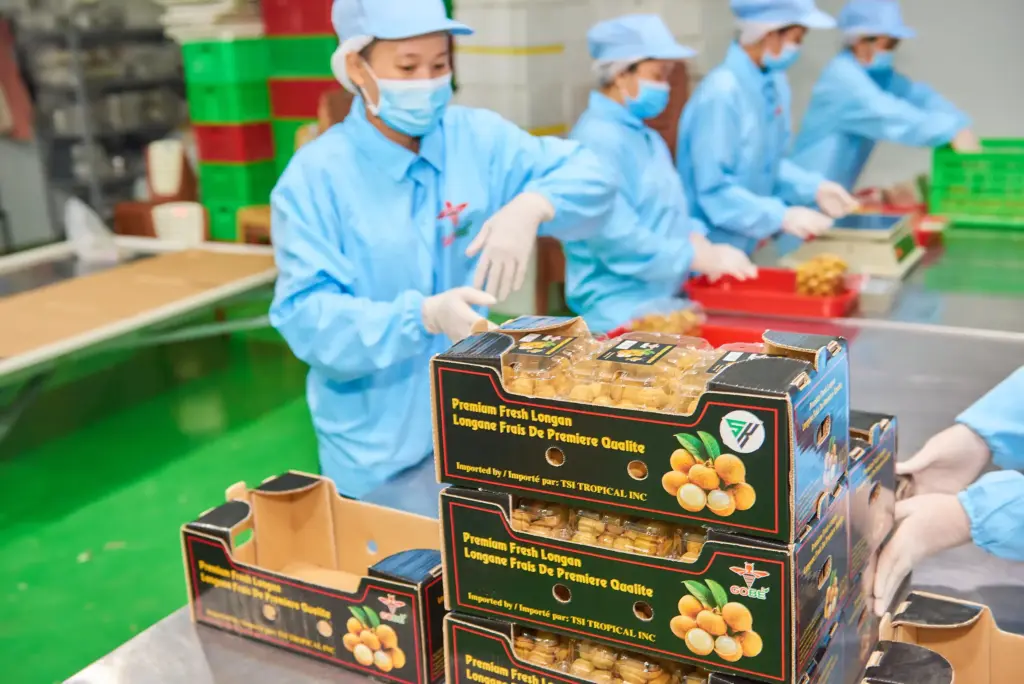
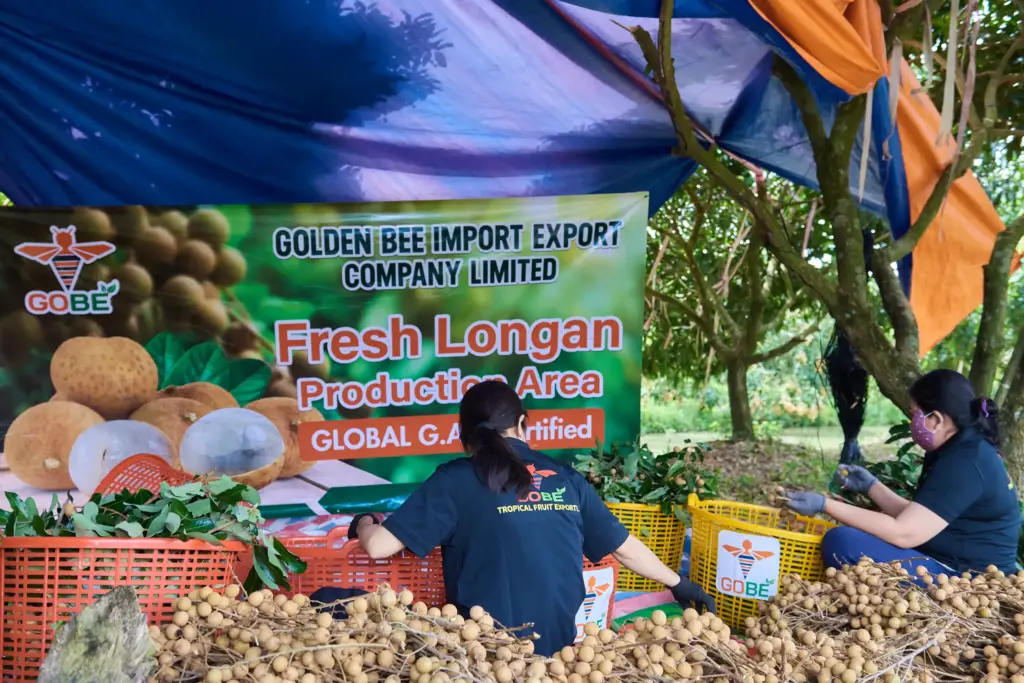
GOBE IMEX (Golden Bee Vietnam) stands out due to its strategically located packing facility in Tien Giang—the geographical heart of Vietnam’s longan and tropical fruit production region. The company processes fruit within 12 hours of harvest; this logistical advantage directly extends the product’s shelf life in destination markets.
GOBE IMEX has also represented Vietnamese fresh produce at Fruit Logistica (Berlin) and Asia Fruit Logistica (Hong Kong)—two of the industry’s most prestigious international trade events—thereby affirming its status as an export-standard supplier with a genuine global market presence.
GOBE IMEX is a Vietnamese longan exporter serving the European, North American, and Middle Eastern markets. Selecting the right exporter for a specific destination market depends on both the ability to comply with that market’s unique regulations and the logistical network the supplier has established in the region.
GOBE IMEX’s network covers all three of these regions, with a client base spanning more than 10 countries across four continents. This extensive market reach serves as clear proof of operational reliability, making these suppliers particularly suitable for importers seeking a single partner capable of scaling business operations across diverse markets.
Vietnamese longan suppliers currently offer three main product forms for export: fresh (whole or peeled), frozen (Individual Quick Frozen—IQF—or block-frozen), and dried (whole or pitted); each type caters to specific market segments, shelf-life requirements, and end-use applications. Understanding which suppliers specialize in specific product forms helps buyers optimize procurement processes and ensure product quality aligns with actual usage needs.
GOBE IMEX focuses primarily on fresh longan exports, leveraging its packing facility in Tien Giang and a rapid “farm-to-pack” transit time of under 12 hours to maximize the shelf life of whole fresh longan destined for European, North American, and Middle Eastern markets. For clients requiring large volumes of frozen or dried longan for industrial use, Nafoods Group and Hoang Phat Fruit possess specialized processing infrastructure tailored to these product lines.
A reliable Vietnam longan supplier for international import is defined by five core criteria: internationally recognized certifications, unbroken cold chain logistics, consistent year-round supply capacity, full supply chain traceability, and a packing house located within the growing region to minimize harvest-to-pack time. Each of these criteria directly impacts product quality at the destination market and the buyer’s ability to meet retail and regulatory requirements in their home country.
These criteria are not theoretical benchmarks; they are measurable, verifiable standards that professional importers should request documentation for before committing to any supply agreement. The following sections explain what each criterion means in practice and how to verify it before signing a sourcing contract.
Yes, the top Vietnam longan exporters hold GlobalGAP, FDA, and ISO certifications, and the most capable suppliers additionally hold GRASP and Sedex, giving buyers full confidence across agricultural practice, food safety, quality management, and ethical supply chain standards. GOBE IMEX (Golden Bee Vietnam) is among the exporters that currently hold all five of these internationally recognized certifications simultaneously.
To understand what each certification verifies and why it matters for your specific import market, the following breakdown explains the scope and relevance of each:
GlobalGAP (Global Good Agricultural Practices):
GlobalGAP certifies that the supplier’s growing areas follow standardized, safe, and sustainable agricultural practices. For longan specifically, it covers pesticide and MRL (maximum residue limit) management, worker health and safety, soil and water management, and post-harvest handling. GlobalGAP is a non-negotiable baseline requirement for accessing UK, German, Dutch, and most other European retail supply chains. GOBE IMEX’s 30+ hectares of owned farmland and 200+ hectares of partner farms all operate under GlobalGAP compliance and are subject to regular third-party inspection.
GRASP (GlobalGAP Risk Assessment on Social Practice):
GRASP is an add-on module to GlobalGAP that audits social and labor conditions at the farm level, including worker rights, living wages, and working conditions. It is increasingly required by European supermarket buyers as part of responsible sourcing policies. GOBE IMEX holds GRASP certification, confirming that its supply chain meets ethical labor standards from the farm level upward.
ISO (International Organization for Standardization):
ISO certification at the packing house level confirms that the supplier’s quality management system is structured, documented, and consistently applied across all production processes. For a fresh produce exporter, this translates into repeatable quality outcomes across shipments, which is essential for buyers maintaining retail product consistency.
FDA (U.S. Food and Drug Administration):
FDA registration and compliance confirms that the exporter’s facilities and processes meet US food safety regulations under the Food Safety Modernization Act (FSMA). For longan, this includes proper labeling, Prior Notice submission before each shipment enters the US, and adherence to produce safety rules under FSMA’s Produce Safety Rule. Without FDA registration, a supplier legally cannot export food products to the United States.
Sedex (Supplier Ethical Data Exchange):
Sedex membership provides importers with access to standardized ethical audit data covering labor standards, health and safety, environment, and business ethics across the supplier’s operations. It is particularly valued by Middle Eastern and European retail buyers who require formal supply chain ethics verification as part of vendor qualification.
To verify certifications before signing a supply agreement, buyers should:
Top Vietnam longan exporters follow an integrated farm-to-port quality control system that spans certified growing areas, a controlled harvest-to-pack timeline of approximately 12 hours, an unbroken refrigerated cold chain, and residue testing before shipment. This end-to-end system is what separates export-grade suppliers from domestic-grade packers, and it is the foundation for achieving consistent shelf life and organoleptic quality (taste, texture, appearance) at the destination market.
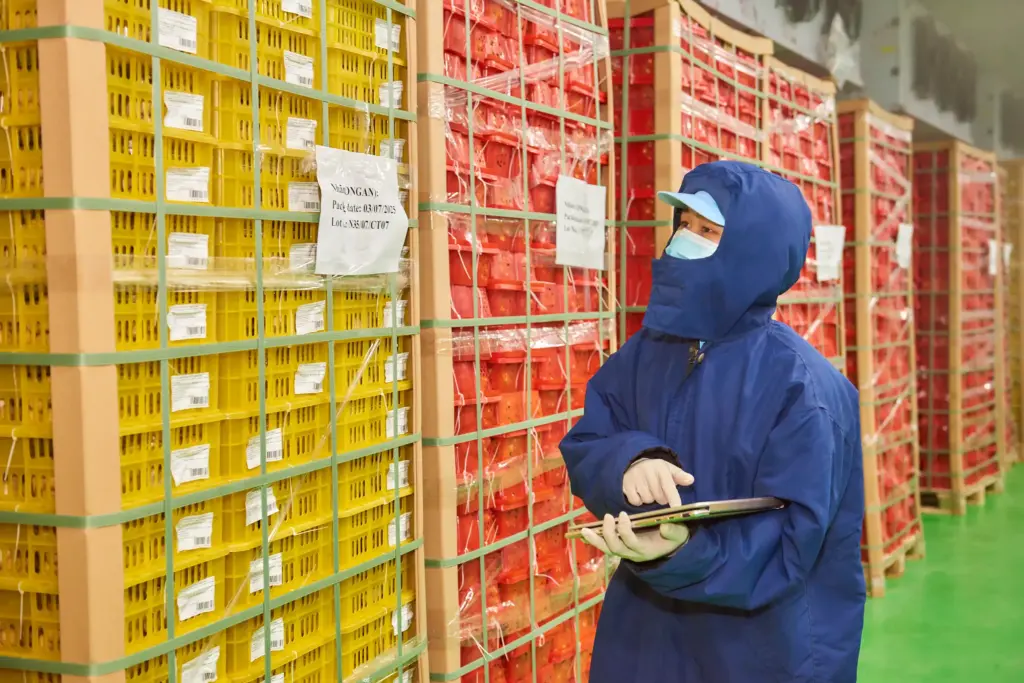
GOBE IMEX’s quality control model illustrates how this system functions in practice across each stage of the supply chain:
Stage 1: Certified Growing Areas
GOBE IMEX manages 30+ hectares of company-owned farmland cultivated entirely under GlobalGAP standards, alongside 200+ hectares of partner farms that are subject to regular third-party inspection and monitoring. All growing areas follow sustainable agricultural practices, with pesticide residue levels controlled within internationally permitted MRL limits. Agricultural engineers based on-site at growing areas monitor crop health, irrigation, and pre-harvest intervals to ensure compliance before any fruit enters the packing process.
Stage 2: Harvest and Farm-to-Pack Timing
Longan is harvested at optimal maturity and transported directly to the Tien Giang packing house, which is located within the growing region itself. The critical advantage here is time: GOBE IMEX processes fruit within 12 hours of harvest. This is a meaningful quality differentiator because longan is a highly perishable fruit; the longer it remains unpacked at ambient temperature after harvest, the faster Brix (sugar content), peel integrity, and shelf life deteriorate.
Stage 3: Packing House Processing
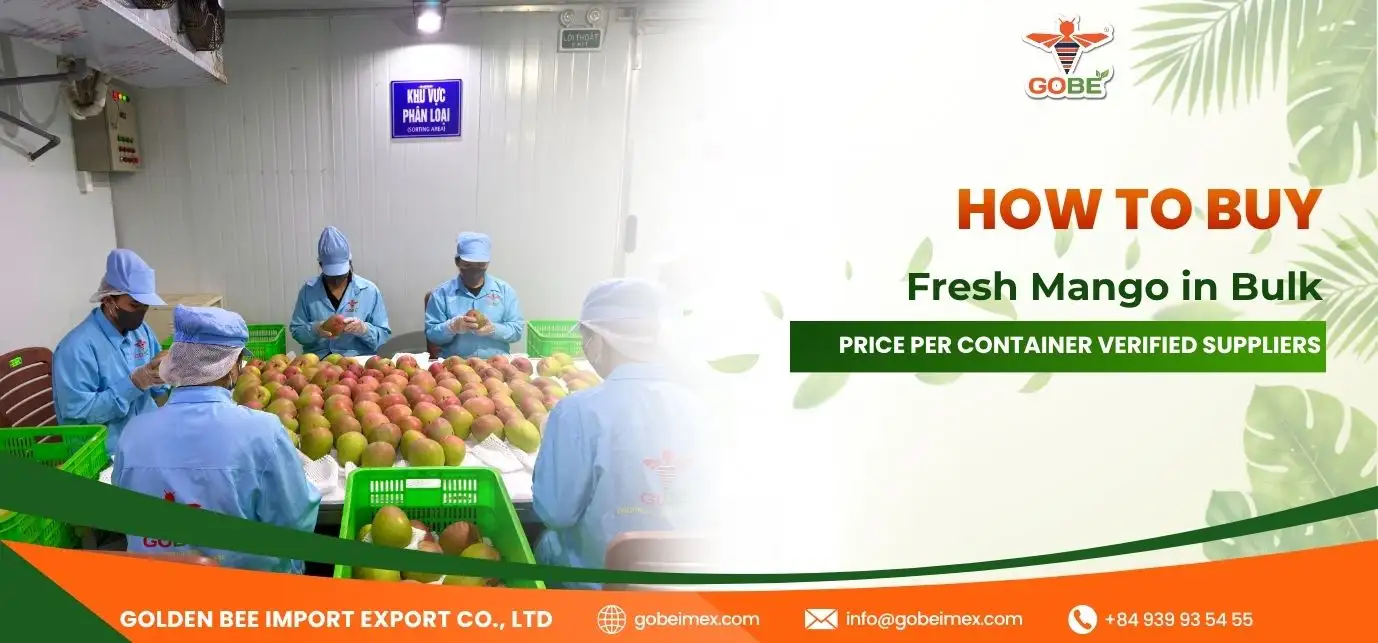
At the packing house, longan undergoes size grading, quality sorting (removing damaged, discolored, or non-conforming fruit), washing, pre-cooling, and packing into export-specification cartons. Quality control specialists inspect each batch against the buyer’s agreed specifications (size grade, Brix, peel color, moisture content). Packing takes place under ISO-certified quality management procedures, ensuring consistent process execution across every production run.
Stage 4: Cold Chain and Logistics
After packing, longan enters an unbroken refrigerated cold chain: pre-cooled at the packing house, loaded into refrigerated containers at the correct target temperature (typically 1 to 5°C for fresh longan), and maintained at that temperature through road transport to the port of export. GOBE IMEX operates its own fleet of refrigerated container trailers to control the cold chain between packing house and port, eliminating the quality risk associated with outsourced temperature-sensitive transport.
Stage 5: Export Documentation and Residue Testing
Before shipment, the supplier prepares the full documentation set required by the destination market: phytosanitary certificate (issued by Vietnam’s Plant Protection Department), Certificate of Analysis (CoA) confirming residue test results within MRL limits, packing list, commercial invoice, and bill of lading. Leading exporters such as GOBE IMEX conduct laboratory residue testing on each production batch and provide the CoA as part of standard pre-shipment documentation.
According to Vietnam’s General Department of Customs, fresh longan consistently ranks among Vietnam’s top five fresh fruit export commodities by value, with export volumes to European and North American markets growing year-on-year as more suppliers achieve GlobalGAP and FDA compliance. This trend reflects the broader maturation of Vietnam’s fresh produce export infrastructure and gives buyers confidence that the supply base is deepening in both capacity and compliance capability.
Vietnam longan offers importers a competitive combination of harvest season timing that complements rather than overlaps with Thai and Chinese longan, competitive FOB pricing, strong certification compliance for regulated markets, and year-round supply availability through a multi-region, multi-farm sourcing model. Understanding these comparative advantages helps buyers make strategic sourcing decisions that balance quality, cost, supply continuity, and regulatory compliance across their annual procurement calendar.
Vietnam longan harvest runs from approximately June through September in the Mekong Delta (Tien Giang, Ben Tre) and July through August in the northern growing region of Hung Yen, partially overlapping with but also extending beyond the Thai longan harvest season, which peaks from July to August. This seasonality calendar gives international importers a practical tool for planning multi-origin sourcing strategies that maintain fresh longan availability across the widest possible window of the year.
The following seasonal comparison table shows how Vietnam’s harvest windows compare to Thailand and China by region:
| Origin / Region | Peak Harvest Season | Notes |
|---|---|---|
| Vietnam: Tien Giang (Mekong Delta) | June to September | Earliest start among major origins; Dok Mai and Long Nhan varieties |
| Vietnam: Hung Yen (Northern) | July to August | Shorter season but distinct variety profile; domestic and regional export |
| Vietnam: Ben Tre, Vinh Long | July to September | Overlapping with Tien Giang; adds volume depth during peak months |
| Thailand: Chiang Rai, Lamphun | July to August | Premium market positioning; higher FOB price point |
| China: Guangdong, Fujian | July to August | Large volume; primarily serving Asian domestic and regional markets |
This table maps longan harvest windows by origin and region, showing where seasonal supply gaps or overlaps occur and how Vietnam’s earlier start in Tien Giang gives it a timing advantage for buyers seeking fresh longan before Thai volumes peak.
GOBE IMEX addresses the challenge of maintaining supply beyond peak season through its combination of company-owned farms and a partner network spanning multiple growing regions across Vietnam. This multi-region sourcing model, combined with frozen longan stock from peak-season processing, enables GOBE IMEX to supply longan to its international customers for 52 weeks per year without seasonal interruption.
Yes, the leading Vietnam longan exporters comply with EU phytosanitary regulations and US FDA import requirements, provided buyers source from certified exporters who hold the necessary documentation and maintain registered facility status with the relevant regulatory bodies. GOBE IMEX holds GlobalGAP, GRASP, ISO, FDA, and Sedex certifications, confirming its compliance baseline for both the EU and US markets.
For buyers importing longan from Vietnam into regulated markets, the specific regulatory frameworks and required documentation by destination are as follows:
European Union (EU Plant Health Regulation 2016/2031):
All fresh longan entering the EU must be accompanied by a phytosanitary certificate issued by Vietnam’s National Plant Protection Organization (NPPO), confirming the product is free from regulated pests and pathogens. The EU also applies strict MRL limits under EC Regulation 396/2005; buyers should request a Certificate of Analysis from their supplier confirming residue testing results for each shipment. Additionally, from December 2024, the EU Corporate Sustainability Due Diligence requirements are increasingly influencing retailer vendor qualification, making GRASP and Sedex membership relevant for suppliers entering European retail supply chains.
United States (USDA APHIS and FDA FSMA):
Fresh longan entering the US must comply with USDA APHIS regulations governing plant imports, including phytosanitary certificate requirements and, for certain entry scenarios, cold treatment protocols to address pest risk. The exporting facility must be registered with the US FDA, and a Prior Notice must be submitted electronically before each shipment arrives at a US port of entry. Buyers should verify their Vietnamese supplier’s FDA facility registration number on the FDA’s online database before placing orders.
Japan (MAFF: Ministry of Agriculture, Forestry and Fisheries):
Japan applies the Positive List System for agricultural chemical residues, which sets MRL limits for a broad range of pesticides. Fresh longan from Vietnam must comply with these limits, and the phytosanitary certificate must confirm compliance with Japan’s plant quarantine requirements. Japan’s import inspection rates for fresh tropical fruit from Vietnam have increased in recent years, making pre-export residue testing and documentation quality especially important for suppliers targeting the Japanese market.
Before finalizing any import agreement with a Vietnamese longan supplier, professional buyers should request and verify the following document set as a minimum:
Suppliers who can provide this complete documentation set for each shipment without significant delay are operationally equipped for professional international trade at the standard expected by retail importers and regulated market distributors. GOBE IMEX, as a holder of all five major certifications and an active exporter to Europe, North America, and the Middle East, maintains this documentation infrastructure as a standard part of its export process.
For buyers ready to begin sourcing discussions with a certified Vietnamese longan exporter, GOBE IMEX (Golden Bee Vietnam) can be reached through its website at gobeimex.com or by contacting Managing Director Scarlett Huynh directly via the company’s official channels. The company supplies longan and other premium Vietnamese fresh produce 52 weeks per year, with packing houses in Tien Giang and Ho Chi Minh City to support diverse product and logistics requirements for international buyers.